
Between Social Engagement and Academic Formality Rethinking the True Meaning of Community Service Programs
Gusti Ayu Tita P
27 Februari 2026
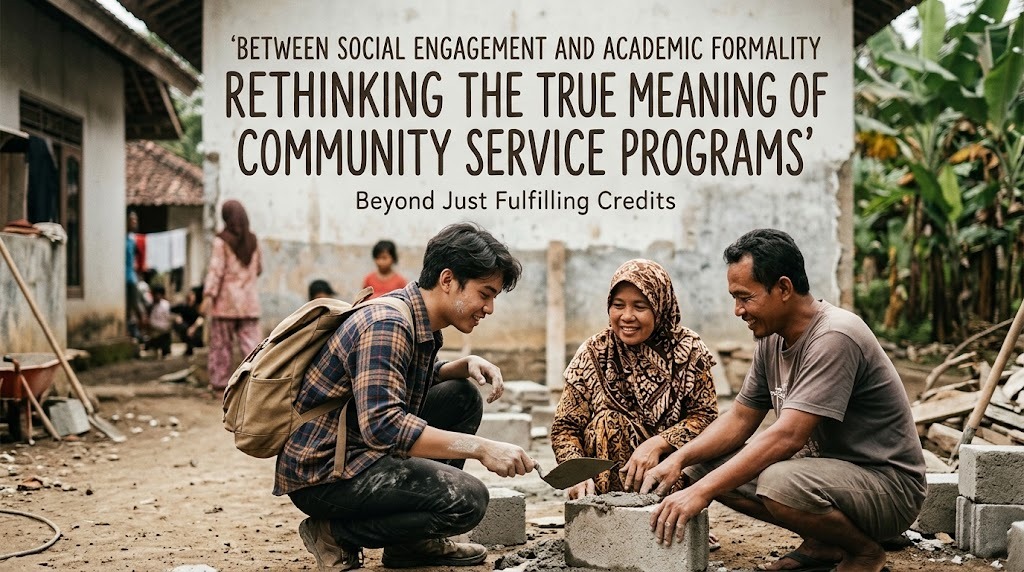
Community service programs have long been positioned as a bridge between universities and society. They symbolize institutional commitment to social responsibility while offering students practical exposure beyond academic theory. However, as participation becomes mandatory in many institutions, a pressing question emerges: are these programs genuine platforms for social engagement, or have they become merely academic formalities?Reexamining the true meaning of community service programs is essential to ensure they remain relevant, impactful, and aligned with the broader mission of higher education.
THE PHILOSOPHY OF SOCIAL ENGAGEMENT
At their core, community service programs are rooted in the philosophy of civic engagement. Universities are not isolated intellectual spaces; they are part of a larger social ecosystem. Through community involvement, students learn that knowledge carries responsibility.
Authentic social engagement encourages collaboration rather than charity. Instead of positioning communities as passive recipients, effective programs emphasize partnership. Students and community members co-identify problems, co-design solutions, and co-evaluate outcomes. This participatory approach fosters mutual respect and sustainable impact.
When this philosophy is upheld, community service becomes transformative—not only for students but also for the communities involved.
THE RISK OF ACADEMIC FORMALITY
Despite noble intentions, institutional pressures can shift the focus toward administrative compliance. Assessment rubrics, attendance requirements, and report submissions sometimes overshadow genuine engagement.
In such circumstances, students may prioritize fulfilling documentation standards rather than building meaningful relationships. Community activities are compressed into tight academic schedules, limiting long-term impact. The result is a procedural experience that satisfies curriculum demands but lacks depth.
Academic formality can also reduce innovation. When programs are rigidly structured, students have little room to adapt initiatives to local contexts. Flexibility and creativity—key components of impactful service—become secondary to standardized evaluation.
REDEFINING THE TRUE MEANING
To rethink the true meaning of community service programs, institutions must return to their foundational goals: empowerment, collaboration, and experiential learning. Community engagement should not be treated as an isolated academic task but as an integrated learning process.
Reflection plays a critical role in this redefinition. Structured discussions, reflective journals, and critical analysis sessions allow students to connect field experiences with theoretical concepts. This process transforms activities into learning moments.
Furthermore, sustainability should become a central measure of success. Programs that leave lasting benefits—capacity building, knowledge transfer, or infrastructure improvement—demonstrate deeper value than short-term interventions.
BUILDING A BALANCED FRAMEWORK
A balanced framework requires collaboration between universities, students, and communities. Institutions must provide guidance and monitoring while allowing flexibility for contextual adaptation. Students must commit to ethical engagement, and communities must be recognized as equal partners.
Technology can also support this balance. Digital platforms enable documentation of impact, continuous communication, and long-term collaboration beyond program timelines. By integrating innovation with human-centered values, community service programs can remain dynamic and relevant.
CONCLUSION
Community service programs exist between two realities: social engagement and academic formality. Their true meaning depends on how institutions and students interpret and implement them. When reduced to bureaucratic obligations, their impact diminishes. However, when grounded in authentic collaboration and reflective learning, they become powerful instruments for civic growth and social transformation.
Reconsidering their purpose is not merely an academic exercise—it is a commitment to ensuring that higher education remains socially responsive and ethically grounded.
Tentang Penulis
Gusti Ayu Tita P
Penulis — Universitas STEKOM
Penulis aktif yang berfokus pada isu-isu akademik, teknologi pendidikan, dan pengembangan sumber daya manusia di lingkungan kampus.















