Can Academic Competitions Improve Students’ Competitiveness in the Workplace
Gusti Ayu Tita P
24 Agustus 2026
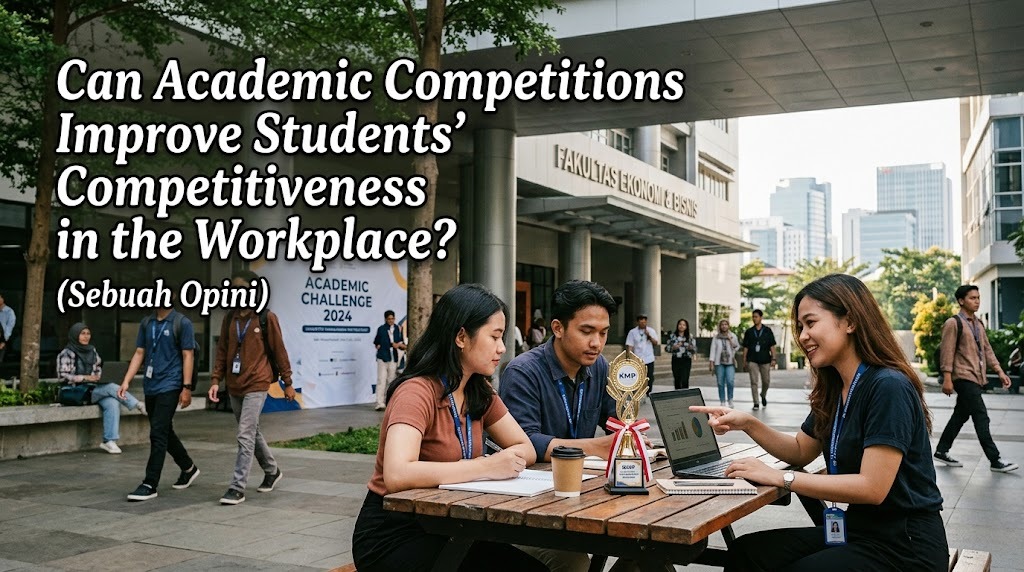
Academic competitions are often viewed as activities that help students demonstrate their knowledge and abilities. However, their benefits can extend beyond academic achievement when students learn how to handle challenges, manage time, and communicate ideas effectively. These experiences may provide useful preparation for professional environments where employees are expected to perform under pressure. Academic competitions can contribute to workplace competitiveness, but they are not the only factor that determines career success. Students still need practical experience, interpersonal skills, and adaptability to become well prepared for the workplace.
HOW ACADEMIC COMPETITIONS DEVELOP COMPETITIVE SKILLS
Academic competitions require students to prepare themselves for specific goals. They may need to study consistently, practice difficult questions, or improve their performance within a limited period. This process can encourage students to become more disciplined and focused. Goal setting and consistent preparation are valuable habits in both education and professional life.
Competitions also expose students to different levels of performance. Students can observe how others approach problems and identify areas where they need improvement. Instead of treating competitors only as rivals, students can use these experiences as opportunities to learn. Healthy competition can encourage continuous self improvement.
DEVELOPING PROBLEM SOLVING ABILITIES
Many academic competitions involve complex questions that cannot always be answered through memorization. Participants must analyze information, identify important details, and determine appropriate solutions. These activities can strengthen critical thinking and problem solving skills. Such abilities are relevant in many professional environments.
Workplace problems are often different from academic questions, but the underlying thinking process can be similar. Employees may need to evaluate information, consider alternatives, and make decisions within certain limitations. Academic competitions can provide students with early opportunities to practice this type of thinking. Problem solving experience can make students more comfortable with challenging situations.
LEARNING FROM FAILURE AND FEEDBACK
Not every student will win an academic competition. Losing can provide an opportunity to evaluate preparation, identify weaknesses, and improve future performance. Students can learn that failure is not necessarily proof of inability. Constructive responses to failure can build resilience and a growth mindset.
Feedback is equally important. Teachers, mentors, and competitors may provide different perspectives about performance. Students who are willing to accept useful criticism can identify areas for improvement more quickly. The ability to receive and apply feedback is highly valuable in professional development.
DEVELOPING A GROWTH MINDSET
Academic competitions can encourage students to see skills as abilities that can be developed through practice. A student who initially performs poorly may improve after changing study methods or practicing more effectively. This experience can demonstrate the value of persistence. A growth mindset encourages students to focus on progress rather than fixed ability.
This mindset can also be useful in the workplace. Professional environments frequently require employees to learn new technologies, procedures, and responsibilities. Students who are comfortable learning from mistakes may adapt more easily to these changes. Continuous learning is an important part of long term career competitiveness.
COMPETITION ALONE IS NOT ENOUGH
Although academic competitions can develop useful abilities, they do not automatically make students competitive in the workplace. Professional environments require practical experience, teamwork, communication, adaptability, and responsibility. These skills may not be fully developed through individual competitions. Academic achievement should therefore be combined with real world experience.
Internships, student organizations, projects, entrepreneurship, volunteering, and part time activities can provide additional learning opportunities. These experiences allow students to interact with different people and deal with practical challenges. A combination of academic and practical learning can produce stronger workplace preparation.
THE IMPORTANCE OF TEAMWORK
Some academic competitions are individual, while others involve teams. Team based competitions can teach students how to divide responsibilities, communicate ideas, and coordinate decisions. Participants must understand that individual performance can affect the entire group. Teamwork experience can prepare students for collaborative workplace environments.
Even individual competitions can teach lessons about cooperation. Students may study with peers, seek advice from mentors, or exchange ideas with other participants. These interactions show that competition does not always have to eliminate collaboration. Strong professionals need to know when to compete and when to cooperate.
HOW ACADEMIC COMPETITIONS CAN SUPPORT CAREER PREPARATION
Students can gain greater benefits from competitions when they connect them with career goals. For example, a student interested in business can participate in entrepreneurship competitions, while someone interested in technology can explore programming or innovation challenges. This approach makes competition more relevant to future professional interests. Career aligned activities can help students build both skills and experience.
Students should also document meaningful achievements and the skills they developed during the process. Competition certificates can be useful, but employers may be more interested in what students actually learned and accomplished. Explaining the challenges faced, solutions created, and lessons learned can make the experience more meaningful. The value of a competition lies not only in the award but also in the competencies developed.
CONCLUSION
Academic competitions can improve students’ competitiveness in the workplace by developing discipline, problem solving, time management, communication, resilience, and goal setting. These experiences can help students become more comfortable with challenges and performance expectations. However, competition should not be considered a complete preparation for professional life.
Students need to combine academic competitions with practical experience, teamwork, communication, adaptability, and continuous learning. The most competitive graduates are not necessarily those with the largest number of awards, but those who can apply their knowledge effectively and continue developing their abilities. When academic competition is used as part of a broader learning strategy, it can become a valuable foundation for future career growth.
Tentang Penulis
Gusti Ayu Tita P
Penulis — Universitas STEKOM
Penulis aktif yang berfokus pada isu-isu akademik, teknologi pendidikan, dan pengembangan sumber daya manusia di lingkungan kampus.