Can KKN Become A Real Space For Student Transformation And Learning
Gusti Ayu Tita P
20 Agustus 2026
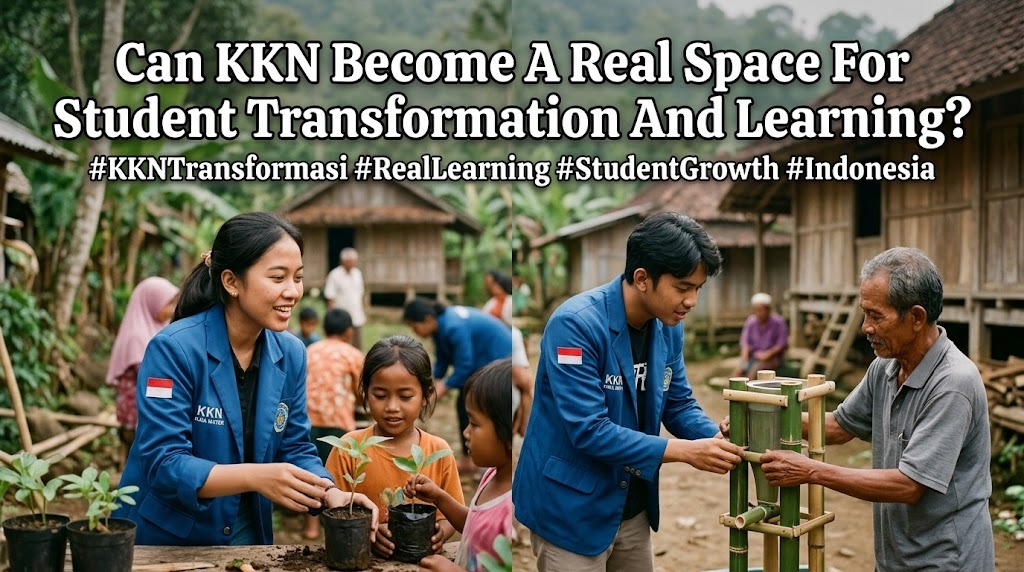
KKN or Kuliah Kerja Nyata is a community service program that allows university students to apply their academic knowledge directly in society. Instead of learning only through lectures and assignments, students experience real situations involving communities, local problems, and social relationships. This environment can create opportunities for student transformation and practical learning. However, KKN does not automatically transform every student. Its impact depends on how actively students participate, how well programs respond to community needs, and how deeply students reflect on their experiences.
KKN AS A BRIDGE BETWEEN CAMPUS AND COMMUNITY
University education provides students with theories, concepts, and technical knowledge. KKN creates an opportunity to connect this knowledge with real conditions in communities. Students may use their academic backgrounds to support education, local businesses, environmental activities, digital literacy, or other community initiatives. Practical application helps students understand that theories may need adjustment when they are used in different social environments. This makes learning more relevant and meaningful.
KKN also introduces students to situations that cannot always be explained through textbooks. A community may have limited resources, different priorities, or cultural practices that students need to understand first. Students must therefore learn to observe and communicate before deciding on a solution. The connection between academic knowledge and local needs can create a more complete learning experience. Students begin to see education as something that can be applied to real problems.
DEVELOPING STUDENT SELF AWARENESS
KKN can become a valuable opportunity for students to understand themselves better. Working in unfamiliar environments may reveal strengths and weaknesses that are not obvious in the classroom. Students may discover that they are good at organizing activities, communicating with residents, solving problems, or leading teams. They may also recognize weaknesses such as poor time management or difficulty adapting. Self awareness is an important foundation for personal development.
Students can use their KKN experiences to evaluate how they respond to pressure and responsibility. They may learn whether they can remain patient when plans change or when people have different opinions. These situations encourage students to understand their behavior and make improvements. Personal reflection can turn everyday experiences into meaningful lessons. As a result, KKN can contribute to greater maturity and confidence.
STRENGTHENING COMMUNICATION SKILLS
Communication is one of the most important skills students develop during KKN. They may interact with community leaders, parents, children, business owners, teachers, and other residents. Each group can have different expectations and communication styles. Students need to explain ideas clearly while respecting local perspectives. Effective communication helps students build trust and avoid misunderstandings.
KKN also teaches students that communication involves listening. Before creating a program, students need to understand what residents actually need. They cannot assume that their ideas will automatically be appropriate for the community. Active listening and respectful dialogue can create stronger cooperation. These communication skills can later benefit students in academic organizations and professional workplaces.
LEARNING TO SOLVE REAL COMMUNITY PROBLEMS
Real community problems are often more complex than problems presented in classroom exercises. Students may encounter limited budgets, lack of facilities, low participation, or difficulties coordinating schedules. These situations require students to develop practical problem solving skills. They need to analyze the situation and determine what can realistically be achieved. This process encourages students to think beyond theoretical solutions.
Students may also need to change their original plans when circumstances develop differently. A successful KKN team should be willing to evaluate its approach and make adjustments. Flexibility and creativity become important when students face unexpected challenges. Instead of viewing obstacles as reasons to stop, students can treat them as opportunities to learn. This experience can prepare them for uncertain situations in future careers.
CONNECTING STUDENTS WITH LOCAL CULTURE
KKN can provide students with opportunities to learn about local traditions and cultural practices. Communities may have unique customs, economic activities, crafts, foods, or forms of social cooperation. Students can gain cultural awareness and respect for local knowledge through direct interaction. This experience can broaden their understanding of Indonesia's social and cultural diversity. It also encourages students to become more sensitive when working with people from different backgrounds.
Understanding culture is important when developing community programs. Activities that ignore local customs may not receive strong support from residents. Students therefore need to observe and communicate before deciding how a program should be implemented. Cultural sensitivity can help create more appropriate community engagement. This lesson can also prepare students for increasingly diverse academic and professional environments.
TURNING EXPERIENCE INTO MEANINGFUL LEARNING
Experience alone does not guarantee transformation. Students need to reflect on what happened and understand what they learned from it. They can evaluate their successes, mistakes, challenges, and relationships with community members. Reflection transforms experience into learning because it encourages students to think about how their behavior and understanding have changed. Without reflection, KKN may become only a series of activities that students complete to fulfill academic requirements.
Reflection can be conducted through reports, group discussions, journals, presentations, or evaluation sessions. Students can ask what they learned, what difficulties they experienced, and what they would do differently in the future. These questions encourage continuous learning and self improvement. Students can then connect their KKN experiences with their academic and career goals. This makes the program more valuable as a long term learning experience.
WHEN KKN BECOMES MORE THAN A GRADUATION REQUIREMENT
KKN can become transformative when students actively engage with the community rather than simply completing assigned tasks. Programs should begin with an understanding of genuine community needs. Students should also involve residents in planning and implementation whenever possible. Meaningful participation creates opportunities for both students and communities to learn from one another. This makes KKN more than a formal academic obligation.
The sustainability of a program is also important. A short activity may provide immediate benefits, but a program designed with local participation has a better chance of continuing after students leave. Students can therefore focus on practical, relevant, and sustainable solutions. This approach encourages them to think about long term impact rather than simply completing a list of activities. KKN becomes more meaningful when learning and community benefit develop together.
CHALLENGES THAT CAN LIMIT STUDENT TRANSFORMATION
KKN also has limitations that should not be ignored. Some students may participate only because the program is required, while others may have difficulty adapting to community conditions. Poor communication, unclear responsibilities, limited resources, or unrealistic program plans can reduce the learning experience. Student engagement is essential if KKN is expected to produce meaningful transformation. Without active involvement, the program may become routine rather than educational.
Universities also have an important role in preparing students. Students need clear guidance, appropriate training, realistic objectives, and opportunities to receive feedback. Community partners should also be involved in identifying priorities and evaluating outcomes. Good preparation and collaboration can increase the educational value of KKN. With the right support, challenges can become learning opportunities instead of barriers.
CONCLUSION
KKN can become a real space for student transformation and learning when students actively engage with communities, apply academic knowledge, solve real problems, and reflect on their experiences. The program can strengthen communication, teamwork, leadership, empathy, adaptability, independence, problem solving, and social responsibility. However, transformation does not happen simply because students participate in KKN. It requires meaningful interaction, community involvement, proper preparation, and continuous reflection. When these elements are present, KKN can move beyond being a graduation requirement and become a valuable learning experience that prepares students for academic, social, and professional life.
Tentang Penulis
Gusti Ayu Tita P
Penulis — Universitas STEKOM
Penulis aktif yang berfokus pada isu-isu akademik, teknologi pendidikan, dan pengembangan sumber daya manusia di lingkungan kampus.