Common Causes of Land Disputes You Should Know
Gusti Ayu Tita P
2 September 2026
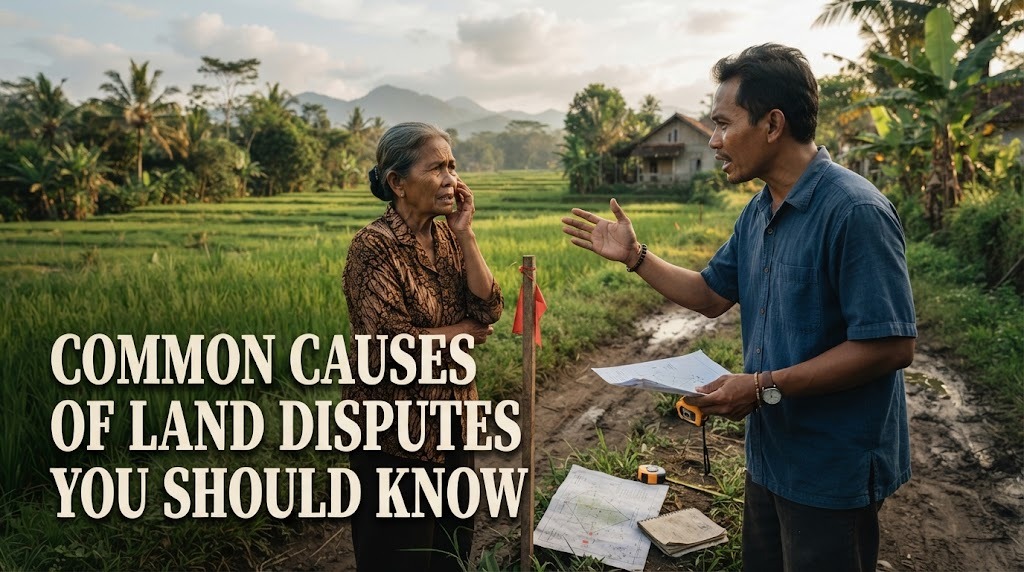
Land disputes are common legal problems that can affect individuals, families, businesses, and communities. These disputes may involve ownership, land boundaries, inheritance, property transactions, or land use. In many cases, conflicts happen because land documents are incomplete, unclear, or inconsistent with the actual condition of the property. Understanding the causes of land disputes can help property owners and buyers take preventive steps and avoid unnecessary legal problems.
UNCLEAR LAND OWNERSHIP DOCUMENTS
One of the most common causes of land disputes is unclear or incomplete ownership documentation. Some properties may still rely on old documents, informal agreements, or records that have not been properly updated. Problems can arise when more than one person claims ownership of the same piece of land. Differences between official records and the actual condition of the property can also create uncertainty.
Property owners should keep their land documents safe and make sure the information is accurate. Buyers should also verify the legal status and ownership history before purchasing land. Proper document verification can significantly reduce the risk of becoming involved in a property dispute.
UNCLEAR LAND BOUNDARIES
Unclear boundaries are another frequent source of conflict between neighboring landowners. Disputes may occur when boundary markers are missing, damaged, moved, or incorrectly placed. A small difference in the understanding of a boundary can eventually develop into a serious disagreement. This problem is particularly common when properties have been passed down through several generations.
Land boundaries should be checked against available official records and physical conditions. Neighboring owners should understand where their respective property lines are located. Proper measurement and documentation can help prevent disagreements over the size and location of land.
INHERITANCE DISPUTES
Inherited property can become a source of conflict when family members disagree about their respective rights. Problems often arise when there is no clear agreement regarding the distribution of inherited land. Disputes can become more complicated if one heir sells, occupies, or manages the property without the agreement of other heirs. Old family property that has never been formally registered can also create additional uncertainty.
To prevent inheritance disputes, heirs should establish a clear agreement regarding the distribution and management of the property. Relevant inheritance and land documents should also be properly organized. Formalizing changes in ownership can provide greater legal certainty for everyone involved.
PROBLEMATIC LAND TRANSACTIONS
Buying or selling land without proper verification can create serious legal problems. For example, a buyer may purchase property from someone who does not have the legal authority to transfer the land. A property may also be involved in an existing dispute or have claims from another party. Transactions based only on informal agreements can make it harder to establish the rights of each party.
Before purchasing land, buyers should verify the seller's identity, ownership documents, land status, and transaction history. Using the appropriate legal procedure and authorized officials can provide additional protection. Careful verification before a transaction is generally much safer than trying to resolve a dispute afterward.
OVERLAPPING LAND RIGHTS
Overlapping claims can occur when different parties have documents or claims relating to the same land. This situation may be connected to administrative errors, unclear boundaries, or incomplete land records. Each party may believe that they have a legitimate right to the property. As a result, disagreements can develop into lengthy land ownership disputes.
Accurate land records are important for preventing overlapping rights. Property buyers should check the available land information before completing a transaction. If there are conflicting claims, the transaction should be postponed until the legal status of the property is clarified.
UNAUTHORIZED LAND OCCUPATION
Unauthorized occupation happens when someone uses or controls land without permission or a valid legal basis. A person may occupy another party's property or continue using land after their right to use it has ended. Conflicts can become more complicated when the occupation continues for a long period. Each side may then present different evidence regarding the history of the property.
Property owners should maintain documents that demonstrate their legal rights and relationship to the land. If unauthorized occupation occurs, the issue should be addressed through appropriate legal procedures rather than through unilateral action. A lawful approach can reduce the risk of escalating the dispute.
CHANGES IN LAND USE
Changes in how land is used can also lead to disputes when they affect the rights or interests of other parties. For example, a landowner may change the use of a property in a way that interferes with neighboring rights or existing agreements. Disagreements can also occur when land previously used jointly is taken over by one party. The legal status and applicable land use requirements therefore need to be considered.
Before changing the use or development of a property, owners should check the applicable regulations and existing rights. Clear agreements with relevant parties can also help prevent future conflicts. Proper documentation is especially important when significant changes are made to the property.
HOW TO PREVENT LAND DISPUTES
Preventing land disputes is often easier and less expensive than resolving them after a conflict has developed. Property owners should keep ownership documents complete, verify land boundaries, and maintain records of important transactions. Buyers should conduct proper due diligence before purchasing property. Inherited land should also be formally managed and documented by the relevant heirs.
If a disagreement begins, communication and mediation may provide an opportunity to reach a settlement before litigation becomes necessary. When a dispute cannot be resolved through discussion, the parties can consider appropriate legal procedures. Professional legal advice can also help determine the most suitable course of action based on the facts and available evidence.
CONCLUSION
The common causes of land disputes include unclear ownership documents, boundary problems, inheritance conflicts, problematic transactions, overlapping rights, unauthorized occupation, and disputes over land use. Many of these problems can be reduced through careful document verification and proper land administration. Property owners and buyers should not rely solely on verbal agreements when dealing with valuable property. Taking preventive measures from the beginning can provide greater legal certainty and reduce the risk of lengthy disputes.
Tentang Penulis
Gusti Ayu Tita P
Penulis — Universitas STEKOM
Penulis aktif yang berfokus pada isu-isu akademik, teknologi pendidikan, dan pengembangan sumber daya manusia di lingkungan kampus.