
Community Service Programs Transforming Student Perspectives or Simply Fulfilling Credit Requirements
Gusti Ayu Tita P
27 Februari 2026
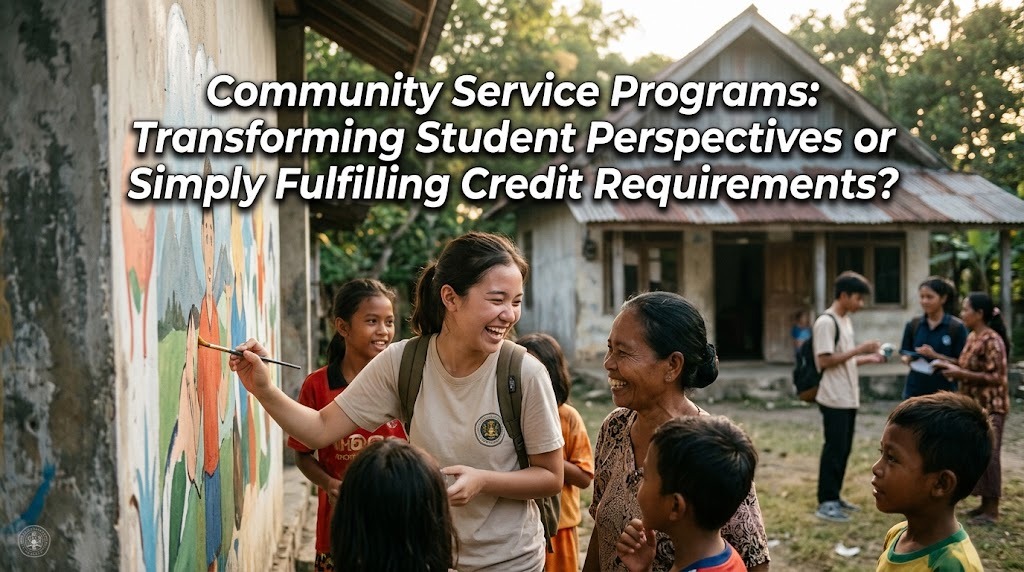
Community service programs have become an integral component of higher education across the globe. Universities increasingly require students to participate in structured social engagement activities as part of graduation requirements. While these programs are often promoted as transformative experiences, a critical question remains: do they genuinely reshape student perspectives, or do they merely function as a mechanism to fulfill academic credits?
In the context of modern higher education, community service is expected to bridge the gap between theory and real-world application. However, the depth of its impact largely depends on design, supervision, and student engagement.
THE PURPOSE OF COMMUNITY SERVICE PROGRAMS
The primary goal of community service programs is to connect academic knowledge with societal needs. Through direct involvement in communities—whether rural, urban, or marginalized—students are exposed to complex social realities that cannot be fully understood within classroom walls.
Ideally, such programs cultivate empathy, social awareness, and problem-solving skills. Students encounter economic disparities, educational challenges, and cultural diversity firsthand. These experiences often challenge preconceived notions and encourage critical reflection.
Yet, when poorly structured, community service risks becoming procedural. Students may focus more on documentation, reports, and attendance rather than meaningful engagement. In such cases, the transformative potential is significantly reduced.
TRANSFORMING STUDENT PERSPECTIVES
When implemented effectively, community service can alter how students perceive society and their future professional roles. Interaction with local communities fosters humility and adaptability. Students learn to communicate across cultural and socioeconomic boundaries, which strengthens emotional intelligence.
Moreover, facing real-world challenges encourages creative thinking. Instead of relying solely on theoretical frameworks, students must adapt to limited resources and unpredictable circumstances. This experience often reshapes career aspirations, steering some toward socially driven professions or entrepreneurial innovation aimed at community development.
The transformation occurs not only externally but internally. Students frequently report increased confidence, resilience, and a stronger sense of purpose after completing meaningful community projects.
FULFILLING CREDIT REQUIREMENTS
Despite its potential, community service programs sometimes devolve into administrative formalities. When institutions emphasize grading criteria over social impact, students may prioritize completing tasks quickly rather than building sustainable initiatives.
Short program durations, limited supervision, and lack of follow-up evaluation contribute to superficial outcomes. In these situations, the experience becomes transactional—students offer temporary service in exchange for academic credit, with minimal long-term benefit for the community.
This disconnect highlights the importance of institutional commitment. Without reflective sessions, mentorship, and measurable social goals, community service risks being perceived as an obligation rather than an opportunity.
STRIKING A BALANCE
To ensure that community service programs truly transform student perspectives, universities must integrate reflective learning components. Structured debriefings, impact assessments, and interdisciplinary collaboration can deepen learning outcomes.
Students, on the other hand, must approach the experience with intrinsic motivation. When they view community engagement as a platform for growth rather than merely a graduation requirement, the results become more meaningful.
Ultimately, community service programs hold the power to redefine education beyond academic achievement. They can cultivate socially responsible graduates who are not only competent professionals but also compassionate citizens.
CONCLUSION
Community service programs stand at the intersection of academic obligation and social transformation. Their impact depends largely on intention, structure, and execution. When thoughtfully designed and genuinely embraced, they have the capacity to transform student perspectives in profound ways. However, without depth and reflection, they risk becoming nothing more than a checklist item on the path to graduation.
Tentang Penulis
Gusti Ayu Tita P
Penulis — Universitas STEKOM
Penulis aktif yang berfokus pada isu-isu akademik, teknologi pendidikan, dan pengembangan sumber daya manusia di lingkungan kampus.



