Complete Guide To ASN Career Development And Professional Opportunities
Gusti Ayu Tita P
10 Agustus 2026
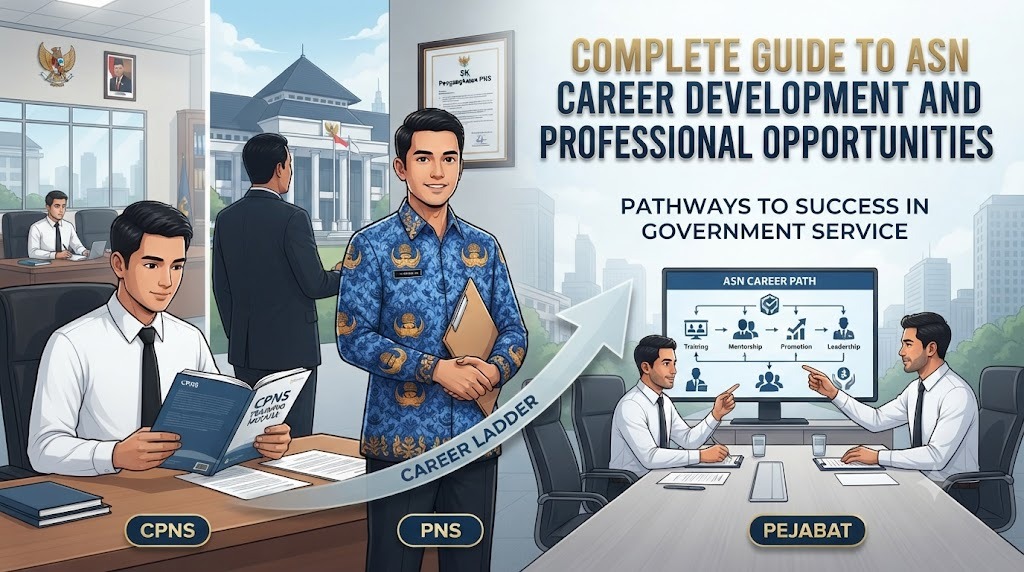
ASN career development is an important part of building a professional government workforce in Indonesia. ASN consists of Civil Servants or PNS and Government Employees with Work Agreements or PPPK. A career in the public sector offers opportunities to develop professional expertise, take on greater responsibilities, and contribute to public services. However, career development requires continuous learning, strong performance, and an understanding of applicable career systems.
Professional growth is not limited to promotion. It can include competency development, professional experience, functional specialization, managerial responsibilities, and new assignments. Employees who understand the available opportunities can create more realistic career plans. A clear development strategy can also help ASN employees align personal goals with institutional needs.
UNDERSTANDING THE ASN CAREER SYSTEM
The ASN career system is designed to support professional development based on relevant qualifications, competence, performance, and organizational needs. The current legal framework under Law No. 20 of 2023 on ASN emphasizes professional and merit based personnel management. This means career decisions should be supported by objective considerations rather than personal relationships. Employees should understand the rules that apply to their positions and institutions.
Career development can take different forms depending on an employee's position and career direction. Employees may develop through vertical, horizontal, or other forms of career movement within the applicable system. Understanding these possibilities helps employees avoid assuming that career growth always means moving to a higher position. Professional development can also mean becoming a more specialized and capable employee.
KNOWING THE MAIN ASN CAREER PATHS
ASN positions are broadly categorized into managerial and nonmanagerial positions. Managerial positions involve leadership and organizational management responsibilities, while nonmanagerial positions include functional and executive roles. Each pathway requires different competencies and professional expectations. Employees should understand these differences before creating long term career goals.
A functional career can be suitable for employees who want to develop specialized expertise. Managerial career development may be more appropriate for those who are interested in leadership and organizational responsibilities. The best pathway depends on qualifications, competence, interests, experience, and organizational opportunities. Employees should evaluate their strengths before deciding which direction to pursue.
DEVELOPING PROFESSIONAL COMPETENCE
Competence is a central element of ASN career development. Employees need technical knowledge and practical skills that match their current responsibilities. They may also need managerial, communication, social, and digital competencies depending on their position. Strong competence helps employees handle tasks effectively and prepare for more complex responsibilities.
Competence development should be continuous rather than limited to formal training. Employees can learn through education, training, mentoring, workplace assignments, professional communities, and independent study. Regular learning helps employees respond to changing regulations, technology, and public service expectations. A continuous learning mindset can therefore support sustainable professional growth.
BUILDING STRONG WORK PERFORMANCE
Work performance is an important foundation for career development. Employees should understand their responsibilities, performance targets, and expected contributions. Completing work accurately, efficiently, and responsibly can demonstrate professional reliability. Performance evaluation can also identify strengths and areas that require further development.
Good performance should not be measured only by the quantity of completed tasks. It should include quality, accountability, discipline, integrity, teamwork, and service orientation. Employees should keep track of meaningful achievements and professional contributions. A consistent record of strong performance can support career development within a merit based system.
CREATING A PERSONAL CAREER PLAN
A personal career plan gives employees a clearer direction for professional growth. The process can begin by identifying a desired position or professional field. Employees can then study the qualifications, competencies, experience, and other requirements associated with that career goal. This makes development activities more focused and relevant.
Career goals should be divided into realistic short term and long term objectives. For example, an employee may plan to improve a technical skill, complete relevant training, gain experience through a specific assignment, or strengthen leadership abilities. Progress should be reviewed regularly because career goals and organizational priorities can change. A flexible career plan allows employees to adjust without losing their overall direction.
USING TRAINING AND EDUCATION OPPORTUNITIES
Training and education can help employees close competency gaps and improve professional performance. ASN employees should select learning programs that are relevant to their responsibilities and career objectives. Relevant training is usually more valuable than simply collecting certificates. Employees should focus on whether the knowledge gained can be applied in their work.
Learning opportunities may include formal courses, workshops, technical training, leadership programs, seminars, mentoring, and self learning. Employees can also learn from colleagues with greater experience or expertise. The most effective development approach combines learning with practical application. This allows employees to turn knowledge into professional capability.
GAINING MEANINGFUL WORK EXPERIENCE
Professional experience provides opportunities to apply knowledge and develop practical judgment. Employees can gain experience through projects, team assignments, public service activities, cross unit coordination, and problem solving. Different responsibilities can expose employees to new challenges and improve their understanding of government operations. Experience can therefore complement formal qualifications and training.
Employees should actively learn from challenging assignments instead of avoiding responsibilities that seem difficult. New experiences can strengthen adaptability, communication, teamwork, decision making, and problem solving. Keeping records of important projects and achievements can also help employees evaluate their professional progress. Meaningful experience can prepare employees for future responsibilities.
DEVELOPING DIGITAL COMPETENCE
Digital transformation is changing the way government organizations manage information and deliver services. ASN employees increasingly need to use digital platforms, workplace applications, electronic documents, and data based systems. Digital competence can improve efficiency and help employees adapt to modern government processes. It is becoming an important supporting skill across many professional fields.
Employees should develop practical abilities such as data management, digital communication, information security, online collaboration, and responsible technology use. They should also remain willing to learn new tools as government systems evolve. Digital competence should be combined with professional judgment and compliance with applicable rules. Employees who can combine technical expertise with digital skills can be better prepared for future opportunities.
DEVELOPING LEADERSHIP AND COMMUNICATION SKILLS
Leadership and communication are valuable skills for both managerial and nonmanagerial employees. Government work often requires coordination between different teams, institutions, and stakeholders. Employees who communicate clearly can improve teamwork and reduce misunderstandings. Effective communication also helps employees explain information and solve problems more efficiently.
Leadership can be developed before an employee holds a formal managerial position. Taking responsibility, coordinating activities, supporting colleagues, and making careful decisions can provide valuable leadership experience. Employees should also develop problem solving, conflict management, delegation, and decision making skills. These abilities can become increasingly important as professional responsibilities grow.
UNDERSTANDING THE MERIT SYSTEM
The merit system is an important principle in ASN personnel management. It emphasizes objective considerations such as qualifications, competence, performance, potential, integrity, and organizational requirements. Understanding this principle can help employees focus on genuine professional development. Career opportunities should be pursued through demonstrated capability and meaningful performance.
Employees should therefore avoid viewing career advancement solely as a matter of seniority. They should focus on developing relevant skills and producing measurable results. Professional credibility is built through consistent competence, integrity, and performance. Understanding merit based career management can also encourage employees to take greater responsibility for their own development.
EXPLORING PROFESSIONAL OPPORTUNITIES
ASN employees can encounter various professional opportunities throughout their careers. These may include functional positions, managerial roles, specialized assignments, professional development programs, talent management initiatives, and leadership development. The availability of opportunities depends on applicable regulations, institutional structures, qualifications, and organizational needs. Employees should regularly monitor relevant opportunities within their institutions.
Professional opportunities should be evaluated carefully rather than accepted simply because they appear attractive. Employees should consider whether an opportunity matches their competencies and long term career direction. A challenging assignment can sometimes provide greater professional value than a position that offers immediate recognition. Strategic career decisions can help employees build sustainable professional growth.
BUILDING A PROFESSIONAL REPUTATION
A strong professional reputation is developed through consistent behavior and results. Employees should demonstrate integrity, reliability, accountability, discipline, and respect for colleagues and the public. Professional reputation is not created through one successful project but through repeated actions over time. Trust is especially important for employees working in public institutions.
Employees should also maintain good professional relationships without compromising fairness or ethical standards. They can build credibility by sharing knowledge, helping colleagues, responding responsibly to problems, and completing commitments. Constructive feedback should be treated as an opportunity for improvement. A strong reputation can support professional trust and long term career development.
PREPARING FOR FUTURE CAREER CHANGES
The public sector continues to change because of digital transformation, new regulations, organizational reforms, and evolving public expectations. ASN employees need to remain adaptable and willing to learn throughout their careers. Skills that are valuable today may require adjustment as government services and technologies develop. Future readiness therefore depends on continuous professional development.
Employees should regularly review their career plans and identify emerging skills relevant to their field. They can also prepare for possible changes by gaining experience in different projects and improving their digital capabilities. Career flexibility allows employees to respond to new opportunities without abandoning professional goals. Long term career success requires both direction and adaptability.
CONCLUSION
ASN career development is a continuous process that combines competence, performance, experience, integrity, and strategic career planning. Employees can develop through managerial or nonmanagerial pathways, depending on their qualifications, interests, competencies, and organizational opportunities. Training, education, meaningful work experience, digital skills, communication, and leadership development can strengthen professional capabilities. Understanding the merit system can also help employees focus on objective and sustainable career development.
A successful ASN career is not defined only by reaching a higher position. It is also about becoming a competent, ethical, adaptable, and reliable public servant. Employees who consistently improve their abilities and align their career goals with organizational needs can be better prepared for future opportunities. Through continuous learning and responsible performance, ASN employees can build meaningful careers while contributing to better public services.
Tentang Penulis
Gusti Ayu Tita P
Penulis — Universitas STEKOM
Penulis aktif yang berfokus pada isu-isu akademik, teknologi pendidikan, dan pengembangan sumber daya manusia di lingkungan kampus.