
Duplicate Land Certificates and How to Resolve the Dispute?
Gusti Ayu Tita P
28 Agustus 2026
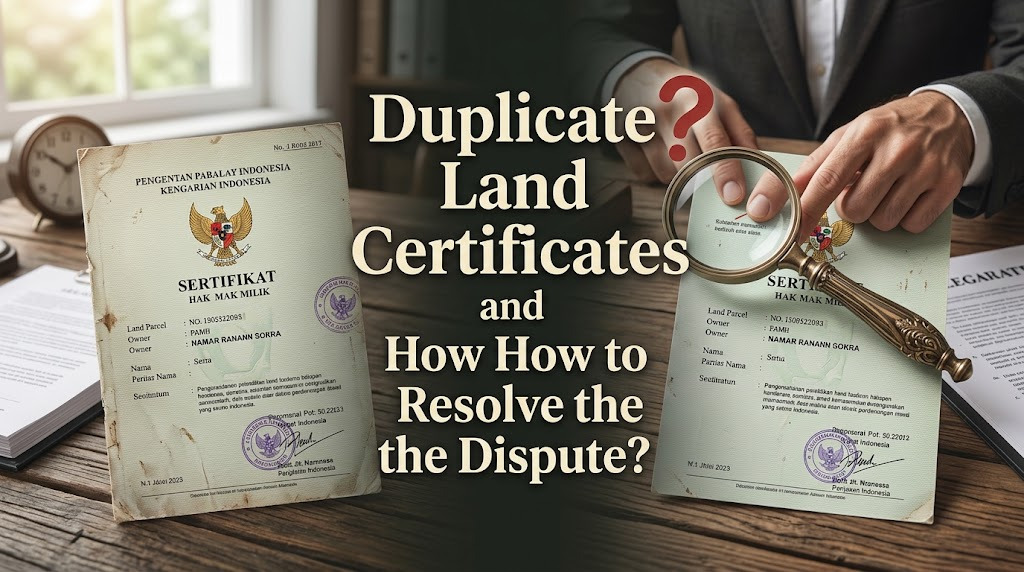
Duplicate land certificates can create serious uncertainty over land ownership because more than one certificate may be associated with the same land parcel or overlapping areas. This situation can cause conflicts between individuals who each believe they have valid rights to the property. If not handled carefully, the dispute may affect the use, sale, or transfer of the land.
Resolving such a dispute requires official verification, complete ownership evidence, and a clear understanding of the land's history. The parties should not immediately assume that one certificate is valid simply because it was issued earlier. The actual circumstances need to be examined through the appropriate administrative and legal procedures.
VERIFY THE DUPLICATE CERTIFICATES
The first step is to determine whether the certificates actually refer to the same land or overlapping areas. Compare the certificate numbers, names of rights holders, land area, location, survey information, and boundaries. These details should also be compared with the physical condition of the property. Any inconsistency should be documented for further examination.
It is important to distinguish a duplicate certificate issue from a forged certificate. A duplicate situation may involve overlapping registration or administrative problems, while a forged document is created or altered unlawfully. The appearance of a document alone cannot establish its legal status. Official records and supporting evidence are needed to determine what has actually occurred.
CHECK OFFICIAL LAND RECORDS
The parties should request official verification from the relevant Land Office. The purpose is to compare the information contained in the certificates with registered physical and legal data. Information concerning land boundaries, area, location, survey records, and registered rights may be relevant to the examination. The applicable requirements should be confirmed with the relevant authority.
The results of official verification can help identify overlapping boundaries or inconsistencies in land registration. All official documents and responses should be kept securely. If an administrative problem is identified, ask the relevant authority about the available procedure for correcting or resolving the issue. Important land transactions should be handled carefully while the dispute remains unresolved.
GATHER OWNERSHIP EVIDENCE
Each party should collect documents that support its respective land rights. These may include land certificates, survey documents, sale and purchase deeds, inheritance records, gift documents, and other transfer records. The evidence should be arranged according to the chronology of ownership. A well-organized collection of documents can make the competing claims easier to understand.
The parties should also prepare a clear ownership history. Explain when the land was acquired, how it was obtained, and whether there were previous transfers. Supporting documents should be preserved in their original form whenever possible. The relevance and strength of each document should be assessed based on the circumstances of the case.
TRY MEDIATION
If the dispute involves two or more parties, mediation may be considered as an initial way to seek a settlement. Each party can present its evidence and explain the basis of its claim. Mediation can provide an opportunity to discuss the problem without immediately moving to formal litigation. It may be effective when the parties are willing to cooperate.
If an agreement is reached, the result should be properly documented and implemented through the applicable procedures. If the parties cannot reach an agreement, further administrative or legal measures may be necessary. The parties should avoid making unilateral decisions about the disputed land. A careful process can help prevent the conflict from becoming more complicated.
PURSUE APPROPRIATE LEGAL ACTION
If mediation does not resolve the dispute, the affected party may consider appropriate legal or administrative action. The correct procedure depends on whether the issue concerns land registration, administrative decisions, document validity, or competing ownership claims. Because each dispute has different circumstances, the available evidence should be carefully reviewed before taking formal action.
A party considering further action should prepare certificates, survey records, ownership documents, transfer records, and a detailed ownership chronology. Consulting a land law professional may help clarify the available options and procedures. The disputed property should not be sold or transferred without understanding its legal status. Proper preparation can help protect the party's interests during the dispute-resolution process.
CONCLUSION
Duplicate land certificate disputes should be handled through official verification, examination of ownership evidence, and proper dispute-resolution procedures. The parties should first establish whether the certificates refer to the same land or overlapping areas. Official land records are important for understanding the registered physical and legal data.
Mediation may provide an opportunity to reach a settlement when the parties are willing to cooperate. If no agreement can be achieved, appropriate administrative or legal measures may be considered. By relying on reliable evidence and following the applicable procedures, the parties can work toward greater certainty over land ownership and rights.
Tentang Penulis
Gusti Ayu Tita P
Penulis — Universitas STEKOM
Penulis aktif yang berfokus pada isu-isu akademik, teknologi pendidikan, dan pengembangan sumber daya manusia di lingkungan kampus.















