Duplicate Land Certificates How Can They Be Resolved?
Gusti Ayu Tita P
28 Agustus 2026
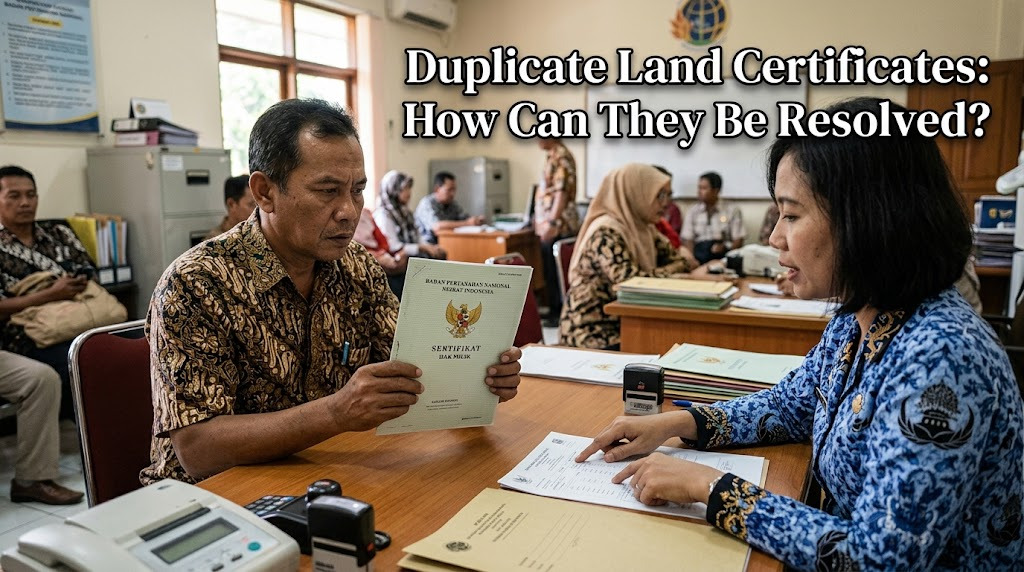
Duplicate land certificates can create uncertainty over land ownership when more than one certificate is associated with the same land parcel or overlapping areas. This condition can lead to disputes between individuals or parties who each claim rights to the same property. If not addressed properly, the issue may also complicate land transactions and the transfer of ownership.
Resolving duplicate certificates requires a careful review of official land records, physical data, legal data, and ownership history. The parties involved should avoid taking unilateral action before the status of the land is properly examined. A systematic process can help determine the most appropriate solution.
VERIFY THE LAND CERTIFICATES
The first step is to confirm whether the certificates actually refer to the same land parcel or overlapping areas. Compare the certificate numbers, registered names, land area, location, survey information, and boundaries shown in the documents. These details should also be compared with the physical condition of the land. Any differences should be documented and investigated further.
The existence of two certificates does not automatically mean that one document is fraudulent. The legal status of each certificate must be assessed using official records and supporting evidence. The issue date or physical appearance of a certificate alone is not sufficient to determine which document has the stronger legal basis. Official verification should therefore be carried out before further action is taken.
CHECK OFFICIAL LAND RECORDS
The next step is to request official verification from the relevant Land Office. The purpose is to compare the certificates with the registered physical and legal data. Information about the land location, boundaries, area, rights holder, and survey records may be relevant to the examination. The applicable procedures and requirements should be confirmed directly with the relevant authority.
This verification can help identify overlapping boundaries, administrative inconsistencies, or other registration problems. The results should be kept together with the supporting documents. If an inconsistency is discovered, the landowner should ask the relevant authority about the appropriate administrative process. Important transactions involving the disputed land should be handled carefully until its status becomes clearer.
GATHER OWNERSHIP EVIDENCE
Each party involved should gather documents that support their ownership or land rights. These may include land certificates, survey documents, sale and purchase deeds, inheritance records, gift documents, and other evidence of legal transfers. The documents should be organized according to the history of ownership. This can make it easier to identify how the competing claims arose.
A chronological ownership history should also be prepared. It should explain when the land was acquired, from whom it was obtained, and whether it was subsequently transferred. Supporting documents can help establish the history, although their legal relevance must be assessed individually. Original documents should be stored securely and made available when required by the relevant process.
TRY MEDIATION FIRST
If the duplicate certificates have resulted in a dispute, mediation may be considered as an initial approach. Each party can present its documents and explain the basis of its claim. Mediation gives the parties an opportunity to discuss the issue and seek a mutually acceptable solution. It may be particularly useful when both parties are willing to cooperate.
If an agreement is reached, the outcome should be recorded in a clear document and implemented according to applicable procedures. If no agreement can be reached, the parties may need to consider other administrative or legal mechanisms. The appropriate next step depends on the nature of the dispute and the evidence available. Professional advice can be useful when the matter becomes legally complicated.
CONSIDER LEGAL AND ADMINISTRATIVE ACTION
When mediation does not resolve the dispute, the affected party may consider appropriate legal or administrative action. The correct procedure depends on whether the issue concerns land registration, administrative decisions, document validity, or competing ownership claims. Because land disputes can involve different legal aspects, the available evidence should be reviewed carefully. A land law professional can help determine which option may be appropriate.
All relevant evidence should be prepared before taking further action. This may include certificates, survey records, ownership documents, transfer deeds, and a detailed ownership history. Landowners should avoid selling, transferring, or otherwise dealing with disputed land without first understanding its legal status. Careful handling can help prevent additional disputes from arising.
CONCLUSION
Duplicate land certificates can be resolved by verifying the certificates, checking official land records, gathering ownership evidence, and examining the history of the property. The parties should not assume that one certificate is automatically valid simply because it was issued earlier or appears more convincing. The actual status needs to be assessed through official records and relevant evidence.
Mediation can be considered when the parties are willing to find a settlement, while administrative or legal action may be necessary if mediation fails. Professional assistance can also help when the dispute involves complicated documents or competing claims. By following the proper procedures, the parties can work toward greater legal certainty over the land.
Tentang Penulis
Gusti Ayu Tita P
Penulis — Universitas STEKOM
Penulis aktif yang berfokus pada isu-isu akademik, teknologi pendidikan, dan pengembangan sumber daya manusia di lingkungan kampus.