Educational Holidays as a Way to Introduce Children to Science
Gusti Ayu Tita P
1 September 2026
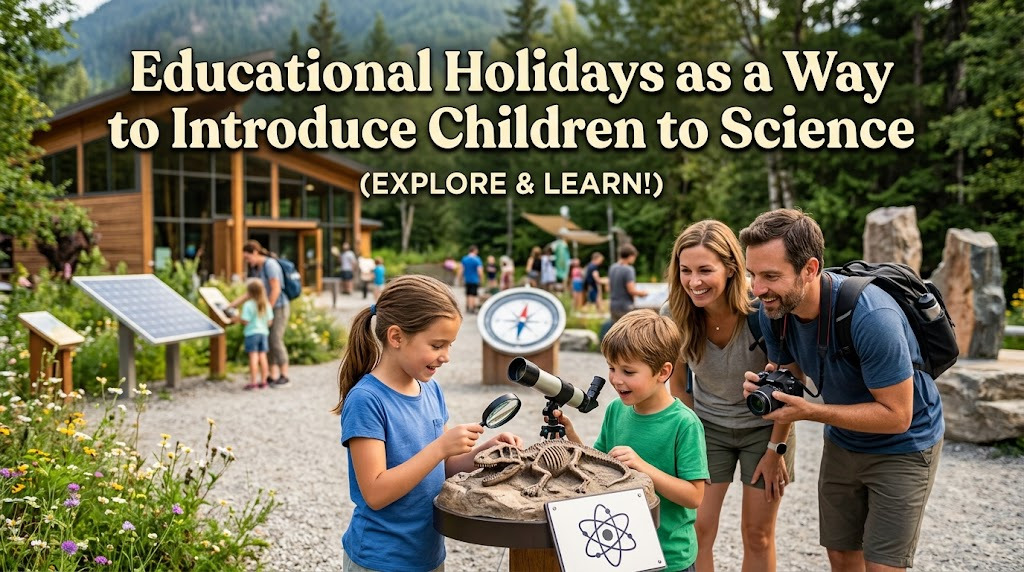
Science is closely connected to everyday life, making it an interesting subject for children to explore during holidays. Educational holidays can provide opportunities to learn about nature, technology, animals, space, and scientific processes through direct experiences. Children can observe different phenomena and ask questions outside the classroom. With suitable activities, a holiday can encourage curiosity and interest in science.
VISIT SCIENCE CENTERS
Science centers are excellent destinations for introducing children to scientific concepts. Many science centers provide interactive exhibits, experiments, demonstrations, and educational simulations that allow children to learn by participating directly. These activities can make difficult concepts easier to understand. Children can also discover how scientific principles are connected to everyday life.
Parents can encourage children to explore exhibits at their own pace. Ask simple questions about what they observe and allow them to explain their ideas. If there are guided activities, choose programs appropriate for their age. Interactive science experiences can make learning more enjoyable and encourage children to become curious about how things work.
EXPLORE NATURE AND NATURAL PHENOMENA
Nature provides many opportunities to introduce children to science. Families can explore forests, beaches, botanical gardens, farms, mountains, or nature parks and observe plants, animals, rocks, weather, and other natural features. Parents can explain simple scientific concepts based on what children see. This approach allows children to connect scientific knowledge with real environments.
Children can also be encouraged to ask questions about natural phenomena. For example, they may wonder why leaves have different shapes or why certain animals live in specific habitats. Parents can help them find reliable explanations without making the activity feel like a formal lesson. Nature exploration can make science more concrete and easier to understand.
TRY SIMPLE AND SAFE EXPERIMENTS
Simple experiments can make a science-focused holiday more engaging. Children can participate in age-appropriate and safe activities that demonstrate basic scientific principles. The experiments should use suitable materials and be supervised by adults when necessary. The goal is to encourage observation and curiosity rather than achieving a perfect result.
Parents can ask children to predict what might happen before an experiment begins. Afterward, they can compare the prediction with the actual result and discuss why the outcome occurred. This process introduces children to basic scientific thinking. Simple experiments can show children that science involves questions, observations, testing, and learning from results.
LEARN ABOUT ANIMALS AND PLANTS
Zoos, botanical gardens, aquariums, farms, and conservation areas can help children learn about living things. They can observe animal behavior, plant characteristics, habitats, food sources, and relationships between organisms. Information provided by the destination can help explain what children see. Direct observation can make biological concepts more memorable.
Parents should teach children to respect animals and plants during the visit. Children should not feed, touch, or disturb animals unless the facility specifically allows it. They should also avoid damaging plants or natural habitats. Learning about living organisms can develop scientific knowledge while encouraging respect for nature.
ENCOURAGE SCIENTIFIC THINKING
A science-focused holiday can also help children develop a habit of thinking critically. Parents can encourage them to ask questions, make simple predictions, observe evidence, and explain their conclusions. These activities can be introduced naturally during a trip without requiring formal worksheets. Children can learn that different ideas should be supported by observations and reliable information.
Parents should welcome questions even when they do not immediately know the answer. Searching for information together can show children how knowledge is developed and verified. Encourage them to compare observations with explanations from trusted sources. Scientific thinking can become a useful habit that supports learning both inside and outside school.
CONCLUSION
Educational holidays can introduce children to science through science centers, nature exploration, safe experiments, observations of plants and animals, and scientific thinking activities. These experiences allow children to learn through direct observation while enjoying time with their families. Parents should choose activities that are safe, age-appropriate, and connected to children's interests. With an enjoyable approach, holidays can help children develop curiosity and a lasting interest in science.
Tentang Penulis
Gusti Ayu Tita P
Penulis — Universitas STEKOM
Penulis aktif yang berfokus pada isu-isu akademik, teknologi pendidikan, dan pengembangan sumber daya manusia di lingkungan kampus.