Essential Skills for Building a Career in Historical Heritage Preservation
Gusti Ayu Tita P
4 September 2026
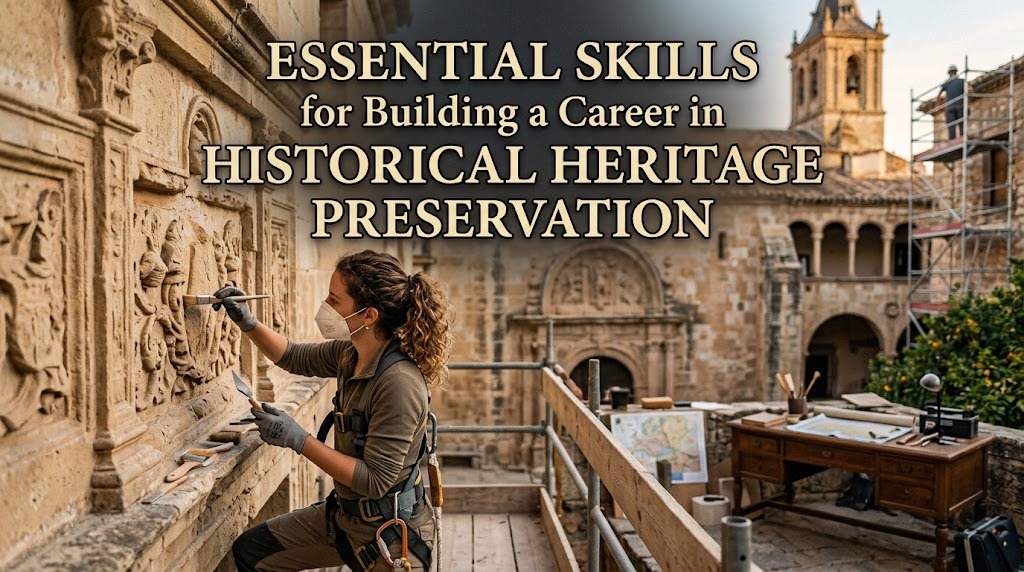
A career in historical heritage preservation requires more than an interest in the past. Professionals need a combination of research ability, technical knowledge, communication skills, and respect for cultural values. These skills are useful when working with historic buildings, archaeological sites, monuments, tombs, archives, and other heritage resources. Developing the right abilities can help students and young professionals prepare for meaningful careers in heritage conservation.
RESEARCH AND HISTORICAL ANALYSIS SKILLS
Strong research skills are fundamental for anyone working in heritage preservation. Professionals need to collect information from documents, archives, field observations, interviews, archaeological evidence, and other reliable sources. They must also evaluate information carefully before using it to make conclusions about a heritage site.
Historical analysis is equally important because heritage sites need to be understood within their original context. Professionals should be able to connect physical evidence with historical events, cultural traditions, social conditions, and changes over time. This ability helps prevent inaccurate interpretations and supports responsible preservation decisions.
DOCUMENTATION AND OBSERVATION SKILLS
Heritage preservation depends heavily on accurate site documentation. Professionals may need to record architectural features, materials, dimensions, inscriptions, damage, environmental conditions, and changes to a site. Careful observation allows them to create reliable records that can support future research and conservation.
Photography, mapping, written notes, and digital records are commonly useful documentation methods. Professionals should pay attention to small details and organize information systematically. Accuracy and consistency are important because incomplete documentation can make future conservation and research more difficult.
TECHNICAL AND DIGITAL SKILLS
Modern heritage work increasingly uses digital technology. Professionals may benefit from knowledge of digital photography, geographic information systems, 3D scanning, mapping, databases, and digital archives. These tools can improve documentation and help researchers study heritage sites without unnecessary physical intervention.
Digital skills can also support public education. Virtual tours, online exhibitions, interactive maps, and digital models can introduce heritage sites to wider audiences. Combining technology skills and heritage knowledge can therefore create new opportunities in the modern preservation sector.
COMMUNICATION AND TEAMWORK SKILLS
Heritage preservation is rarely completed by one person. Projects can involve historians, archaeologists, architects, conservators, government officials, local communities, educators, and researchers. Professionals need to communicate clearly and work effectively with people who have different areas of expertise.
Communication is also important when explaining heritage values to the public. A specialist may need to present complex historical information in language that students, visitors, or community members can easily understand. Teamwork, listening, presentation, and writing skills can therefore support both professional projects and public education.
ETHICAL AND CULTURAL AWARENESS
Working with heritage requires a strong understanding of ethical responsibilities. Professionals must respect cultural traditions, religious practices, local communities, and the significance of historic sites. This is particularly important when working with burial places, human remains, sacred locations, or culturally sensitive materials.
Ethical awareness also means avoiding unnecessary damage during research or conservation. Professionals should follow applicable laws, professional standards, and established conservation principles. Respect and responsibility help ensure that preservation benefits both historical knowledge and the communities connected to the heritage.
PROBLEM SOLVING AND PROFESSIONAL DEVELOPMENT
Heritage sites can face complex challenges such as deterioration, environmental threats, limited funding, uncontrolled tourism, development pressure, or natural disasters. Professionals need problem-solving skills to identify risks and develop practical preservation strategies. They may need to balance conservation needs with community interests, educational goals, and available resources.
Continuous learning is also important because preservation methods and technologies continue to develop. Training courses, workshops, internships, research projects, and professional networks can help individuals improve their abilities. Building a combination of academic knowledge, practical experience, digital skills, and professional ethics can create a strong foundation for a long-term career.
CONCLUSION
A successful career in historical heritage preservation requires a combination of research, documentation, technical, communication, ethical, and problem-solving skills. Professionals must understand historical evidence while also knowing how to protect physical and cultural resources. Digital technology provides additional tools for documentation, research, and public education. By continuously developing their knowledge and practical experience, future heritage professionals can make valuable contributions to protecting cultural heritage for generations.
Tentang Penulis
Gusti Ayu Tita P
Penulis — Universitas STEKOM
Penulis aktif yang berfokus pada isu-isu akademik, teknologi pendidikan, dan pengembangan sumber daya manusia di lingkungan kampus.