FAST LEARNING IN AN INSTANT ERA, DOES TECHNOLOGY BUILD DEEP UNDERSTANDING OR ONLY THE HABIT OF MEMORIZING FOR SNBT?
Gusti Ayu Tita P
17 Juni 2026
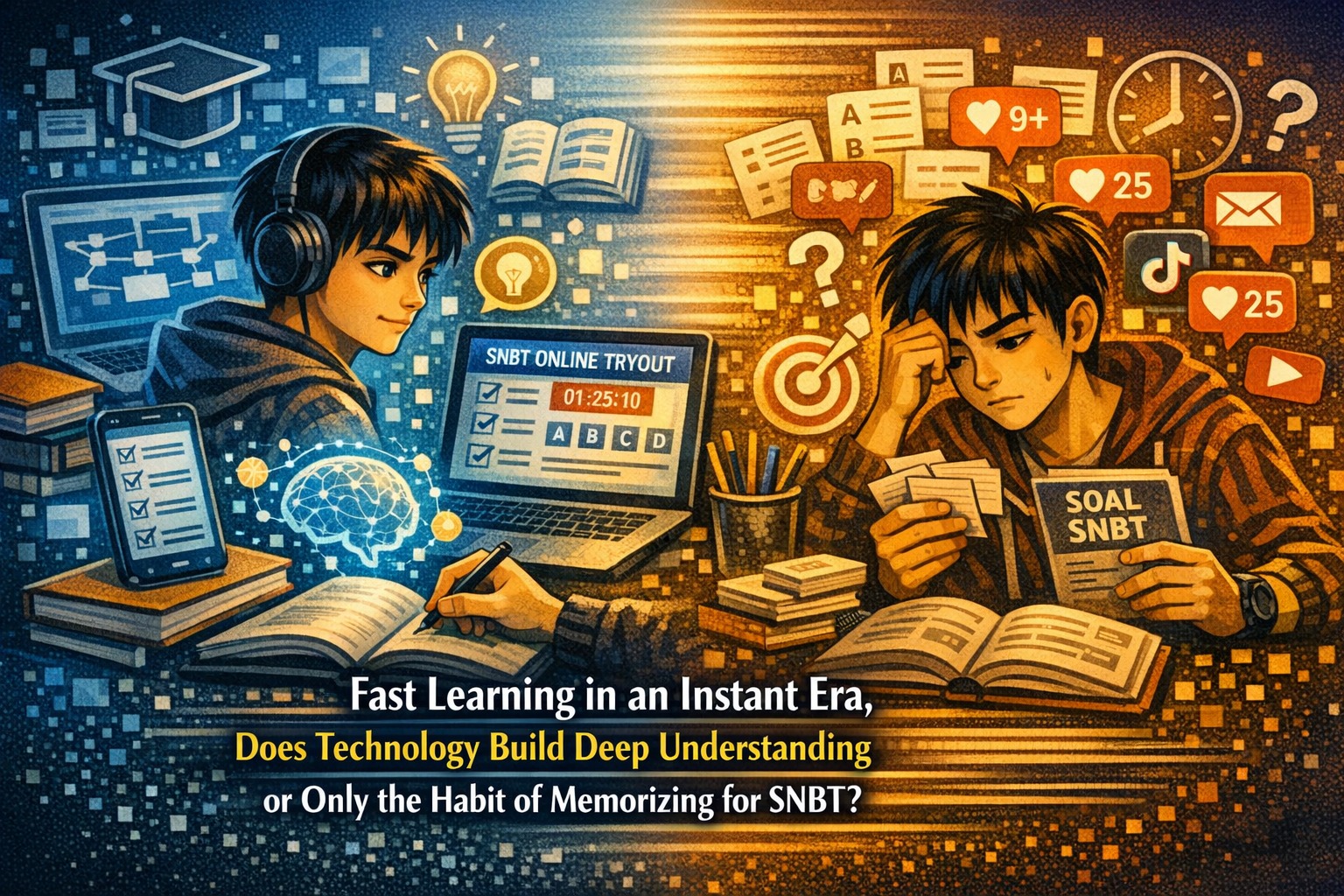
In the modern digital era, students preparing for SNBT (Seleksi Nasional Berdasarkan Tes) are surrounded by speed. Information arrives instantly, explanations are available within seconds, and educational content can be accessed anytime through smartphones and laptops. A difficult mathematics concept can be solved through a short video, a literacy question can be discussed in an online forum, and thousands of practice questions are only one click away. Learning has become faster than ever before.
For many students, this feels like a major advantage. Technology offers efficiency, flexibility, and easier access to academic resources. Students no longer depend only on school lessons or printed books. They can learn independently and explore topics from many different sources.
However, this speed also creates an important concern. When learning becomes too fast, students may focus more on quick answers than true understanding. They may search for shortcuts, memorize patterns, and depend on instant solutions without fully building reasoning skills.
This creates a serious question for students preparing for one of the most competitive university entrance exams in Indonesia: does technology help build deep understanding, or does it only strengthen the habit of memorizing for SNBT?
The answer matters because SNBT is not designed to reward simple memorization. It tests critical thinking, logic, literacy, and problem-solving under pressure. Students who only memorize formulas without understanding concepts often struggle when facing unfamiliar questions.
Technology can become either a bridge to meaningful learning or a trap of shallow preparation. The difference depends on how students use it.
THE RISE OF INSTANT LEARNING CULTURE
Today’s students grow up in an environment where speed is normal. Search engines provide immediate answers, educational videos summarize complex topics in minutes, and learning applications promise faster understanding through shortcuts and quick strategies.
This instant learning culture changes academic behavior. Instead of spending hours reading textbooks, students often prefer short explanations that feel practical and efficient.
For SNBT preparation, this approach can be helpful in certain situations. Quick concept reviews, formula summaries, and fast practice sessions save time and reduce confusion.
However, the danger appears when students begin to believe that fast learning always means effective learning. Understanding cannot always be rushed.
Some concepts require struggle, repetition, and reflection. Deep comprehension grows slowly, especially in subjects involving reasoning and analysis.
Technology offers speed, but wisdom is needed to decide when speed helps and when it weakens understanding.
WHY MEMORIZATION FEELS SAFER THAN UNDERSTANDING
Many students naturally choose memorization because it feels more predictable.
Memorizing formulas, answer patterns, and shortcut methods gives a sense of control. Students feel prepared because they can recall information quickly.
Understanding, on the other hand, requires uncertainty. It involves asking why, exploring multiple possibilities, and facing mistakes before clarity appears. This process feels slower and more uncomfortable.
During stressful SNBT preparation, students often prefer the safer path of memorization. They want fast visible progress, especially when the exam feels close.
Technology can strengthen this habit. Short videos often focus on “quick tricks” rather than conceptual depth because fast content attracts more attention.
As a result, students may become skilled at recognizing familiar patterns but weak at solving new problems independently.
Memorization creates temporary confidence. Understanding creates long-term academic strength.
HOW TECHNOLOGY CAN SUPPORT DEEP LEARNING
Technology is not the enemy of understanding. In fact, when used intentionally, it can strengthen conceptual mastery significantly.
Visual explanations help students understand abstract ideas more clearly. Graphs, simulations, and interactive examples make difficult topics easier to connect with real logic.
Online discussions also improve reasoning. Students can ask questions, compare perspectives, and learn why one answer is stronger than another.
Repeated access is another major advantage. Students can revisit difficult lessons multiple times without feeling embarrassed or limited by classroom schedules.
Digital tryouts with detailed feedback also help students move beyond scores. They can analyze why mistakes happen and improve thinking patterns instead of simply chasing correct answers.
Technology supports deep learning when students use it to ask better questions, not only to find faster answers.
The goal should be understanding first, speed second.
THE DANGER OF SHORTCUT MENTALITY
One of the biggest risks in digital learning is the shortcut mentality.
Students often search for the fastest way to solve every question. They look for formula tricks, answer hacks, and “guaranteed methods” instead of learning the reasoning behind them.
This habit becomes dangerous in SNBT because exam questions are designed to test flexibility of thought. Questions may look unfamiliar even when they are based on familiar concepts.
Students who depend only on shortcuts often panic when the pattern changes. They know what to memorize, but they do not know how to think.
Shortcut mentality also reduces confidence in the long term. Students become afraid of questions that require independent analysis because they feel unsafe without fixed patterns.
Technology can accidentally encourage this behavior when learning is treated like content consumption rather than intellectual growth.
Fast solutions are useful, but they should come after understanding, not before it.
ACTIVE LEARNING VS PASSIVE CONSUMPTION
Watching educational content is not the same as learning.
Many students spend hours watching explanations, saving notes, and listening to study podcasts, yet struggle when they face real questions alone. This happens because passive consumption feels productive but often lacks deep engagement.
SNBT demands active learning. Students must solve problems independently, explain concepts in their own words, and review mistakes honestly.
Passive learning creates familiarity. Active learning creates mastery.
Technology makes passive learning easy because content is always available. Students can stay busy without facing the discomfort of real practice.
To avoid this trap, students need to interact with what they learn. They should pause videos, write summaries, solve questions manually, and reflect on wrong answers.
The screen should be a tool for thinking, not a substitute for it.
Real understanding grows when students participate, not just observe.
INFORMATION OVERLOAD AND SHALLOW THINKING
Unlimited access to information can sometimes weaken concentration.
Students preparing for SNBT often collect too many study resources. They save dozens of videos, PDF files, and strategy guides because everything feels important.
Instead of clarity, they experience overload.
When the brain receives too much information too quickly, reflection becomes weaker. Students move from one explanation to another without staying long enough to understand deeply.
This creates shallow thinking. They know many small pieces but struggle to connect them into strong reasoning.
Academic confidence becomes fragile because understanding is incomplete.
Sometimes fewer resources with stronger focus produce better results than endless content consumption.
Learning becomes stronger when students choose quality over quantity.
Technology should simplify priorities, not multiply confusion.
BUILDING A STUDY HABIT THAT PRIORITIZES UNDERSTANDING
Students who want strong SNBT results need a study system built around comprehension, not speed alone.
This begins with asking better questions. Instead of “How do I answer this quickly?” students should ask, “Why does this answer make sense?”
Review sessions are also important. After practice tests, students should spend time analyzing mistakes rather than rushing to the next set of questions.
Writing personal explanations helps strengthen understanding. Teaching a concept to oneself often reveals whether learning is real or only memorized.
Study schedules should include both practice and reflection. Fast repetition without review creates weak foundations.
Patience becomes a competitive advantage. Students who accept slow progress often build stronger long-term performance than those who chase instant results.
Deep understanding may feel slower, but it creates lasting confidence.
THE ROLE OF TEACHERS AND PARENTS IN LEARNING QUALITY
Students are strongly influenced by how adults define academic success.
Parents often focus on scores, rankings, and visible performance. While results matter, too much pressure on numbers can push students toward memorization instead of meaningful learning.
Teachers also shape learning habits. When education emphasizes explanation and critical thinking, students feel safer exploring understanding. When it emphasizes only speed and final answers, shortcut behavior becomes stronger.
Supportive guidance helps students value process, not only results.
Parents can encourage healthier habits by asking what students learned, not only how high their scores are. Teachers can recommend reflection-based study methods instead of pure repetition.
The learning environment determines whether students chase understanding or simply chase correct answers.
Technology works best when human guidance gives it direction.
FINDING BALANCE BETWEEN SPEED AND DEPTH
The goal is not to reject fast learning completely. Speed matters, especially in competitive exams like SNBT where time pressure is real.
The challenge is balance.
Students need quick reviews, efficient strategies, and practical tools. But these should support deep understanding, not replace it.
Technology becomes powerful when it helps students move from confusion to clarity, not when it encourages dependence on shortcuts.
Fast learning should be the result of strong understanding, not the substitute for it.
Passing SNBT requires more than memorizing formulas or recognizing repeated patterns. It requires calm thinking, flexible reasoning, and confidence in unfamiliar situations.
Students who understand deeply can adapt. Students who only memorize often freeze when conditions change.
In the end, technology is only a tool. It can build intellectual strength or academic weakness depending on how it is used.
The real shortcut is not faster memorization, but stronger understanding.
That is what truly prepares students not only to pass SNBT, but also to succeed far beyond it.
Tentang Penulis
Gusti Ayu Tita P
Penulis — Universitas STEKOM
Penulis aktif yang berfokus pada isu-isu akademik, teknologi pendidikan, dan pengembangan sumber daya manusia di lingkungan kampus.