FROM LEARNING VIDEOS TO DISCUSSION GROUPS, DOES TECHNOLOGY TRULY BECOME THE BEST FRIEND OF SNBT FIGHTERS?
Gusti Ayu Tita P
18 Juni 2026
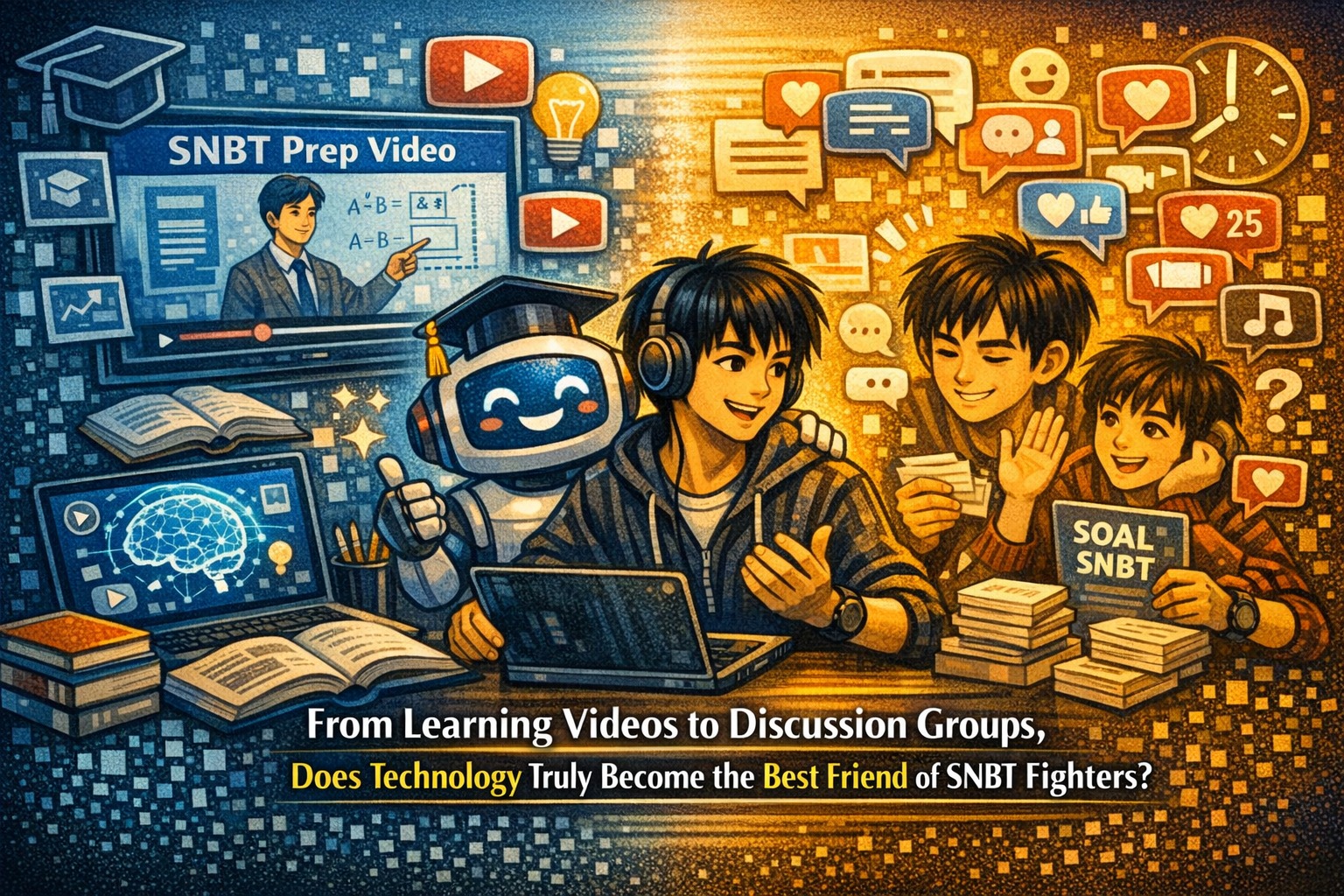
Preparing for SNBT (Seleksi Nasional Berdasarkan Tes) has become one of the biggest academic challenges for students who dream of entering a public university. The competition is intense, the material is broad, and the pressure often feels overwhelming. In the past, students mainly relied on school lessons, printed books, private tutoring, and face-to-face study groups. Today, the situation is completely different. Technology has transformed the way students prepare, making digital learning a major part of the journey.
From learning videos on YouTube to online tryout platforms, from Telegram discussion groups to educational communities on social media, students now have access to academic support anytime and anywhere. A difficult quantitative reasoning problem can be explained in minutes through a video tutorial. A confusing literacy question can be discussed instantly with hundreds of other students online. Technology seems to offer everything needed for better preparation.
Because of this convenience, many students see technology as their strongest academic partner. It saves time, increases access, and creates opportunities that were once difficult to imagine. However, the same technology that helps students learn can also create distraction, anxiety, and unhealthy comparison. Notifications interrupt focus, endless content creates information overload, and social media often becomes a trap of procrastination.
This raises an important question: from learning videos to discussion groups, does technology truly become the best friend of SNBT fighters, or does it sometimes become a silent obstacle hidden behind convenience?
The answer depends on how students use digital tools. Technology is not automatically helpful or harmful. It becomes powerful only when guided by discipline, focus, and purpose.
Success in SNBT is not determined by how many applications students install, but by how wisely they turn technology into real progress.
THE DIGITAL ERA OF SNBT PREPARATION
The digital era has completely changed the landscape of exam preparation. Students no longer depend only on physical classrooms and textbooks. Learning has expanded into online platforms that provide flexible and affordable academic support.
This transformation is especially important for SNBT because the exam requires broad reasoning skills, literacy understanding, and strong analytical thinking. Students need continuous practice and access to various explanations, not just memorization.
Technology provides exactly that. Through digital platforms, students can study independently, repeat lessons as often as needed, and access materials from high-quality educators across the country.
Learning becomes more personal because students can choose their own pace and strategy.
This flexibility creates stronger opportunities for students from different regions, including those who do not have access to major tutoring centers.
Education becomes more equal when knowledge is no longer limited by geography.
WHY LEARNING VIDEOS FEEL SO EFFECTIVE
Learning videos have become one of the most popular tools for SNBT preparation.
Students often prefer videos because they are easier to understand than long written explanations. Visual examples, voice explanations, and step-by-step problem solving make difficult concepts feel less intimidating.
For subjects like mathematics, logic, and quantitative reasoning, video explanations help students see the thinking process clearly. Instead of only reading formulas, they can understand how and why a solution works.
Videos also allow repetition without pressure. Students can pause, replay, and review difficult parts without feeling embarrassed.
This creates comfort and flexibility that traditional classrooms sometimes cannot provide.
However, students must remember that watching is not the same as mastering. Videos should become the beginning of understanding, not the end of learning.
Real progress still requires active practice.
THE POWER OF ONLINE DISCUSSION GROUPS
Discussion groups on platforms like Telegram, WhatsApp, and Discord have become important spaces for SNBT fighters.
These groups allow students to ask questions, share resources, discuss difficult problems, and support each other emotionally during stressful preparation periods.
Sometimes students understand explanations better from peers than from formal teaching because the language feels more relatable.
Discussion groups also reduce the feeling of isolation. Preparing for a competitive exam can feel lonely, especially when pressure grows closer to exam day. Knowing that others face the same struggle creates motivation and emotional strength.
Academic communities can turn preparation into a shared journey instead of a private burden.
Still, not all discussion groups are productive. Some become filled with repeated questions, distractions, or unhealthy comparison.
The quality of the group matters more than the size.
ONLINE TRYOUTS AS A REALITY CHECK
One of the strongest digital tools for SNBT preparation is the online tryout.
Tryouts simulate real exam conditions with time limits, score reports, and ranking systems. They help students measure readiness in a practical way.
Instead of studying blindly, students can identify which sections need improvement and which strategies are already effective.
Online tryouts also train exam mentality. Students learn how to manage time, stay calm under pressure, and recover from difficult questions without panic.
This psychological preparation is often as important as academic knowledge.
Many students make tryouts part of their weekly routine because they provide visible progress.
However, scores should be treated as feedback, not final identity. A low score is information for growth, not proof of failure.
HOW TECHNOLOGY CREATES EQUAL LEARNING OPPORTUNITIES
One of the most powerful benefits of technology is educational accessibility.
Students from remote areas often face limited access to high-quality tutoring centers or experienced teachers. Digital platforms reduce this gap significantly.
A student living far from major cities can now learn from the same educators as students in the best academic centers.
This creates fairer opportunities in competitive exams like SNBT.
Free educational content also helps students from different economic backgrounds. They can access valuable learning materials without depending entirely on expensive private classes.
Technology therefore becomes not only a study tool, but also a bridge for academic equality.
Opportunity becomes wider when learning is no longer restricted by location or cost.
THE DISTRACTION HIDDEN INSIDE THE SAME SCREEN
The biggest challenge of digital learning is simple: the same screen used for studying is also full of distraction.
Students open YouTube for educational content but end up watching entertainment videos. They check one academic message and continue scrolling social media for an hour.
This constant switching weakens concentration and destroys deep focus.
The brain needs uninterrupted time to process difficult reasoning tasks. Notifications and digital interruptions break that process repeatedly.
Many students believe they are multitasking successfully, but divided attention usually creates shallow learning.
Technology becomes dangerous when entertainment quietly takes control of academic time.
Focus is not lost in one big moment. It disappears through many small distractions.
INFORMATION OVERLOAD AND MENTAL FATIGUE
Unlimited access to information can create unexpected pressure.
Students often save too many PDF files, follow too many educational accounts, and join multiple discussion groups at once. Instead of clarity, they feel overwhelmed.
They spend more time choosing what to study than actually studying.
This creates information overload, where the brain becomes tired from too many decisions and too much input.
Students may feel busy every day but still unsure whether they are making real progress.
Mental fatigue grows when learning becomes endless consumption without clear direction.
Sometimes fewer resources with stronger focus are far more effective than unlimited materials without structure.
THE SOCIAL MEDIA COMPARISON TRAP
Social media can inspire motivation, but it can also create silent emotional damage.
Students often see others posting high tryout scores, acceptance announcements, or highly organized study routines. While some find this encouraging, others feel pressure and self-doubt.
They begin comparing their private struggles to someone else’s public success.
This unhealthy comparison increases anxiety and reduces confidence. Students may feel behind even when they are progressing normally.
SNBT preparation becomes emotionally heavier when self-worth depends on online comparison.
Students must remember that social media usually shows highlights, not the full journey.
Progress should be measured against personal growth, not someone else’s timeline.
ACTIVE LEARNING VS PASSIVE CONSUMPTION
Technology makes passive learning extremely easy.
Watching videos, saving notes, and reading study threads can feel productive, but they do not automatically create strong understanding.
SNBT requires active engagement. Students must solve questions independently, review mistakes carefully, and explain concepts in their own words.
Passive learning creates familiarity. Active learning creates mastery.
Many students mistake exposure for competence. They recognize concepts but cannot apply them under exam pressure.
Technology should support action, not replace it.
The strongest students are not always the ones who consume the most content, but the ones who interact with learning most honestly.
BUILDING SELF-DISCIPLINE IN A DIGITAL WORLD
Technology provides tools, but discipline determines results.
Students often search for the best application or the perfect strategy, but no system works without consistency.
Self-discipline means choosing difficult revision over easy distraction. It means studying even when motivation feels low and progress feels slow.
This does not require perfection. Every student experiences procrastination and distraction. The important part is returning quickly to productive habits.
Discipline also means realistic planning. Extreme study schedules often fail because they are emotionally unsustainable.
Balanced routines create stronger long-term performance.
Success in SNBT usually comes from repeated ordinary effort, not dramatic last-minute study sessions.
THE ROLE OF PARENTS IN DIGITAL PREPARATION
Parents often see screen time as a problem, but not all screen time is the same.
Students preparing for SNBT may spend hours on digital learning that looks similar to entertainment from the outside.
Parents who understand this difference can provide better support.
Instead of focusing only on restrictions, they can help students create healthy routines, balanced schedules, and emotional stability.
Supportive communication is more effective than constant suspicion.
Students perform better when they feel trusted and guided rather than judged.
Technology becomes safer when the home environment supports responsibility.
HOW TEACHERS SHAPE DIGITAL STUDY HABITS
Teachers remain important even in a highly digital learning environment.
Students often need guidance to choose reliable platforms, trusted explanations, and realistic study strategies. Without direction, unlimited online content can become confusing.
Teachers can help students focus on quality rather than quantity.
They also shape how students define success. When teaching emphasizes understanding and reflection, students become less dependent on memorization and shortcuts.
Digital tools work best when human guidance gives them purpose.
Technology should support education, not replace mentorship.
BALANCING MOTIVATION AND MENTAL HEALTH
SNBT preparation is not only an academic challenge but also an emotional one.
Students face pressure from competition, expectations, and personal dreams. Technology can either strengthen motivation or increase mental exhaustion depending on how it is used.
Study communities and motivational content can provide encouragement. But constant pressure to always be productive can create burnout.
Students need permission to rest without guilt.
Healthy preparation includes sleep, recovery, and emotional balance.
Burnout does not improve scores. Sustainable habits do.
Mental health is not separate from academic success. It is part of it.
USING TECHNOLOGY WITH PURPOSE
The real issue is not whether students use technology, but whether they use it intentionally.
Opening a learning app without a clear goal often leads to distraction. Entering a discussion group without focus often leads to confusion.
Students need simple questions: Why am I using this platform? What result do I want from this session? Is this helping my preparation or only filling time?
Awareness creates stronger digital habits.
Technology becomes helpful when every action has direction.
Purpose protects focus.
DOES TECHNOLOGY TRULY BECOME THE BEST FRIEND OF SNBT FIGHTERS?
The answer is yes—but only under the right conditions.
Technology can absolutely become the best friend of SNBT fighters. It provides access, flexibility, academic support, and opportunities that previous generations could only imagine.
But it can also become a silent enemy when students lose control of their attention.
Learning videos, discussion groups, and online tryouts are powerful tools, but they are not magic solutions. Without discipline, reflection, and emotional balance, digital convenience can turn into digital dependence.
The strongest students are not those with the most applications, but those with the clearest purpose.
Technology should be a partner, not a master.
In the end, success in SNBT is not decided by the screen itself, but by the student behind it.
That is where real victory begins.
Tentang Penulis
Gusti Ayu Tita P
Penulis — Universitas STEKOM
Penulis aktif yang berfokus pada isu-isu akademik, teknologi pendidikan, dan pengembangan sumber daya manusia di lingkungan kampus.