
How Can Students Balance between Pursuing a Degree and Expanding Their Knowledge?
Gusti Ayu Tita P
19 Februari 2026
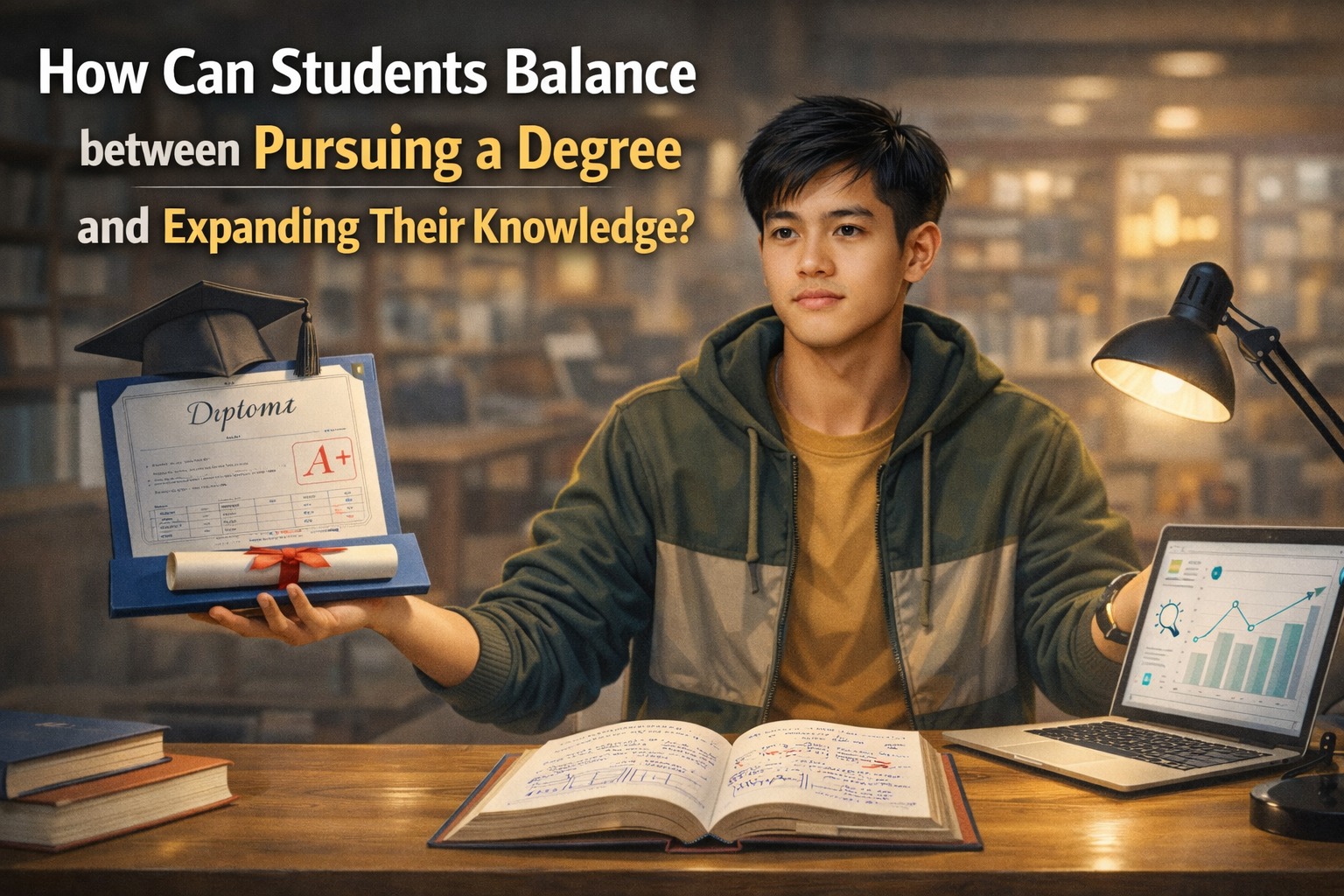
In today’s competitive academic environment, students often face a challenging dilemma: should they focus primarily on earning a degree, or should they dedicate more time to expanding their knowledge beyond the classroom? While obtaining a diploma remains an important milestone, long-term success increasingly depends on deep understanding, critical thinking, and continuous learning.
This raises an essential question: How can students balance between pursuing a degree and expanding their knowledge?
Achieving this balance is not only possible but necessary for sustainable academic and professional growth.
UNDERSTANDING THE DIFFERENCE BETWEEN A DEGREE AND KNOWLEDGE
A degree is a formal qualification that proves a student has completed a structured educational program. It often serves as a gateway to employment opportunities and career advancement. Employers frequently use degrees as an initial screening requirement.
Expanding knowledge, however, goes beyond fulfilling curriculum requirements. It involves curiosity, independent research, skill development, and applying concepts to real-world situations.
While a degree represents academic completion, knowledge represents intellectual depth and adaptability. Students who understand this distinction are better prepared to balance both priorities effectively.
SETTING CLEAR ACADEMIC AND PERSONAL GOALS
The first step in achieving balance is goal-setting.
Students should define both short-term and long-term objectives, such as:
- Maintaining a target GPA
- Developing specific professional skills
- Gaining practical experience
- Exploring personal interests
Clear goals help students allocate time efficiently. Instead of viewing coursework as a burden, they can align academic tasks with personal growth objectives.
When students connect their studies to future aspirations, the pursuit of a degree becomes meaningful rather than mechanical.
ENGAGING ACTIVELY IN THE LEARNING PROCESS
Balancing a degree and knowledge expansion requires active engagement.
Rather than studying only for exams, students can:
- Participate in class discussions
- Ask critical questions
- Seek clarification beyond lecture notes
- Apply concepts in practical projects
Active learning enhances comprehension and retention. It transforms assignments from routine tasks into opportunities for intellectual development.
By treating coursework as a foundation for deeper exploration, students can strengthen both their academic performance and their understanding.
EXPLORING LEARNING BEYOND THE CURRICULUM
Formal education provides structure, but meaningful knowledge often grows through additional experiences.
Students can expand their knowledge by:
- Reading books and research articles outside required materials
- Taking online courses
- Attending seminars or workshops
- Participating in internships
- Joining student organizations
These activities complement academic studies and build valuable soft and hard skills. They also expose students to real-world challenges, helping them connect theory with practice.
MANAGING TIME EFFECTIVELY
Time management plays a crucial role in maintaining balance. Without proper planning, students may become overwhelmed by academic demands and neglect personal development.
Effective strategies include:
- Creating weekly study schedules
- Prioritizing important tasks
- Avoiding procrastination
- Allocating time for independent learning
By organizing their time wisely, students can maintain strong academic performance while still pursuing broader knowledge.
EMBRACING LIFELONG LEARNING
The modern world evolves rapidly. Technologies change, industries transform, and new skills emerge continuously. Students who adopt a lifelong learning mindset understand that a degree is only the beginning of their educational journey.
Balancing degree requirements with knowledge expansion prepares students for long-term adaptability. It ensures they are not only qualified but also competent and innovative in their chosen fields.
CONCLUSION
Balancing between pursuing a degree and expanding knowledge is not about choosing one over the other. Instead, it requires intentional planning, active engagement, and continuous curiosity. A degree provides formal recognition and access to career opportunities, while expanded knowledge builds critical thinking, adaptability, and long-term success.
Students who successfully integrate both goals gain more than a diploma—they develop the skills, confidence, and intellectual depth needed to thrive in an ever-changing world.
Tentang Penulis
Gusti Ayu Tita P
Penulis — Universitas STEKOM
Penulis aktif yang berfokus pada isu-isu akademik, teknologi pendidikan, dan pengembangan sumber daya manusia di lingkungan kampus.



