How to Apply for a Land Ownership Certificate Easily
Gusti Ayu Tita P
28 Agustus 2026
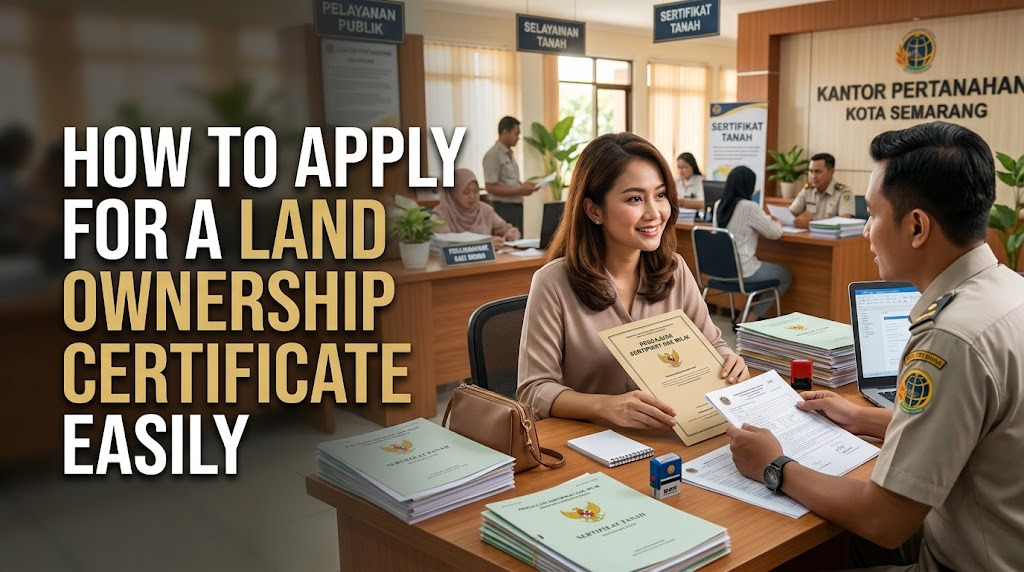
A Land Ownership Certificate is an important document for proving registered rights over a particular plot of land. For property owners, having proper land documentation can provide greater legal certainty and make future transactions easier. However, many people are still unsure about the process of applying for a land ownership certificate and the documents that need to be prepared.
The application process generally involves document preparation, submission to the appropriate land administration office, land measurement, legal and administrative verification, and issuance of the certificate. The exact requirements can vary depending on the land's history and the type of registration being requested. Understanding the basic steps can make the process easier to follow.
UNDERSTANDING THE LAND OWNERSHIP CERTIFICATE
A Land Ownership Certificate is evidence of registered land rights. In Indonesia, one important form is the Sertifikat Hak Milik (SHM), which records Hak Milik over a specific plot of land. The certificate contains information that helps identify the rights holder and the registered land.
Having a certificate does not mean that the owner can use the land without restrictions. Land use must still comply with applicable regulations, including spatial planning and other legal requirements. Therefore, applicants should understand both their rights and responsibilities before and after obtaining the certificate.
PREPARING THE REQUIRED DOCUMENTS
The first step in the land certificate application process is preparing the required documents. These may include personal identification, proof of acquisition or possession of the land, tax-related documents, and other supporting documents depending on the circumstances. The requirements can differ between newly registered land and land that already has a registered history.
For example, land obtained through a purchase may require documents relating to the transaction, while inherited land may require documents proving the inheritance. The origin of the land is an important factor in determining the required documents. Applicants should therefore confirm the latest requirements with the relevant Land Office before submitting an application.
SUBMITTING THE APPLICATION
Once the documents are ready, the applicant can submit a land ownership certificate application through the relevant Land Office or an official service channel available for the particular application. Officers will review the submitted documents to determine whether the administrative requirements have been met.
If the application is incomplete, the applicant may be asked to provide additional documents or correct certain information. Applicants should keep receipts and submission records throughout the process. These records can be useful for tracking the application and responding to requests from the land administration office.
LAND SURVEY AND MEASUREMENT
One important stage in the process is land measurement and mapping. The measurement helps establish the location, boundaries, and area of the land for registration purposes. The owner should provide accurate information about the boundaries and identify the land correctly when the measurement is conducted.
Clear boundaries are particularly important when neighboring plots are located close to one another. Disagreements about boundaries can create complications during registration. Applicants should therefore make sure the boundaries shown to the surveyor accurately reflect the land being registered.
LEGAL AND ADMINISTRATIVE VERIFICATION
After measurement, the application goes through administrative and legal verification. The relevant authority reviews the physical and legal information concerning the land and examines the documents supporting the applicant's claim. This process helps determine whether the land can be registered under the requested rights.
If discrepancies are discovered, the applicant may need to provide clarification or additional documentation. Accurate information and consistent documents are essential for avoiding unnecessary delays. Applicants should respond promptly to any official request for additional information.
PAYING THE REQUIRED FEES
Applying for a land ownership certificate may involve official service fees, including charges related to measurement, registration, or other services required for the particular application. The amount is not necessarily the same for every property because factors such as land area and the type of service can affect the calculation.
Applicants should obtain information about official fees and payment procedures directly from authorized government channels. They should also distinguish official land service fees from taxes or professional service fees that may arise in certain transactions. Keeping payment receipts is important for maintaining a complete administrative record.
RECEIVING AND CHECKING THE CERTIFICATE
After the required procedures have been completed, the land ownership certificate can be issued according to the applicable process. When receiving the certificate, the owner should carefully check the information recorded in it. Important details include the rights holder's name, land area, location, certificate number, and other relevant land information.
If an error is discovered, the owner should immediately contact the relevant Land Office to ask about the correction procedure. Once the information is confirmed to be correct, the original certificate should be stored securely. Making a backup copy or digital record can also be useful in case the original document is lost or damaged.
KESIMPULAN
The land ownership certificate application process generally involves preparing documents, submitting an application, conducting land measurement, completing legal and administrative verification, paying official fees, and receiving the certificate. The exact requirements can vary depending on the land's origin and legal status.
To make the process easier, applicants should prepare complete documents, provide accurate land boundary information, use official ATR/BPN services, and keep all receipts and submission records. Avoid unofficial intermediaries who promise instant certificates without following the required procedures. Proper preparation can make the application process safer, clearer, and more organized.
Tentang Penulis
Gusti Ayu Tita P
Penulis — Universitas STEKOM
Penulis aktif yang berfokus pada isu-isu akademik, teknologi pendidikan, dan pengembangan sumber daya manusia di lingkungan kampus.