How to Evaluate Investment Feasibility for Business Growth
Gusti Ayu Tita P
7 Juni 2026
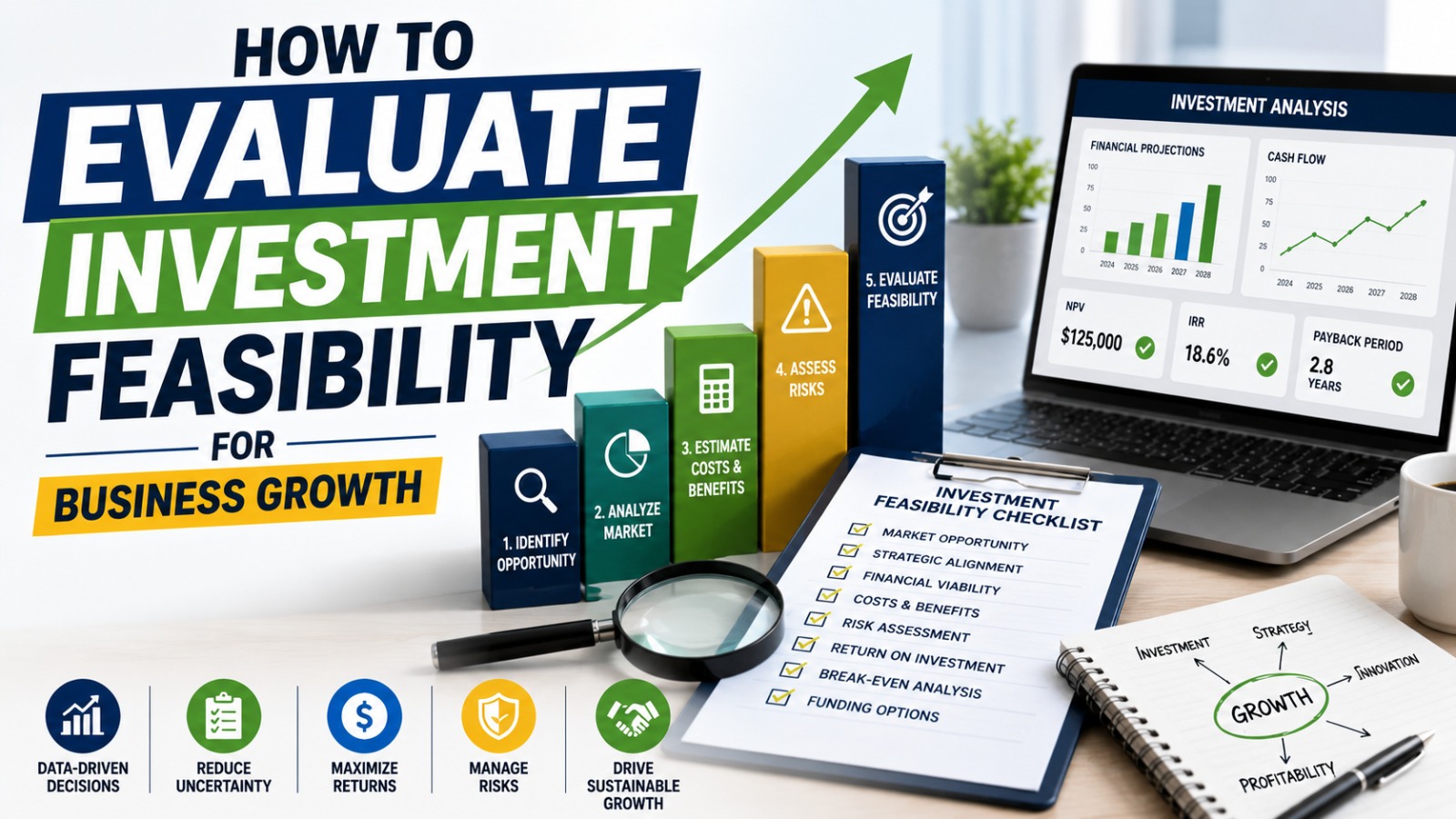
Business growth often requires strategic investments. Whether expanding operations, launching new products, purchasing equipment, or entering new markets, every investment decision carries both opportunities and risks. Without proper evaluation, businesses may face financial losses, operational problems, or limited returns.
Evaluating investment feasibility helps business owners determine whether a project is financially viable and aligned with long-term goals. A careful analysis can reduce risk, improve decision-making, and increase the chances of sustainable business growth.
UNDERSTANDING INVESTMENT FEASIBILITY
Investment feasibility refers to the process of analyzing whether a business investment is worth pursuing. The evaluation focuses on financial performance, operational impact, market potential, and overall profitability.
A feasibility study allows businesses to answer important questions such as:
- Will the investment generate sufficient profit?
- How long will it take to recover the investment?
- What risks are involved?
- Does the investment support long-term business objectives?
By conducting a detailed evaluation, companies can avoid costly mistakes and allocate resources more effectively.
ANALYZE MARKET DEMAND
One of the first steps in evaluating investment feasibility is understanding market demand. Even a well-funded investment can fail if customer demand is weak.
Businesses should analyze:
- Target customer needs
- Industry trends
- Competitor performance
- Market size
- Consumer purchasing behavior
Strong market demand increases the likelihood that the investment will generate stable revenue and long-term growth.
CALCULATE INITIAL INVESTMENT COSTS
Businesses must clearly identify all costs associated with the investment before making a decision.
Common investment costs include:
- Equipment purchases
- Technology implementation
- Employee training
- Marketing expenses
- Operational setup costs
- Maintenance and upgrades
Accurate cost estimation prevents unexpected financial pressure in the future.
ESTIMATE PROJECTED REVENUE
Projected revenue helps determine whether the investment can produce acceptable financial returns.
Businesses should estimate:
- Expected sales growth
- Pricing strategies
- Customer acquisition rates
- Recurring revenue opportunities
Revenue projections should remain realistic and based on reliable market research rather than overly optimistic assumptions.
EVALUATE CASH FLOW IMPACT
Cash flow analysis is essential when evaluating investment feasibility. Some investments may generate profit eventually but create short-term cash shortages that disrupt operations.
Businesses should examine:
- Monthly operating expenses
- Expected cash inflows
- Financing obligations
- Emergency reserve requirements
Positive and stable cash flow improves investment sustainability and reduces financial risk.
USE RETURN ON INVESTMENT (ROI) ANALYSIS
Return on Investment (ROI) measures how much profit an investment generates relative to its cost.
The formula for ROI is:
ROI=Net ProfitInvestment Cost×100%ROI = \frac{\text{Net Profit}}{\text{Investment Cost}} \times 100\%ROI=Investment CostNet Profit×100%
A higher ROI generally indicates a more attractive investment opportunity. Comparing ROI across multiple projects helps businesses prioritize the most profitable options.
CALCULATE PAYBACK PERIOD
The payback period measures how long it takes for an investment to recover its initial cost.
Shorter payback periods are often preferred because they reduce financial risk and improve liquidity.
The formula is:
Payback Period=Initial InvestmentAnnual Cash Inflow\text{Payback Period} = \frac{\text{Initial Investment}}{\text{Annual Cash Inflow}}Payback Period=Annual Cash InflowInitial Investment
Businesses should compare the payback period with their financial goals and risk tolerance.
ASSESS BUSINESS RISKS
Every investment involves uncertainty. Identifying potential risks early helps businesses prepare mitigation strategies.
Common investment risks include:
- Market competition
- Economic downturns
- Technology changes
- Supply chain disruptions
- Regulatory changes
- Operational inefficiencies
Risk assessment allows businesses to develop backup plans and improve decision-making confidence.
CONSIDER OPERATIONAL CAPACITY
An investment may appear financially attractive but still fail if the business lacks operational readiness.
Companies should evaluate whether they have:
- Skilled employees
- Adequate infrastructure
- Management capability
- Production capacity
- Technical expertise
Operational preparedness plays a critical role in investment success.
ANALYZE LONG-TERM STRATEGIC VALUE
Some investments may not produce immediate profits but provide long-term strategic benefits.
Examples include:
- Brand expansion
- Technology upgrades
- Market diversification
- Customer loyalty improvement
Businesses should evaluate whether the investment aligns with long-term growth objectives and competitive positioning.
COMPARE MULTIPLE INVESTMENT OPTIONS
Business owners should avoid making decisions based on a single opportunity. Comparing multiple investment alternatives helps identify the best balance between profitability and risk.
Comparison factors include:
- Estimated ROI
- Cash flow impact
- Market potential
- Risk level
- Operational requirements
A structured comparison process improves investment quality and financial efficiency.
SEEK PROFESSIONAL FINANCIAL ADVICE
Complex investment decisions may require guidance from financial experts, accountants, or business consultants.
Professional advisors can help businesses:
- Validate financial assumptions
- Analyze risks
- Improve forecasting accuracy
- Identify hidden costs
External perspectives often strengthen investment evaluations and reduce decision-making bias.
CONCLUSION
Evaluating investment feasibility is essential for sustainable business growth. Businesses that carefully analyze market demand, financial performance, operational readiness, and potential risks are more likely to make successful investment decisions.
Using tools such as ROI analysis, cash flow projections, and payback period calculations helps companies measure profitability and reduce uncertainty. With proper planning and evaluation, businesses can invest confidently while supporting long-term financial stability and growth.
Tentang Penulis
Gusti Ayu Tita P
Penulis — Universitas STEKOM
Penulis aktif yang berfokus pada isu-isu akademik, teknologi pendidikan, dan pengembangan sumber daya manusia di lingkungan kampus.