How to Tell Whether a Land Ownership Certificate Is Genuine or Fake?
Gusti Ayu Tita P
28 Agustus 2026
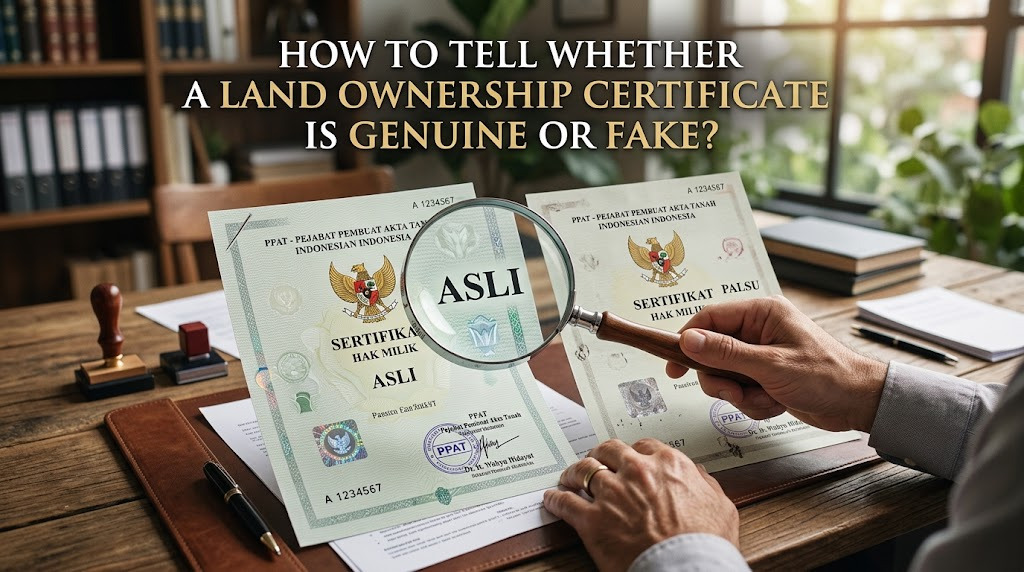
A Land Ownership Certificate is one of the most important documents in a land transaction. In Indonesia, a certificate such as a Sertifikat Hak Milik (SHM) contains information about registered land rights and the rights holder. Because property transactions involve significant financial value, buyers should verify the certificate before making a payment or signing an agreement.
Determining whether a certificate is genuine should not be based only on its paper, printing, or physical appearance. A document that looks convincing can still contain inaccurate or fraudulent information. The safest approach is to compare the document with official land records through authorized procedures.
UNDERSTAND WHAT A LAND CERTIFICATE PROVES
A Land Ownership Certificate serves as evidence of registered rights over a particular plot of land. It contains important information that identifies the land and its registered rights holder. However, the certificate should be considered together with other relevant documents and official land records.
Buyers should understand that a certificate is not simply a piece of paper proving that someone can sell the property. The identity of the registered rights holder and the legal status of the land are important factors. Therefore, proper verification should take place before any major transaction.
CHECK THE CERTIFICATE INFORMATION
The first step is to examine the information recorded on the certificate. Pay attention to the name of the rights holder, certificate number, land area, location, and other relevant data. Compare these details with the seller's identity documents and the actual property.
Look carefully for information that does not match. Differences in names, land area, or location should be investigated rather than ignored. A minor administrative difference may have an explanation, but buyers should obtain clarification through the proper channel before proceeding.
DO NOT RELY ONLY ON THE PHYSICAL APPEARANCE
Some people try to identify a fake land certificate by examining the paper, stamp, printing, or other physical characteristics. Although physical examination can reveal obvious irregularities, it is not sufficient to establish authenticity. Modern document reproduction techniques can make fraudulent documents appear convincing.
The more important question is whether the information corresponds with official land registration records. Therefore, a document that looks authentic should still be verified. Conversely, an old or damaged document should not automatically be considered fake without official examination.
VERIFY THE CERTIFICATE THROUGH ATR/BPN
The safest way to check a certificate is through official land administration channels, including the relevant ATR/BPN Land Office. Depending on the service available, applicants may also be able to use official digital land services for certain information or processes.
When requesting verification, provide the required documents and identification. Official records are more reliable than informal opinions about whether a certificate is genuine. If the certificate cannot be verified through the available digital service, ask the relevant Land Office about the appropriate offline procedure.
CHECK THE SELLER'S IDENTITY
Certificate verification should also include checking the identity of the seller. The seller's name should correspond with the registered rights holder, unless the seller is legally authorized to act for that person. If someone else is representing the owner, appropriate documentation of authority should be requested.
Extra caution is needed when the land comes from inheritance, joint ownership, or another transfer arrangement. More than one person may have legal interests in the property. Buyers should make sure that the person signing the transaction has the appropriate authority.
CHECK THE ACTUAL PROPERTY
A genuine certificate should relate to the actual land being offered for sale. Visit the property and compare its location, approximate area, boundaries, and other identifying features with the information contained in the documents.
If the physical property appears substantially different from the certificate, stop and investigate. A genuine certificate can still be connected to the wrong property if the transaction is improperly represented. This is why both document verification and physical inspection are important.
USE A PPAT FOR PROPERTY TRANSACTIONS
When purchasing registered land, involving a Pejabat Pembuat Akta Tanah (PPAT) can help ensure that the transfer is carried out through the appropriate legal and administrative process. A PPAT can assist in examining the documents required for the transaction and preparing the relevant deed.
However, buyers should remain actively involved. Read the documents before signing and ask questions about anything that is unclear. Professional assistance can reduce risk, but buyers should still understand the basic details of the property they are purchasing.
WARNING SIGNS OF A POSSIBLE FRAUD
Several situations should make buyers more cautious, such as a seller refusing official verification, providing inconsistent documents, demanding immediate payment, or offering a property at an unusually low price without a clear explanation. None of these circumstances alone automatically proves that a certificate is fake, but they justify further investigation.
Be particularly careful if the seller says that verification is unnecessary. A legitimate seller should generally be willing to allow reasonable legal and administrative checks. If important questions remain unanswered, delaying the transaction is safer than proceeding under pressure.
CONCLUSION
Determining whether a Land Ownership Certificate is genuine or fake cannot be done reliably by looking only at its physical appearance. Buyers should compare the certificate information with the seller's identity, the actual property, supporting documents, and official land registration records.
For greater protection, use official ATR/BPN verification procedures and consider assistance from a PPAT when completing a property transaction. Do not rush into payment or signing an agreement until the certificate and ownership status have been properly checked.
Tentang Penulis
Gusti Ayu Tita P
Penulis — Universitas STEKOM
Penulis aktif yang berfokus pada isu-isu akademik, teknologi pendidikan, dan pengembangan sumber daya manusia di lingkungan kampus.