In the Middle of Competition and Expectations, Does SNBT Build a Strong Mentality or Give Birth to Anxiety That Is Difficult to Explain?
Gusti Ayu Tita P
7 Juni 2026
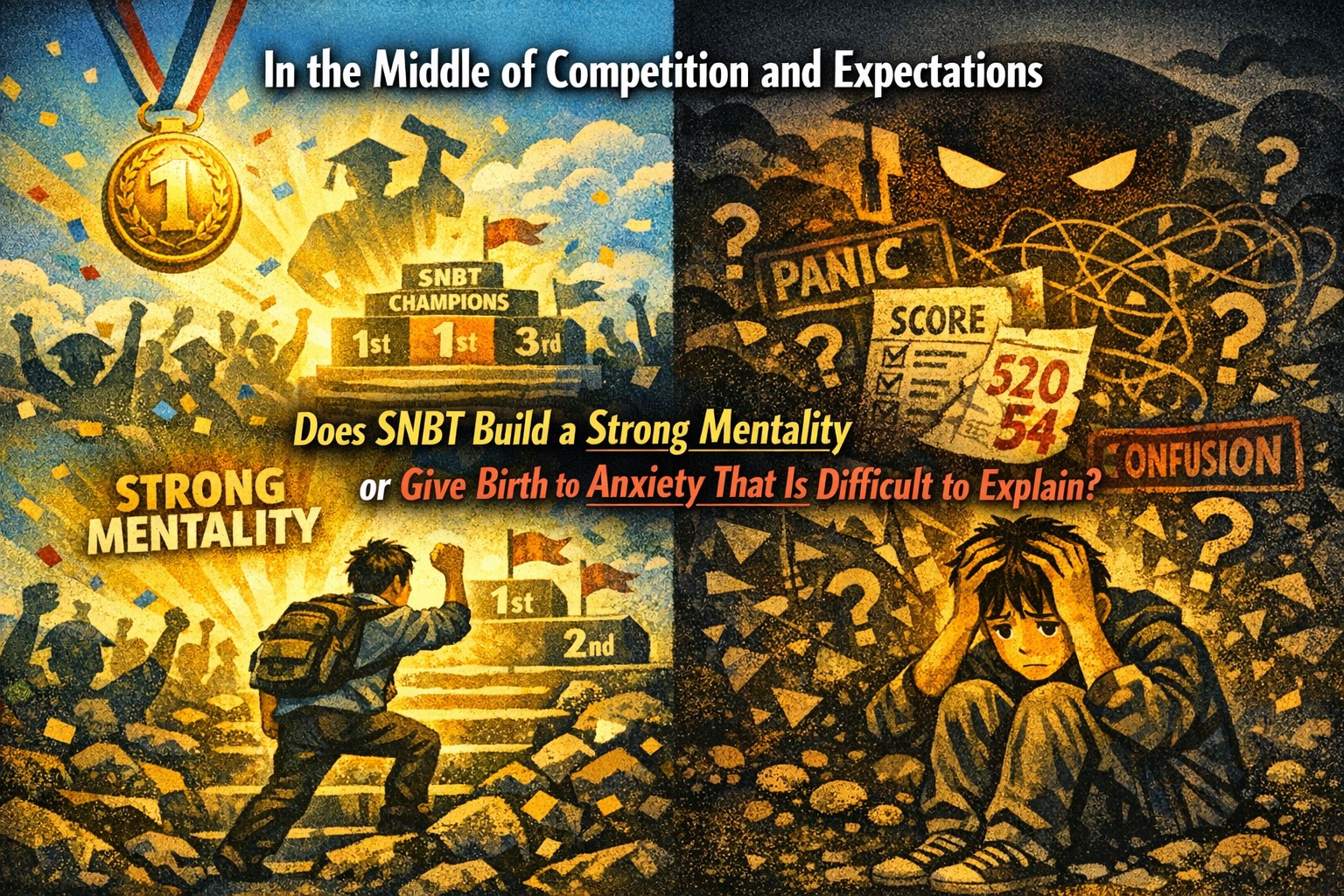
For many students in Indonesia, the journey toward higher education is not only about choosing a university or preparing for lectures. It is also about facing one of the most emotionally intense academic challenges: SNBT (Seleksi Nasional Berdasarkan Tes). This national entrance examination has become a major pathway for students who want to enter public universities, and because of its competitive nature, it often carries expectations far beyond academics.
Students prepare for SNBT for months, sometimes even years. They attend additional tutoring classes, sacrifice free time, reduce social activities, and organize their lives around study schedules and tryout results. Families invest financially and emotionally, while teachers encourage students to reach their best performance. Society also places strong value on students who successfully enter prestigious campuses, making the exam feel even more significant.
Behind all this preparation lies an important question: does SNBT help students build a stronger mentality through discipline and perseverance, or does it quietly create anxiety that is difficult to explain and even harder to manage? The answer is complex because both realities often happen at the same time.
For some students, SNBT becomes a powerful source of motivation. It teaches consistency, responsibility, and resilience. For others, however, it becomes a source of invisible emotional pressure. Fear of failure, constant comparison, and the burden of expectations slowly affect confidence and mental health.
Education should challenge students, but it should not make them lose themselves in the process. That is why understanding the emotional impact of SNBT is just as important as understanding its academic purpose.
SNBT AS A TRAINING GROUND FOR STRONG MENTALITY
One of the positive sides of SNBT is its ability to teach students discipline and mental endurance. Unlike ordinary school tests, SNBT requires long-term commitment. Students must prepare consistently, not only for days but for months with patience and focus.
This process naturally builds discipline. Students learn how to manage time, balance school responsibilities, and prioritize long-term goals over temporary comfort. They become more aware that success requires consistency rather than sudden effort.
SNBT also teaches students how to handle setbacks. Low tryout scores, difficult practice questions, and failed expectations are common experiences. Learning to recover from these moments helps students develop resilience and emotional maturity.
The competition itself can strengthen character when approached healthily. Students who compete fairly while supporting one another often develop confidence without losing empathy. They understand that growth is not only about winning but also about improving themselves.
In this way, SNBT can function as more than an entrance exam. It becomes preparation for adulthood, where challenges, uncertainty, and persistence are part of everyday life.
WHEN EXPECTATIONS BECOME A HEAVY EMOTIONAL BURDEN
The problem begins when expectations surrounding SNBT become too heavy. Students are not only carrying their own dreams but also the hopes of parents, teachers, relatives, and even their communities. This emotional burden can turn healthy ambition into constant pressure.
Parents often want the best for their children, but repeated demands to enter a specific university or achieve a certain score can create fear rather than motivation. Students may begin to believe that failure means disappointing everyone around them.
Teachers can also unintentionally increase stress by focusing too much on rankings, passing grades, and competition statistics. While these things are important, too much emphasis on results can make students feel that they are valuable only when they succeed.
Social media adds another layer of pressure. Students see friends sharing high tryout scores, acceptance stories, and academic achievements. Even when they are progressing well, they may feel left behind simply because someone else appears to be doing better.
When expectations become too loud, students stop studying because they love learning. They study because they are afraid of failing. This emotional shift can slowly damage confidence and mental balance.
THE INVISIBLE ANXIETY THAT GROWS QUIETLY
Anxiety related to SNBT often grows silently. It is not always dramatic or easy to notice. Sometimes it appears as difficulty sleeping, constant overthinking, or the feeling that no amount of preparation is ever enough.
Students may replay mistakes in their minds, worry about future outcomes, and imagine disappointing their families. Even small academic setbacks can feel like major personal failures because so much emotional meaning is attached to the exam.
This anxiety can affect daily life. Students may lose focus in class, become emotionally sensitive, or feel exhausted even after simple activities. Rest no longer feels relaxing because they feel guilty whenever they are not studying.
Burnout becomes a serious risk. Students who study without balance may continue physically but feel mentally empty. They lose motivation, confidence, and sometimes even the original reason they wanted to enter university.
The most difficult part is that many students hide these feelings. They smile, attend school, and continue studying as usual while silently struggling inside. Because academic stress is often normalized, their emotional pain may go unnoticed.
WHEN SCORES START DEFINING PERSONAL VALUE
A dangerous consequence of intense competition is the belief that scores define self-worth. Many students begin to see high scores as proof of intelligence and low scores as proof of failure. Their confidence becomes directly connected to numbers.
This creates unstable self-esteem. A good tryout result may bring temporary happiness, but one disappointing score can destroy confidence for days or even weeks. Students stop seeing mistakes as opportunities to learn and start seeing them as evidence that they are not good enough.
Comparison becomes stronger in this environment. Instead of focusing on personal progress, students constantly measure themselves against classmates and online achievements. They feel successful only when they are better than others.
This mindset is dangerous because it turns education into emotional survival. Students no longer ask how they can improve—they ask whether they deserve success at all.
When identity depends on academic performance alone, rejection becomes deeply painful. A university admission result feels like a judgment of personal worth rather than one step in a much larger life journey.
Education should help students grow in confidence, not reduce them to rankings and percentages.
THE ROLE OF FAMILY, TEACHERS, AND SUPPORT SYSTEMS
Students cannot face SNBT alone. The people around them play a major role in shaping whether the exam becomes a healthy challenge or a harmful emotional burden. Family, teachers, and peer support are essential.
Supportive parents create emotional safety by reminding students that love and respect are not based on university admission results. They encourage effort while also accepting the possibility of different outcomes.
Teachers can reduce anxiety by focusing on progress rather than perfection. Honest feedback is important, but students also need reassurance that mistakes are part of learning, not signs of permanent failure.
Schools should provide counseling services and safe spaces for students to talk about stress. Mental health should not be treated as something separate from education. It is part of academic success itself.
Friends also matter. Healthy friendships reduce loneliness during preparation. Encouragement from peers often helps students feel understood in ways adults sometimes cannot provide.
A strong support system does not remove competition, but it makes students feel they are not facing it alone.
REDEFINING SUCCESS BEYOND ONE EXAM
One of the biggest causes of anxiety is the belief that SNBT is the final definition of success. Many students think that failing to enter a dream university means losing their future. This belief gives one exam too much power.
In reality, success is much broader than one admission result. Public universities are valuable, but private campuses, vocational education, scholarships, entrepreneurship, and work experience also create meaningful futures.
Sometimes failure becomes redirection. A student may discover a better path through unexpected rejection. Personal growth often happens through situations that do not go according to plan.
Students need to understand that they are bigger than their scores. Character, discipline, resilience, creativity, and the ability to keep learning are qualities that shape long-term success far more than one exam result.
When success is defined only by rankings, anxiety becomes destructive. But when success is understood as continuous growth, students can pursue ambition without losing peace of mind.
Ultimately, SNBT should be a door of opportunity, not a prison of fear. It should help students become stronger, not convince them that they are never enough.
In the middle of competition and expectations, SNBT can indeed build a strong mentality—but only if students are supported by healthy perspectives and emotional balance. Without that support, it risks becoming the beginning of anxiety that is difficult to explain and even harder to heal.
Education should create courage, not permanent fear. Students deserve a system that challenges them while still protecting their confidence, dignity, and mental well-being.
Because in the end, true success is not only entering university—it is becoming someone who can continue growing without losing themselves along the way.
Tentang Penulis
Gusti Ayu Tita P
Penulis — Universitas STEKOM
Penulis aktif yang berfokus pada isu-isu akademik, teknologi pendidikan, dan pengembangan sumber daya manusia di lingkungan kampus.