Indonesia’s River Potential for Future Hydropower Development
Gusti Ayu Tita P
31 Agustus 2026
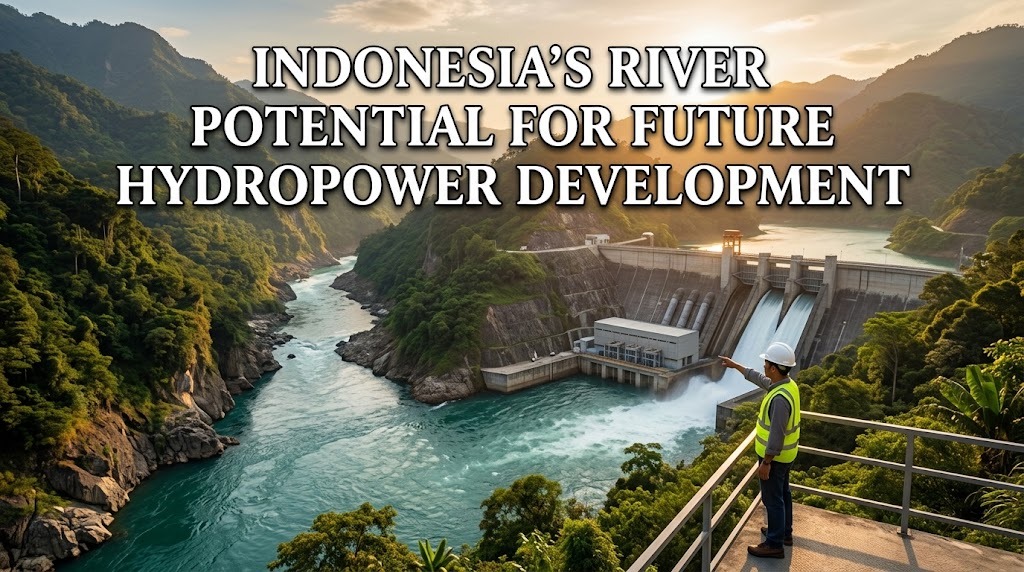
Indonesia has significant hydropower potential because of its extensive river systems, mountainous landscapes, high rainfall in many regions, and numerous watersheds. Rivers can provide energy through natural water flow and elevation differences, creating opportunities for hydropower development. The Indonesian Ministry of Energy and Mineral Resources has estimated the country's hydropower potential at around 95 GW, while installed hydropower capacity was about 6.7 GW when the figure was reported in 2023.
This large gap between potential and installed capacity shows that many opportunities remain to be explored. However, not every river can or should be developed into a hydropower facility. Water availability, environmental conditions, local communities, geology, infrastructure, and economic feasibility must all be considered before a project is built.
INDONESIA HAS LARGE HYDROPOWER RESOURCES
Indonesia's geography creates favorable conditions for hydropower. Mountainous areas can provide significant elevation differences, while rivers transport water from higher areas toward lower elevations. This combination creates the water flow and hydraulic head needed to generate electricity.
The country's hydropower potential is spread across different regions rather than being concentrated in one location. This creates opportunities to develop projects closer to areas with growing electricity demand. At the same time, many promising river locations are far from existing transmission networks, making infrastructure development an important part of future planning.
RIVERS TURN NATURAL FLOW INTO ELECTRICITY
A hydropower plant uses the energy of moving or falling water to rotate turbines. The turbine is connected to a generator that converts mechanical energy into electricity. After passing through the turbine, the water normally continues downstream through the river system.
The amount of electricity produced depends on factors such as water flow, hydraulic head, turbine efficiency, and operating conditions. Rivers with strong and relatively reliable flows can offer attractive opportunities. However, seasonal changes must also be studied because water levels can vary significantly between wet and dry periods.
MOUNTAINOUS AREAS OFFER STRONG POTENTIAL
Many Indonesian rivers begin in highland and mountainous regions before flowing toward lower areas. This creates differences in elevation that can be useful for hydropower development. Higher hydraulic head can increase the energy available from a given volume of water, depending on the project's design.
Mountainous locations can therefore be attractive for certain types of hydropower plants. However, construction in these areas can be technically challenging. Roads, tunnels, dams, transmission lines, and other infrastructure may require significant investment. Geological stability and natural hazards such as landslides must also be carefully assessed.
SUMATRA AND KALIMANTAN HAVE IMPORTANT OPPORTUNITIES
Several Indonesian regions have significant potential for renewable electricity development, including areas with large river systems. Sumatra and Kalimantan have extensive watersheds and large geographic areas that can support different types of hydropower projects where suitable conditions exist.
The national electricity plan also identifies different regions for renewable energy development. Under the RUPTL PLN 2025–2034, Indonesia plans to add 11.7 GW of hydropower capacity as part of a broader renewable energy expansion. The plan covers development across Sumatra, Java-Madura-Bali, Sulawesi, Kalimantan, and eastern Indonesian regions.
SMALL RIVERS CAN ALSO PROVIDE ENERGY
Hydropower development does not always require a massive dam. Small hydropower and microhydropower systems can use relatively modest river flows to generate electricity. These systems can be particularly useful in areas where connecting communities to large centralized grids is difficult.
Small projects may also require less infrastructure than very large developments, although their impacts and costs still need to be assessed carefully. They can support local electricity needs for households, agriculture, small industries, schools, and public facilities. For remote areas, local hydropower can become an important source of reliable renewable electricity when suitable water resources are available.
RIVER FLOW MUST REMAIN RELIABLE
One of the biggest considerations in hydropower planning is water availability throughout the year. A river may have strong flows during the rainy season but much lower flows during dry months. A plant designed without considering these seasonal differences may not produce electricity as expected.
Engineers therefore study long-term hydrological data before determining a project's design. Rainfall patterns, river discharge, seasonal changes, drought risks, and extreme rainfall events can all affect potential electricity production. Reliable hydrological information is essential for making realistic decisions about hydropower capacity.
CLIMATE CHANGE MAY ALTER RIVER POTENTIAL
Climate change can affect Indonesia's future hydropower resources. Changes in rainfall patterns, drought periods, extreme rainfall, and temperature can influence river discharge. A river that appears highly suitable based only on historical data may experience different conditions in the future.
Future hydropower projects therefore need to include climate resilience in their planning. Developers can use climate projections, improved hydrological forecasting, flexible reservoir management, and stronger infrastructure design. Protecting watersheds is also important because healthy forests and river basins can help maintain water resources and reduce erosion.
ENVIRONMENTAL PROTECTION IS ESSENTIAL
A river is more than a source of energy. It supports fish, plants, wildlife, agriculture, communities, and downstream ecosystems. Building dams or diverting water can change natural flow patterns and affect these interconnected systems.
Responsible hydropower development must therefore consider environmental flows, sediment movement, aquatic habitats, and biodiversity. Environmental impact assessments should identify potential risks before construction begins. Protecting river ecosystems is essential if hydropower development is expected to remain sustainable over the long term.
COMMUNITIES MUST BENEFIT FROM DEVELOPMENT
River-based projects can affect people living near proposed development sites. Land use, access to water, livelihoods, transportation, and local economic activities may be influenced by construction and operation. These concerns require meaningful community consultation and social impact assessment.
Hydropower can also create positive economic opportunities. Construction and operation can generate employment, while reliable electricity can support local businesses, agriculture, education, healthcare, and other services. The goal should be to ensure that local communities receive fair and lasting benefits from energy development.
TRANSMISSION NETWORKS ARE A KEY REQUIREMENT
Some of Indonesia's most promising hydropower resources are located far from major electricity demand centers. Producing electricity is therefore only one part of the challenge. The power must also be transported through reliable transmission infrastructure.
Indonesia's RUPTL PLN 2025–2034 includes major transmission expansion alongside new generation. The government has planned almost 48,000 circuit kilometers of transmission lines to support electricity distribution and system reliability. Stronger transmission networks can make it easier to connect renewable resources in remote regions with areas where electricity demand is high.
HYDROPOWER CAN SUPPORT THE ENERGY TRANSITION
Hydropower can provide more than renewable electricity. Some facilities can adjust their output to help balance the electricity system. This is particularly useful as Indonesia increases variable renewable generation such as solar and wind.
The RUPTL PLN 2025–2034 plans 11.7 GW of additional hydropower, alongside 17.1 GW of solar, 7.2 GW of wind, and 5.2 GW of geothermal capacity. It also includes 10.3 GW of energy storage, including 4.3 GW of pumped storage hydropower. This combination shows that future hydropower development is expected to work together with other renewable technologies.
TECHNOLOGY CAN IMPROVE RIVER UTILIZATION
Modern hydropower technology can help developers use water resources more efficiently. Advanced turbines, digital monitoring, automated controls, and improved forecasting can increase operational efficiency and reliability. These technologies can also help operators respond to changes in river flow and electricity demand.
Existing hydropower facilities may also be modernized rather than replaced. Upgrading turbines, generators, and control systems can improve performance and extend the useful life of a plant. This approach can make better use of infrastructure that already exists while limiting the need for completely new construction.
PUMPED STORAGE ADDS NEW VALUE
Some hydropower infrastructure can also support large-scale energy storage through pumped storage technology. During periods when electricity is abundant, water is pumped to a higher reservoir. When electricity demand increases, the stored water is released through turbines.
Pumped storage can help balance renewable electricity from sources such as solar and wind. Indonesia's current electricity plan includes 4.3 GW of pumped storage capacity as part of its planned energy storage system. This could make hydropower even more valuable as Indonesia moves toward a more renewable electricity system.
RESPONSIBLE DEVELOPMENT IS THE KEY
Indonesia's river potential offers major opportunities, but development should not be based solely on the amount of available water. Technical feasibility, environmental protection, social impacts, climate risks, financing, and transmission access must be evaluated together.
The best projects will be those that provide reliable electricity while protecting important river functions and respecting affected communities. Careful site selection can help avoid areas with particularly high environmental or social sensitivity. Sustainable hydropower development requires long-term planning rather than simply maximizing installed capacity.
THE FUTURE OF INDONESIA’S RIVER POTENTIAL
Indonesia's large hydropower resource gives the country an opportunity to expand renewable electricity significantly. The estimated 95 GW potential indicates that hydropower could remain an important component of the national energy transition, although only a portion of theoretical potential may ultimately be technically, economically, environmentally, and socially suitable for development.
The future will likely involve a combination of large, medium, and small hydropower projects, alongside modernization of existing facilities and development of pumped storage. Better river data, climate planning, environmental safeguards, modern technology, and stronger transmission networks will determine how much of Indonesia's river potential can be used responsibly.
CONCLUSION
Indonesia's rivers offer significant potential for future hydropower development. Mountainous terrain, extensive watersheds, and diverse river systems create favorable conditions for generating renewable electricity. With an estimated national hydropower potential of around 95 GW and a planned additional 11.7 GW in the 2025–2034 electricity plan, hydropower has a clear role in Indonesia's future energy strategy.
However, river potential should not be measured only by electricity capacity. Water reliability, climate change, ecosystems, communities, infrastructure, and economic feasibility are equally important. If these factors are carefully managed, Indonesia can use its river resources to strengthen renewable electricity supply while protecting the natural systems and communities that depend on them.
Tentang Penulis
Gusti Ayu Tita P
Penulis — Universitas STEKOM
Penulis aktif yang berfokus pada isu-isu akademik, teknologi pendidikan, dan pengembangan sumber daya manusia di lingkungan kampus.