
KKN as a Space for Transformation or Merely a Graduation Ritual
Gusti Ayu Tita P
27 Februari 2026
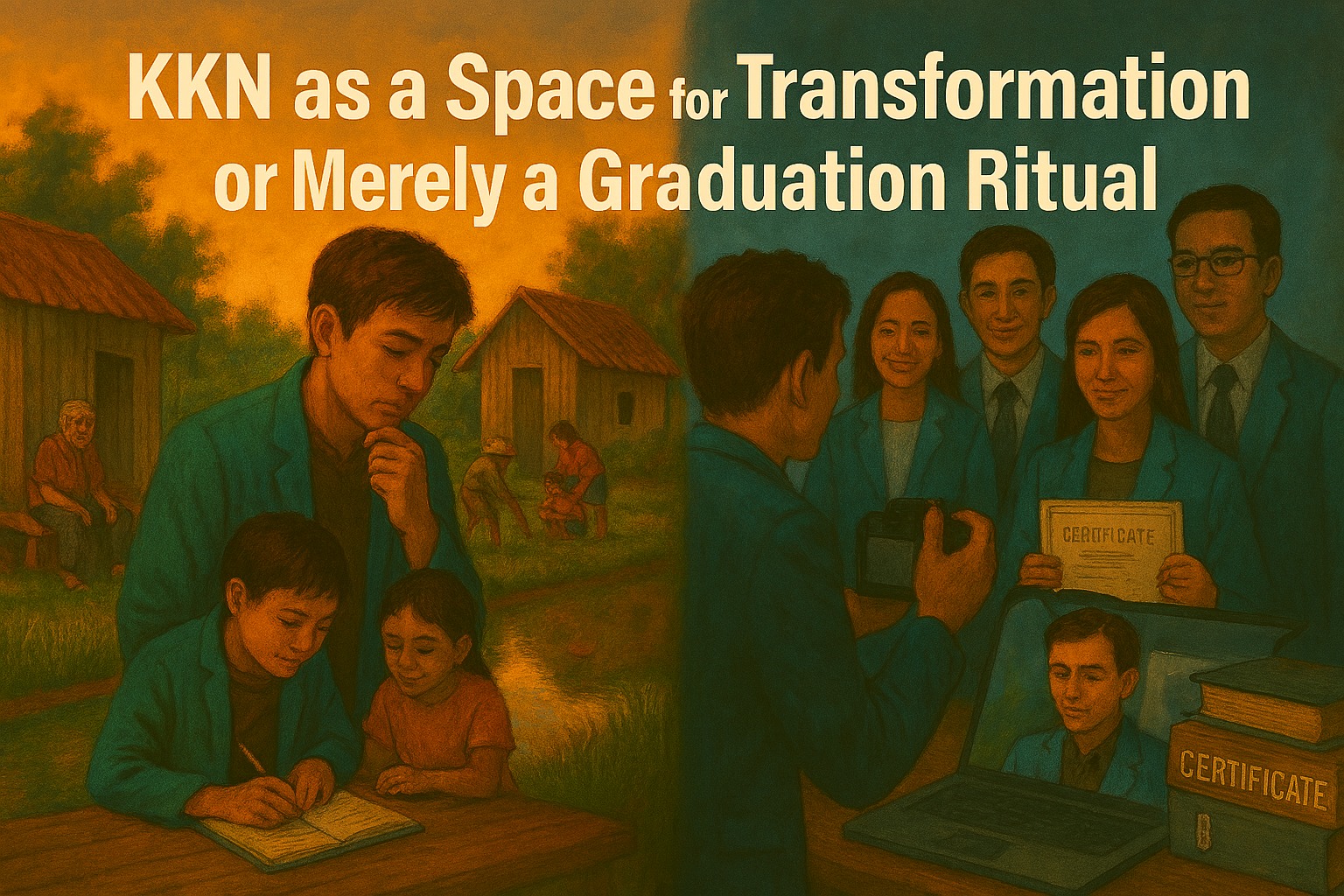
Kuliah Kerja Nyata (KKN) is widely recognized as a core component of higher education in Indonesia. As a community service program, it is designed to connect academic knowledge with real social conditions. Yet, in practice, KKN often stands between two interpretations: a meaningful space for transformation or simply a graduation ritual that must be completed. This article explores the deeper purpose of KKN and questions whether it truly shapes students’ character or merely fulfills academic requirements.
THE ORIGINAL PURPOSE OF KKN
KKN was created to bridge universities and society. Higher education is not only about mastering theory but also about developing social responsibility. Through direct engagement with communities, students are expected to understand real challenges and contribute practical solutions.
Ideally, KKN fosters empathy, adaptability, and leadership. It pushes students beyond classroom discussions and exposes them to social realities that cannot be fully understood through textbooks alone. In this sense, KKN serves as experiential learning that integrates knowledge with action.
WHEN KKN TURNS INTO A FORMALITY
Despite its noble foundation, KKN can gradually shift into a procedural obligation. Students often focus on fulfilling administrative requirements such as proposals, attendance records, and final reports. While these elements are necessary for academic accountability, they may unintentionally dominate the experience.
When the emphasis lies mainly on grades and completion, the transformative dimension becomes secondary. KKN risks being perceived as just another course to pass before graduation. In this scenario, students may complete tasks efficiently without deeply engaging with the community.
THE TRANSFORMATIVE POTENTIAL OF COMMUNITY ENGAGEMENT
KKN has strong transformative potential when students approach it with genuine intention. Living and working within a community exposes them to diverse perspectives, social inequalities, and cultural dynamics. These encounters challenge assumptions and encourage critical thinking.
Real transformation happens when students learn to listen, adapt, and collaborate. They begin to understand that academic knowledge gains meaning when applied with sensitivity and humility. Such awareness often influences their future professional values and social attitudes.
THE IMPORTANCE OF REFLECTION
Experience alone does not guarantee growth. Reflection is the process that turns activity into learning. Without reflection, KKN may remain a series of tasks rather than a meaningful journey.
By critically examining their experiences, students can recognize personal strengths, limitations, and biases. Reflection also helps them see the broader impact of their actions within the community. This internal process strengthens the educational value of KKN far beyond credit accumulation.
REDEFINING KKN IN MODERN EDUCATION
To ensure that KKN remains a space for transformation, both institutions and students must revisit its core mission. Universities can design evaluation systems that prioritize engagement and ethical conduct, not merely documentation. Students, on the other hand, must approach the program with sincerity and openness.
When the focus shifts from simply finishing requirements to embracing meaningful participation, KKN becomes more than a graduation ritual. It becomes a formative experience that shapes socially responsible graduates.
CONCLUSION
KKN stands between two possibilities: transformation or ritual. The difference lies in perspective and commitment. If treated merely as a step toward graduation, its impact will be limited. However, when embraced as an opportunity for growth, KKN can profoundly influence how students view society and their role within it.
Ultimately, KKN is not defined by the credits earned, but by the values cultivated throughout the process.
Tentang Penulis
Gusti Ayu Tita P
Penulis — Universitas STEKOM
Penulis aktif yang berfokus pada isu-isu akademik, teknologi pendidikan, dan pengembangan sumber daya manusia di lingkungan kampus.















