KUR Mandiri vs Regular Business Loans Which One Is Better for MSMEs
Gusti Ayu Tita P
21 Agustus 2026
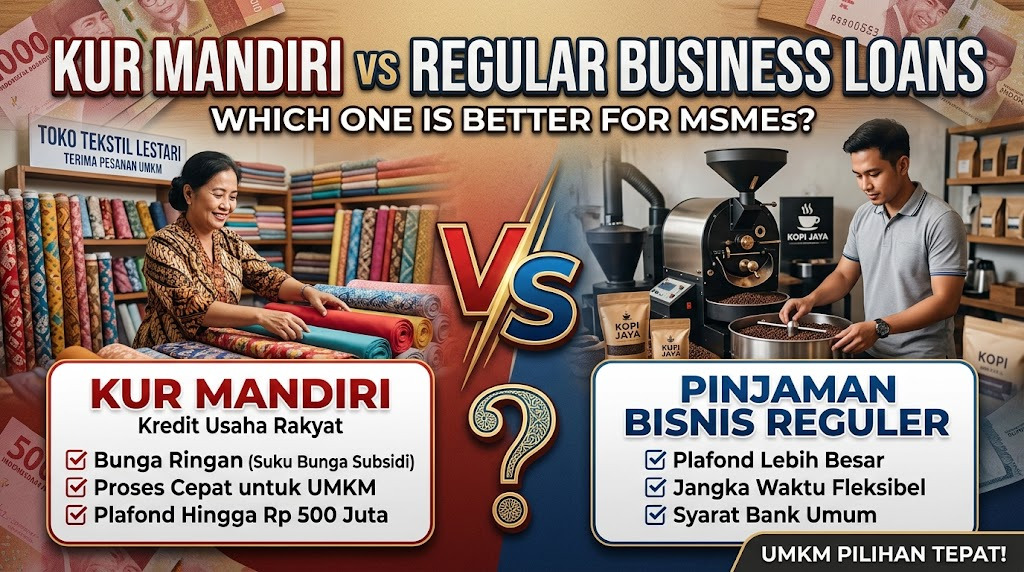
Choosing the right financing is an important decision for Micro Small and Medium Enterprises or MSMEs. Business owners may need additional capital to purchase inventory, improve equipment, increase production, or expand their operations. Two options that may be considered are KUR Mandiri and regular business loans. Although both provide access to financing, their objectives, requirements, and conditions can differ. Understanding these differences can help entrepreneurs choose financing that matches their business needs and financial capacity.
UNDERSTANDING KUR MANDIRI AND REGULAR BUSINESS LOANS
KUR Mandiri is part of the government supported People's Business Credit or Kredit Usaha Rakyat KUR program distributed through Bank Mandiri. It is designed to support eligible productive businesses, particularly MSMEs that need financing for working capital or investment. Bank Mandiri provides different KUR categories, including Super Micro KUR, Micro KUR, and Small KUR, with specific requirements for each category.
Meanwhile, regular business loans are commercial financing products offered by banks according to their respective product terms. These loans can be designed for businesses with different financing needs and may provide various loan structures depending on the applicant and product. The requirements, interest or margin structure, collateral conditions, and financing limits can differ from one product to another. Therefore, entrepreneurs should compare the actual terms instead of assuming that one option is always better.
KEY DIFFERENCES BETWEEN KUR AND REGULAR BUSINESS LOANS
One of the main differences is the purpose and program structure. KUR is part of a government supported financing program intended to improve access to productive financing for eligible businesses. Regular business loans are generally commercial banking products with terms determined by the bank and specific product. This difference can affect eligibility, financing conditions, and the application process.
Another difference can involve requirements and credit assessment. KUR applicants must satisfy applicable program requirements and undergo assessment by the distributing bank. Regular business loans can have different eligibility criteria depending on the product, including requirements related to business history, financial performance, collateral, or other factors. Entrepreneurs should review each product's current terms before making a decision.
WHICH OPTION MAY BE BETTER FOR MSMES
For eligible MSMEs looking for financing under the KUR program, KUR Mandiri may be worth considering because it is specifically designed to support productive business activities. It can be suitable for entrepreneurs whose financing needs and business conditions match the applicable KUR category. However, eligibility does not automatically mean approval. The applicant still needs to meet the requirements and pass the bank's assessment.
A regular business loan may be more appropriate for businesses that need a financing structure outside the applicable KUR program. Established businesses with larger or more specific financing requirements may want to compare commercial loan products that offer different features. The best choice depends on the business's size, purpose of financing, cash flow, repayment capacity, and eligibility. Entrepreneurs should focus on finding financing that is sustainable rather than simply choosing the option with the highest available limit.
FACTORS TO CONSIDER BEFORE CHOOSING
Before choosing between KUR Mandiri vs regular business loans, entrepreneurs should calculate how much financing they actually need. They should also compare repayment obligations with expected business cash flow. A financing facility may appear attractive but become difficult to manage if monthly payments consume too much of the business's available cash. Therefore, repayment capacity should be one of the most important considerations.
Entrepreneurs should also compare financing costs, requirements, collateral conditions, tenor, purpose of financing, and applicable fees. The business owner should understand all obligations before signing a financing agreement. It is also important to consider whether the funds will be used for working capital or long term investment. A careful comparison can help MSMEs avoid unnecessary debt and maintain healthier business finances.
HOW TO MAKE THE RIGHT FINANCING DECISION
The right financing decision should begin with a realistic assessment of the business. Entrepreneurs should review their revenue, expenses, existing debt, assets, and future business plans. They should then determine whether the financing will generate enough economic value to justify the repayment obligation. Business planning and financial discipline are more important than simply obtaining financing quickly.
MSME owners should also avoid comparing financing products based only on the advertised interest rate or financing limit. They should look at the total cost of financing and understand how payments will affect monthly cash flow. If the business is still developing, a smaller and manageable financing facility may be more appropriate than a larger loan. A responsible financing decision should strengthen the business rather than create excessive financial pressure.
CONCLUSION
There is no single answer to whether KUR Mandiri or a regular business loan is better for every MSME. KUR Mandiri may be suitable for eligible entrepreneurs whose businesses and financing needs match the KUR program. Regular business loans may provide alternative structures for businesses with different requirements. The best choice depends on the entrepreneur's eligibility, financing purpose, business condition, and repayment capacity.
In conclusion, MSME owners should compare financing options carefully before making a decision. Consider financing costs, requirements, repayment obligations, collateral, tenor, and intended use of funds rather than focusing only on the amount that can be borrowed. Entrepreneurs should also confirm the latest KUR Mandiri terms directly with Bank Mandiri because program conditions may change. With careful evaluation, business owners can choose financing that supports healthy and sustainable business growth.
Tentang Penulis
Gusti Ayu Tita P
Penulis — Universitas STEKOM
Penulis aktif yang berfokus pada isu-isu akademik, teknologi pendidikan, dan pengembangan sumber daya manusia di lingkungan kampus.