LEARNING FROM SCREENS EVERY DAY, DOES TECHNOLOGY BECOME A SHORTCUT TO PASSING SNBT OR A NEW SOURCE OF DISTRACTION?
Gusti Ayu Tita P
13 Juni 2026
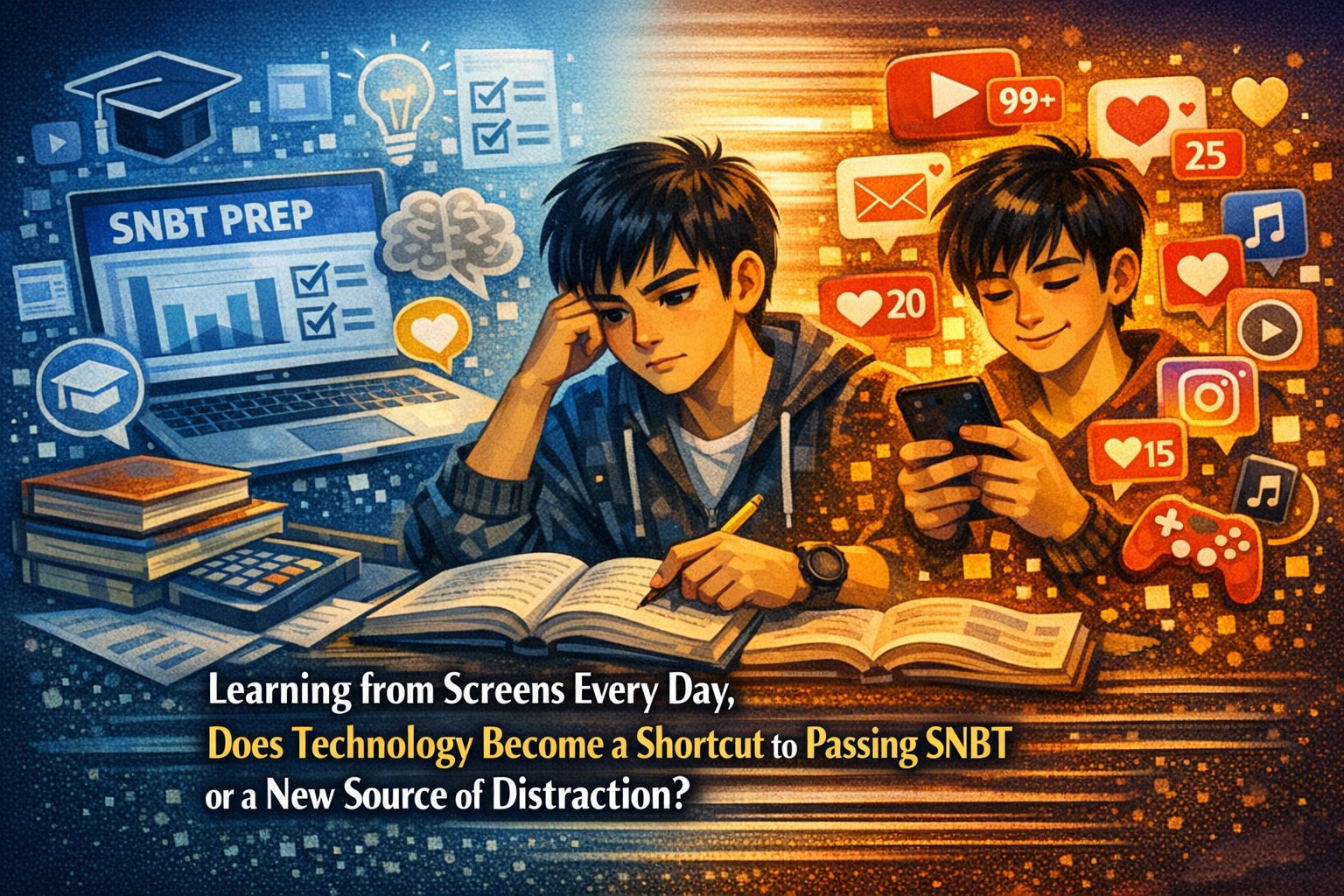
For students preparing for SNBT (Seleksi Nasional Berdasarkan Tes), screens have become part of everyday learning life. Smartphones, tablets, laptops, and digital platforms are now used not only for communication and entertainment, but also for academic preparation. Students watch educational videos, join online tryouts, read digital modules, and discuss difficult questions through group chats. Studying no longer happens only at a desk with printed books. It happens everywhere, often through a screen.
This transformation has changed the way students approach exam preparation. Technology promises speed, convenience, and wider access to information. A difficult mathematics concept can be explained in five minutes through a video. A practice test can be completed in one click. Thousands of students can learn from the same high-quality source regardless of location.
Yet this convenience also creates a serious concern. The same screen used for studying is also filled with social media, entertainment, endless notifications, and digital distractions. A student may begin by opening a learning platform but end up scrolling for hours without real progress.
This raises an important question: does technology truly become a shortcut to passing SNBT, or does it quietly become a new source of distraction that weakens focus and discipline?
The answer depends on how students use technology. Digital tools can support academic success, but they can also create habits that make deep learning more difficult. Understanding this balance is essential for students who want not only to study harder, but to study smarter.
THE SHIFT FROM TRADITIONAL STUDY TO DIGITAL LEARNING
Education has changed significantly in the digital era. In the past, students preparing for competitive exams depended mainly on school textbooks, private tutoring, and face-to-face discussions with teachers. Learning materials were limited by location and cost.
Today, digital learning removes many of these barriers. Students can access video lessons, free question banks, mock exams, and online mentoring programs from home. This creates more flexible and affordable preparation opportunities.
The shift is especially important for SNBT because the exam requires broad reasoning skills and consistent practice. Students can now repeat lessons, compare explanations from different educators, and focus more precisely on weak subjects.
Digital learning also gives students more control over their own study process. They can create personalized schedules and study at their own pace.
However, freedom without discipline can reduce effectiveness. Access alone does not guarantee understanding. Students still need structure, reflection, and repetition.
Technology changes the method, but the effort required remains the same.
WHY SCREEN-BASED LEARNING FEELS MORE EFFICIENT
Many students prefer digital learning because it feels faster and more practical.
Instead of searching through thick books, they can find answers instantly. Search engines, educational platforms, and short explanation videos provide immediate solutions. This saves time and reduces frustration when facing difficult topics.
Interactive features also make learning more engaging. Visual explanations, simulations, and real-time discussions often feel easier to understand than traditional lectures. For complex SNBT subjects such as literacy reasoning and quantitative analysis, this can be highly helpful.
Students also benefit from mobility. They can study while commuting, waiting, or resting at home. Learning becomes integrated into daily life rather than limited to specific study hours.
This flexibility helps students maintain consistency, especially when school schedules are busy.
But efficiency should not be confused with depth. Fast access to information does not always mean strong comprehension. Sometimes students recognize explanations without truly mastering the concept.
Real learning still requires active thinking, not just fast searching.
THE DANGER OF PASSIVE LEARNING
One of the biggest risks of screen-based study is passive learning.
Watching educational videos can feel productive because students spend time with academic content. However, passive watching is very different from active problem-solving.
Many students spend hours consuming explanations without practicing enough questions. They understand concepts while watching, but struggle when facing independent exam problems.
This creates false confidence. Students believe they are improving because they are constantly exposed to learning materials, but real mastery is tested only through application.
SNBT demands analytical thinking, speed, and accuracy under pressure. These skills grow through active engagement, not passive observation.
Students need to pause videos, take notes, solve problems manually, and review mistakes carefully. Without this process, digital learning becomes entertainment disguised as education.
Technology should support active learning, not replace it.
SOCIAL MEDIA AS THE BIGGEST DISTRACTION
The same phone used for studying is also the home of endless distractions.
Social media platforms are designed to capture attention quickly. Short videos, notifications, messages, and algorithm-based recommendations make it difficult for students to leave the screen after completing study tasks.
Many students open YouTube for a lesson and continue watching unrelated content. They check one message and spend thirty minutes replying to chats. Small distractions accumulate into major productivity loss.
This problem is dangerous because it often feels harmless. Students still believe they are in “study mode” because the device remains in their hand.
In reality, divided attention reduces concentration and weakens memory retention. Learning becomes shallow because the brain never enters deep focus.
The issue is not only time wasted, but also the habit of fragmented attention.
Success in SNBT requires concentration that social media constantly tries to interrupt.
INFORMATION OVERLOAD AND MENTAL FATIGUE
Technology gives students unlimited access to information, but too much information can create confusion.
Students often save dozens of study resources, join multiple discussion groups, and follow many educational accounts. Instead of clarity, they feel overwhelmed by too many choices.
They may spend more time organizing materials than actually studying. Deciding what to learn becomes mentally exhausting.
This creates information overload, where the brain struggles to process everything effectively. Students feel busy but not productive.
Digital pressure also increases anxiety. Seeing others study constantly or post high mock test scores can create emotional stress. Students begin comparing themselves and questioning their own progress.
This mental fatigue reduces motivation and confidence.
Sometimes the problem is not lack of resources, but lack of simplicity.
Learning becomes stronger when students choose fewer high-quality materials and focus deeply.
HOW TECHNOLOGY CAN ACTUALLY HELP STUDENTS PASS
Despite the distractions, technology offers powerful advantages when used wisely.
Online tryouts allow students to practice under realistic exam conditions. Time limits and score analysis help improve both strategy and confidence.
Performance tracking helps students identify weaknesses quickly. Instead of studying everything equally, they can focus on the subjects that need the most attention.
Educational communities also provide motivation. Group discussions, mentoring sessions, and shared study challenges create accountability and emotional support.
Students in remote areas gain access to the same quality resources as students in major cities. This improves fairness in academic opportunity.
Technology also supports flexible revision. Students can review difficult topics repeatedly without depending entirely on teachers or tutoring schedules.
These benefits show that technology can become a genuine academic advantage.
The key difference lies in intentional use.
BUILDING DISCIPLINE IN A DIGITAL WORLD
Technology does not remove the need for discipline. In fact, it makes discipline even more important.
Students must learn to separate useful digital habits from harmful ones. This means creating clear study boundaries.
Turning off unnecessary notifications during study sessions helps protect focus. Using dedicated study applications instead of general entertainment platforms reduces temptation.
Time-blocking is also effective. Students can schedule focused learning sessions followed by short breaks rather than switching attention constantly.
A clear daily target improves motivation. Instead of saying “I will study today,” students should define specific goals such as finishing one mock test or reviewing one chapter.
Discipline also means accepting discomfort. Deep learning often feels slower than scrolling because it requires mental effort.
But long-term success is built on repeated focus, not instant satisfaction.
THE ROLE OF PARENTS AND TEACHERS IN DIGITAL LEARNING
Students are not alone in managing digital education. Parents and teachers play an important role.
Parents should understand that screens are not always a sign of distraction. Sometimes students are genuinely learning through digital platforms. Open communication is more effective than constant suspicion.
At the same time, parents can help create healthier routines by supporting balanced schedules, sleep quality, and emotional stability.
Teachers can guide students by recommending reliable study sources instead of leaving them lost in unlimited online content. Trusted direction reduces confusion and wasted time.
Schools should also teach digital literacy. Students need to understand how to manage attention, evaluate online information, and use technology responsibly.
Academic success becomes stronger when the environment supports healthy learning habits.
Technology works best when students are guided, not simply left to manage everything alone.
FINDING BALANCE BETWEEN CONVENIENCE AND CONCENTRATION
The goal is not to reject technology, but to use it with awareness.
Students do not need to return completely to traditional learning methods. Digital tools are valuable and often necessary in modern education. However, convenience should never replace concentration.
Learning from screens every day can become a shortcut to passing SNBT only if students remain active, disciplined, and focused. Without these qualities, the same technology becomes a source of delay and distraction.
Balance means knowing when to use the screen and when to step away from it. It means using social media for inspiration without letting it control attention. It means choosing learning depth over endless consumption.
Passing SNBT is not about having the best device or the most applications. It is about managing time, attention, and habits wisely.
Technology is only a tool. Success still depends on the student behind the screen.
In the end, the real shortcut is not technology itself, but the ability to use it with purpose.
Tentang Penulis
Gusti Ayu Tita P
Penulis — Universitas STEKOM
Penulis aktif yang berfokus pada isu-isu akademik, teknologi pendidikan, dan pengembangan sumber daya manusia di lingkungan kampus.