Mass Protests and Shifts in Public Opinion
Gusti Ayu Tita P
1 September 2026
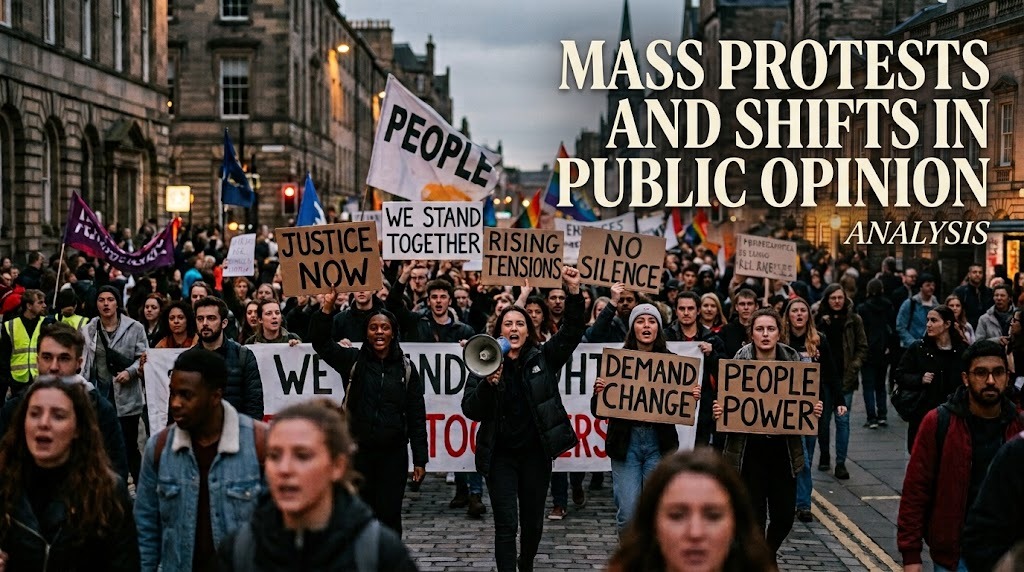
Mass protests can influence how people understand and discuss important social issues. When large groups gather to express concerns, their messages can attract attention from citizens, media organizations, and public institutions. This attention may cause people to reconsider an issue, strengthen existing opinions, or become more interested in a topic they previously ignored. However, protests do not always produce the same response from everyone. Research suggests that their effects on public opinion depend on the issue, protest methods, media coverage, and how people interpret the action.
HOW MASS PROTESTS ATTRACT PUBLIC ATTENTION?
Mass protests can make an issue more visible by bringing many people together around a shared concern. Large gatherings are often noticed because they create a clear public message that is difficult to ignore. Media organizations may report on the demands, participants, and surrounding events, increasing awareness among people who are not present. Issue visibility can encourage citizens to learn more about a topic that previously received little attention. This makes public attention one of the important channels through which protests can influence opinion.
Research on protest shows that demonstrations can generate substantial increases in media and online attention, even when their direct effects on political attitudes are limited. This means that attracting attention and changing people's minds are not necessarily the same thing. A protest may succeed in making an issue widely discussed without producing a major shift in people's overall views. Public awareness can still be an important outcome because it creates space for further discussion.
PROTESTS CAN STRENGTHEN EXISTING OPINIONS
Not everyone changes their opinion after seeing a mass protest. Some people may already support the issue and become more confident in their position. Others may already oppose the protesters and interpret the event as confirmation of their existing beliefs. Personal values, political preferences, social experiences, and trust in institutions can influence these reactions. Existing beliefs therefore play an important role in determining how people respond to collective action.
Public opinion is rarely shaped by one event alone. People usually consider information from multiple sources before changing their views about complex social issues. A protest may become one part of that broader information environment. Opinion shifts are more likely to be understood when the protest is considered alongside media reports, personal experiences, conversations, and other political developments. This explains why the same demonstration can receive very different reactions from different groups.
MEDIA COVERAGE SHAPES PUBLIC PERCEPTION
Media coverage can determine which aspects of a protest receive the most public attention. Reports may focus on the protesters' demands, the size of the crowd, disruptions, responses from authorities, or individual incidents. Different emphases can lead audiences to develop different interpretations of the same event. Media framing therefore plays an important role in shaping public perceptions.
Recent research suggests that disruptive nonviolent protests can generate greater media attention and increase the visibility of an issue, while also reducing approval of the protesters or their tactics. However, the broader effect on concern about the underlying issue is often small or neutral rather than consistently negative. (PubMed Central (PMC)) This distinction is important because people may dislike a protest method while still becoming more interested in the problem being discussed.
SOCIAL MEDIA EXPANDS THE CONVERSATION
Social media allows information about mass protests to move quickly beyond the physical location of an event. Participants can share photographs, videos, statements, and personal experiences directly with online audiences. People who were not present can therefore become part of the wider conversation. Digital communication can increase the speed and reach of public discussion.
However, social media can also create confusion when information is incomplete or inaccurate. A short video may not show the full context of an event, while emotional posts can receive more attention than carefully verified information. Users should compare different sources before accepting claims about a protest. Digital literacy helps people distinguish verified information from speculation, misleading content, and personal opinion.
PROTESTS CAN MAKE CITIZENS MORE CRITICAL
Mass protests can encourage citizens to evaluate the performance of political leaders and public institutions more critically. A demonstration may introduce perspectives that are not strongly represented in formal political discussions. Research on anti-austerity protests in Portugal, for example, found that exposure to a protest reduced satisfaction and trust in political elites while not making citizens less democratic or more politically disengaged. (ScienceDirect)
This distinction is important because becoming more critical of leaders does not necessarily mean rejecting democracy. Citizens may continue supporting democratic institutions while demanding better policies or greater accountability. Critical citizenship can therefore be part of democratic participation. Public debate becomes stronger when people are willing to evaluate decisions rather than simply accepting them.
WHEN PROTESTS CAN CREATE NEGATIVE REACTIONS
Public opinion can also move in an unfavorable direction for protesters, particularly when people strongly dislike the methods used. Disruptive tactics may cause frustration among people who experience traffic problems, interruptions, or other effects of the demonstration. Research reviewed in 2026 found that disruptive nonviolent protests tend to reduce support for the groups and tactics involved.
This does not necessarily mean that the underlying issue loses public support. A person can disagree with the way a protest is conducted while still recognizing that the issue deserves attention. Protest tactics and policy demands should therefore be considered separately when examining public opinion. Understanding this distinction provides a more accurate picture of how demonstrations influence society.
SOCIAL CONTEXT AFFECTS PUBLIC RESPONSE
The impact of protests can vary depending on the social and political environment in which they occur. A demonstration held during an economic crisis may receive a different response from one organized during a period of relative stability. The reputation of institutions, the importance of the issue, and previous experiences with protests can also affect public reactions. Social context helps explain why similar demonstrations can produce different outcomes in different places.
Research from different countries demonstrates that protest effects are not uniform. Some studies find limited changes in broad political attitudes, while others identify changes in specific areas such as trust, satisfaction, or attitudes toward particular issues. Therefore, it is difficult to claim that every mass protest will either improve or damage public support. The effects need to be assessed according to the specific circumstances.
PUBLIC OPINION DOES NOT CHANGE INSTANTLY
A mass protest may attract immediate attention without producing an immediate change in public opinion. People often need time to process information, compare arguments, and observe what happens afterward. Responses from government institutions, media coverage, and subsequent developments can influence how an issue is remembered. Long-term opinion change may therefore depend on what happens after the protest rather than the demonstration itself.
Public opinion can also change in stages. An issue may first become more visible, followed by greater public discussion and eventually changes in attitudes among some groups. Other people may maintain their original positions throughout the process. This shows that social influence is gradual and complex. A single protest should not automatically be treated as proof that society has completely changed its position.
PROTESTS AND DEMOCRATIC PARTICIPATION
Mass protests can become part of democratic life by giving citizens another way to communicate concerns outside formal elections and institutions. Demonstrations can bring civil society voices into public debate and create pressure for political leaders to respond. Scholars have noted that demonstrations can both strengthen connections between public sentiment and political institutions and raise concerns about institutional stability, depending on how they are conducted and received.
For this reason, peaceful and responsible participation remains important. Protesters can communicate clear demands while respecting the safety and rights of others. Authorities can respond to public concerns while maintaining public order and respecting lawful expression. Democratic dialogue becomes stronger when disagreement is handled through communication rather than hostility.
CONCLUSION
Mass protests can influence public opinion by increasing issue visibility, encouraging public discussion, strengthening existing views, and sometimes changing attitudes. Their effects are not always predictable because people respond according to their values, experiences, information sources, and perceptions of protest tactics. Research indicates that protests can successfully attract attention even when their broader effect on political attitudes is limited.
Ultimately, a mass protest should not be judged only by whether it immediately changes people's minds. Its wider significance can also be found in its ability to bring overlooked issues into public discussion and encourage citizens to examine policies and institutions more critically. Accurate information, peaceful participation, responsible media coverage, and continued public dialogue can help ensure that these discussions contribute positively to democratic life.
Tentang Penulis
Gusti Ayu Tita P
Penulis — Universitas STEKOM
Penulis aktif yang berfokus pada isu-isu akademik, teknologi pendidikan, dan pengembangan sumber daya manusia di lingkungan kampus.