Mass Protests as a Reflection of Public Concerns
Gusti Ayu Tita P
1 September 2026
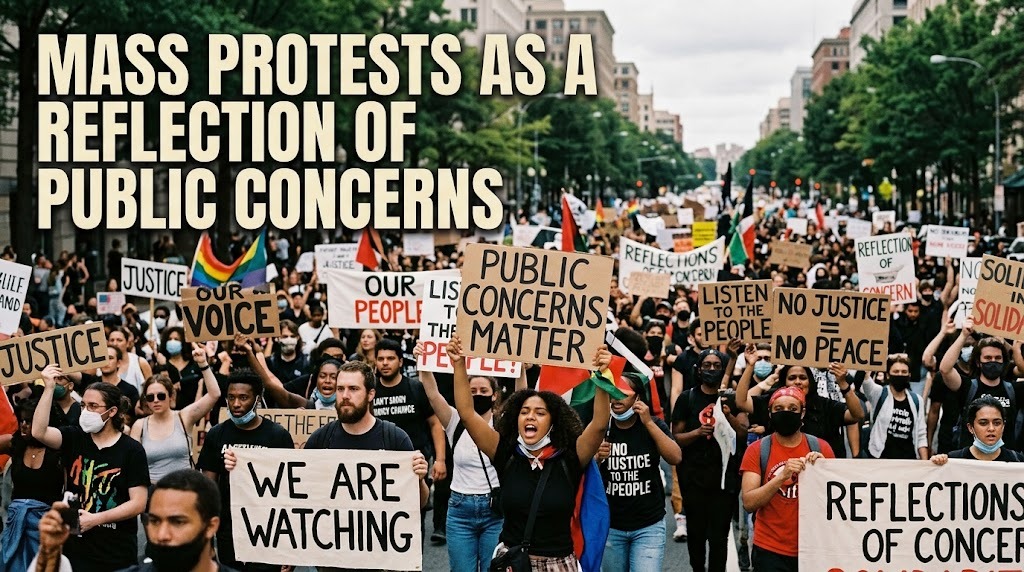
Mass protests are often seen as a visible expression of concerns that exist within society. When many people gather to communicate similar demands, their presence can draw attention to issues that may have received limited public discussion. These concerns can involve government policies, economic conditions, social inequality, education, employment, or public services. A protest does not necessarily represent the views of everyone, but it can provide an important indication that certain groups want their concerns to be heard. Understanding the issues behind a protest is therefore essential for viewing it objectively.
MASS PROTESTS AS PUBLIC EXPRESSION
A mass protest provides citizens with a way to express opinions collectively. People may participate because they share concerns about a particular policy, social condition, or decision that affects their lives. By gathering together, individual voices can become a more visible collective message. Public demonstrations can also encourage other citizens to learn more about the issue being raised. This makes protests one form of participation in public life.
However, the presence of a large crowd does not automatically mean that the entire population agrees with the protesters. Society consists of people with different experiences, priorities, and opinions. Some may support the demands, while others may disagree or remain undecided. Diverse public opinions are a normal part of democratic societies. Therefore, protests should be understood through their specific demands and social context rather than simply through crowd size.
PUBLIC CONCERNS BEHIND MASS PROTESTS
Many protests are connected to problems that people experience directly or believe could affect their future. Economic pressure, changes in public policy, employment conditions, education, environmental concerns, and access to public services can become subjects of collective criticism. When these problems affect a large number of people, they can develop into broader public concerns. Communities may then look for ways to communicate their dissatisfaction more strongly.
A protest can also emerge after people feel that previous forms of communication have not produced satisfactory responses. Complaints, discussions, or formal requests may be perceived as insufficient when a problem continues. This can encourage groups to seek greater public attention through collective action. Unresolved concerns can therefore become an important factor behind the growth of demonstrations. The longer an issue remains without a clear response, the greater the possibility that frustration will increase.
ECONOMIC CONDITIONS INFLUENCE PUBLIC CONCERNS
Economic conditions often have a direct effect on people's everyday lives. Rising living costs, employment difficulties, income inequality, and financial uncertainty can create pressure among households and communities. When many people experience similar difficulties, individual problems can develop into a shared social concern. Economic pressure may then become part of the demands expressed during a mass protest.
Economic concerns can also be connected to perceptions of fairness. People may question whether opportunities, resources, or public policies benefit different groups equally. These perceptions can influence how citizens evaluate institutions and government decisions. Economic inequality can therefore contribute to wider public debates about social justice and policy priorities. Understanding this background helps explain why economic issues can become powerful drivers of collective action.
PUBLIC POLICIES CAN CREATE STRONG REACTIONS
Government policies can become a major focus of public demonstrations when people believe they will significantly affect their lives. Policies concerning education, employment, taxation, transportation, welfare, or environmental protection can generate different reactions among citizens. A policy may receive support from some groups while creating concern among others. Policy dissatisfaction can become stronger when affected communities believe their perspectives were not adequately considered.
Clear communication can help reduce confusion surrounding controversial decisions. Citizens need understandable information about why a policy was created, who will be affected, and how potential problems will be addressed. When communication is limited, uncertainty can create room for speculation. Public consultation can provide opportunities for communities to express concerns before disagreements become more intense. Open communication does not remove differences, but it can create better conditions for dialogue.
SOCIAL MEDIA AMPLIFIES PUBLIC CONCERNS
Social media has made it easier for people to share experiences and discuss issues that matter to them. A personal story, photograph, video, or statement can reach a large audience within a short period. People with similar concerns can discover one another and form online communities around an issue. Digital communication can therefore increase the visibility of concerns that might otherwise remain within a small group.
At the same time, social media can spread incomplete or inaccurate information. Emotional posts may receive significant attention even when they do not provide enough context. Users should verify important claims before sharing them with others. Digital literacy helps citizens distinguish facts from opinions and misleading content. Responsible information sharing can make online discussions more useful and reduce unnecessary social tension.
SOLIDARITY TURNS INDIVIDUAL CONCERNS INTO COLLECTIVE ACTION
People are more likely to participate in collective action when they recognize that others experience similar problems. Shared experiences can create feelings of solidarity and encourage individuals to support a common cause. Organizations, communities, student groups, workers, and other social groups may help connect people with related concerns. Social solidarity can transform separate complaints into a more organized public message.
Participants in a protest may still have different backgrounds and motivations. One person may be concerned about economic conditions, while another may focus on public policy or social justice. They can nevertheless cooperate because they share a broader objective. Common goals help connect these different perspectives. Understanding this diversity is important for recognizing that mass protests can contain multiple voices rather than a single viewpoint.
MEDIA SHAPES HOW PROTESTS ARE UNDERSTOOD
Media coverage can influence how society interprets a mass protest. News reports may focus on the protesters' demands, the size of the gathering, public disruption, responses from authorities, or specific incidents. Each emphasis can affect how audiences understand the overall event. Media framing can therefore influence public perception of both the protest and the concerns behind it.
People should avoid relying on one source when trying to understand a complex demonstration. Comparing reports from reliable sources can provide a broader picture of what happened and why the protest occurred. Readers should also distinguish factual information from commentary or opinion. Critical media consumption helps people form judgments based on more complete information. This is particularly important when a protest becomes a highly controversial public issue.
PROTESTS CAN INCREASE PUBLIC AWARENESS
One important effect of a mass protest is its ability to make an issue more visible. A concern that was previously discussed by a limited group may receive broader attention after a large demonstration. Media coverage and online discussions can introduce the issue to people who had not previously considered it. Public awareness may then increase as more citizens learn about the background and demands of the movement.
Greater awareness does not necessarily produce agreement. Some people may become more supportive, while others may question the protesters' arguments or methods. The important point is that the issue becomes part of a wider public conversation. Public debate can encourage institutions and communities to examine different perspectives. In this way, a protest can help move an overlooked concern into the broader social agenda.
RESPONSIBLE PROTEST SUPPORTS HEALTHY DIALOGUE
The way a protest is conducted can influence how its message is received. Peaceful demonstrations allow participants to express strong opinions while reducing risks to other people. Clear demands and respectful communication can make the purpose of an action easier to understand. Peaceful participation also supports a healthier environment for public discussion.
Responsibility applies not only to protesters but also to other groups involved in the event. Authorities need to consider public safety while respecting lawful expression, while media organizations should provide accurate information. Social media users also have a responsibility to avoid spreading unverified claims. Constructive communication can prevent disagreements from becoming unnecessary conflict. When different groups communicate responsibly, public concerns have a greater opportunity to be discussed seriously.
MASS PROTESTS AND SOCIAL CHANGE
Mass protests can become part of a larger process of social change. By bringing public concerns into the spotlight, they can encourage discussions among citizens, institutions, policymakers, and community organizations. However, a protest alone does not guarantee that a policy or social condition will change. Social change usually requires continued dialogue, evaluation, negotiation, and concrete action. Demonstrations can therefore be one stage in a longer process.
The public role can continue after a protest ends. Citizens can monitor policy responses, participate in community discussions, provide feedback, and use formal civic channels. Continued engagement can prevent important concerns from disappearing after media attention declines. Sustained civic participation can help transform public demands into longer-term discussions and solutions. This makes collective action more meaningful beyond the moment of the demonstration.
CONCLUSION
Mass protests can serve as a reflection of public concerns by making collective dissatisfaction, demands, and expectations more visible. Their causes can include economic pressure, controversial policies, social inequality, unresolved problems, and shared experiences. Social media and traditional media can further expand the reach of these concerns and bring them into wider public discussions. However, a protest should not automatically be treated as the voice of the entire population.
Ultimately, understanding mass protests requires looking beyond the crowd and examining the issues, demands, social conditions, and public responses surrounding the action. Peaceful participation, accurate information, respectful dialogue, and continued civic engagement can help ensure that public concerns are discussed constructively. When society creates space for different voices, protests can become part of a broader democratic process and contribute to meaningful social change.
Tentang Penulis
Gusti Ayu Tita P
Penulis — Universitas STEKOM
Penulis aktif yang berfokus pada isu-isu akademik, teknologi pendidikan, dan pengembangan sumber daya manusia di lingkungan kampus.