Mass Protests in the Digital Age of Information
Gusti Ayu Tita P
1 September 2026
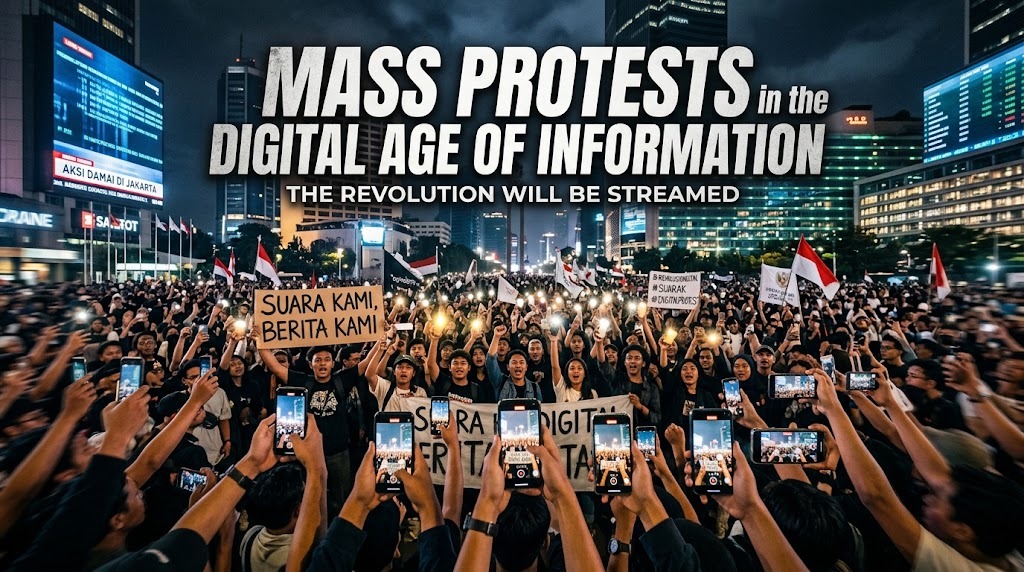
The digital age has changed how people receive information, communicate opinions, and participate in public issues. Mass protests that once depended heavily on face-to-face meetings and traditional media can now gain attention through social media and digital platforms. Information about a demonstration can spread quickly, allowing people from different locations to follow the same issue. Digital communication has therefore become an important part of modern public participation.
However, the digital environment also creates new challenges. Information can spread rapidly without being verified, while emotional content can influence how people understand an event. Social media can strengthen public awareness, but it can also increase misunderstanding when users share incomplete information. Understanding the relationship between mass protests and digital information is important for viewing modern social movements more objectively.
SOCIAL MEDIA CHANGES HOW PROTESTS ARE COMMUNICATED
Social media provides people with simple ways to share information about public issues. Users can publish opinions, photographs, videos, and updates that may reach large audiences. A concern that begins within one community can quickly become known by people in other areas. Social media visibility can therefore make a protest more noticeable than it might be through local communication alone.
The speed of online communication also changes how quickly people respond to events. Participants can provide updates while a demonstration is taking place, while observers can follow developments from a distance. This creates a continuous flow of information between participants and the wider public. Real-time communication can make public discussions more active, although the accuracy of information still needs careful attention.
INFORMATION SPREADS FASTER THAN BEFORE
In the digital age, information can move from one person to thousands of people within a short period. A single post or video can receive significant attention when many users share it. This can help important public concerns reach people who previously knew little about them. Rapid information sharing can increase awareness and encourage wider discussion.
The same speed can become problematic when information is incorrect. An old photograph may be presented as a recent event, while an edited video can create a misleading impression. People who share such content without checking it can unintentionally contribute to confusion. Information verification is therefore essential when following mass protests online.
DIGITAL PLATFORMS HELP PEOPLE ORGANIZE
Organizing a large public gathering requires communication and coordination. Digital platforms can help groups share information about meeting points, schedules, transportation, and other practical matters. Participants can communicate without needing to meet physically before an event. Online coordination can make organizing collective activities more flexible.
Digital organization can also connect people who live far apart. Different communities may discuss similar concerns and coordinate their messages through online networks. This can help a movement expand beyond its original location. However, effective organization still requires clear goals and responsible communication. Digital tools can support organization, but they do not replace thoughtful planning.
HASHTAGS CREATE SHARED CONVERSATIONS
Hashtags can help users find posts related to a particular protest or public issue. When many people use the same hashtag, separate conversations can become connected. This can make an issue easier to follow and allow users to discover different perspectives. Shared digital conversations can increase the visibility of collective concerns.
Hashtags can also help create a sense of community among people who support a similar cause. Users may feel connected even when they have never met in person. However, popularity does not automatically mean that the information connected to a hashtag is accurate. Online popularity should not be confused with factual reliability. Users still need to examine the source and context of information.
DIGITAL PARTICIPATION IS NOT ALWAYS PHYSICAL PARTICIPATION
People can support a public issue online without attending a physical demonstration. They may share information, discuss an issue, create educational content, or express their opinions through social media. This creates different forms of digital participation in modern civic life. Online engagement can help people become aware of issues even when physical participation is not possible.
However, online support and physical participation are not identical. Sharing a post requires less direct involvement than attending a demonstration or participating in community activities. A movement with high online engagement may not always have the same level of participation offline. Online attention and real-world action should therefore be understood as related but different forms of engagement.
DIGITAL INFORMATION CAN INFLUENCE PUBLIC OPINION
The information people encounter online can influence how they understand a protest. Supportive posts may encourage sympathy, while critical content can lead people to question the movement. Repeated exposure to similar opinions can also strengthen existing beliefs. Public opinion can therefore be shaped by the type of information people encounter.
This makes balanced information particularly important. Users should avoid forming conclusions based on one viral post or short video alone. Comparing different credible perspectives can provide a more complete understanding of an event. Critical thinking helps people separate factual information from personal interpretation.
MISINFORMATION CREATES SERIOUS CHALLENGES
Mass protests can create an environment where misinformation spreads quickly. People may share claims because they are emotional, surprising, or consistent with their existing opinions. False information can increase fear, anger, or misunderstanding among different groups. Misinformation can therefore make an already sensitive situation more complicated.
Users can reduce this risk by checking the original source and looking for supporting evidence. The date, location, context, and identity of the source should also be considered before information is shared. If a claim cannot be verified, it is better not to present it as fact. Responsible information sharing can help maintain a healthier digital discussion.
ALGORITHMS CAN SHAPE WHAT PEOPLE SEE
Digital platforms use systems that determine which content appears more prominently in users' feeds. Content receiving strong engagement may receive greater visibility, depending on the platform and its recommendation systems. This can cause certain protest-related narratives to spread more widely than others. Algorithmic visibility can therefore influence how people encounter information.
This does not necessarily mean that algorithms intentionally support one side of a protest. Their effects can result from the way platforms prioritize engagement and user interests. People may consequently see information that matches their previous interests more frequently. Diverse information sources can help users avoid developing an overly narrow understanding of a complex issue.
DIGITAL ACTIVISM CAN BUILD PUBLIC AWARENESS
Digital activism allows people to support causes through online campaigns and public discussions. Educational posts, videos, petitions, and awareness campaigns can introduce social issues to broader audiences. People who do not participate in physical protests can still contribute to public conversations. Online activism can therefore complement other forms of civic participation.
Its effectiveness depends on whether online attention leads to meaningful engagement. A large number of views or likes does not necessarily indicate long-term commitment to a cause. Continued discussion, community involvement, and constructive action are often necessary. Digital awareness becomes more meaningful when it encourages informed participation.
THE ROLE OF RESPONSIBLE DIGITAL CITIZENS
Every social media user has a role in maintaining the quality of online public discussions. Before sharing protest-related information, users should consider whether the content is accurate and presented in the correct context. They should also avoid spreading personal attacks or unverified accusations. Digital responsibility can help reduce unnecessary tension.
Responsible users can contribute by sharing reliable information and encouraging respectful discussion. They can acknowledge differences of opinion without turning disagreements into personal conflicts. This is especially important when public issues are emotionally sensitive. Respectful digital communication can help create a healthier environment for civic discussion.
MASS PROTESTS AND THE FUTURE OF PUBLIC PARTICIPATION
The relationship between digital platforms and mass protests is likely to remain important as communication technology develops. People will continue using online spaces to discover public issues, communicate concerns, and connect with communities. At the same time, society will need stronger digital literacy to deal with misinformation and misleading content. The future of public participation will increasingly involve both digital and physical spaces.
Digital platforms should therefore be viewed as tools rather than automatic solutions. They can amplify voices, but meaningful change still requires organization, responsible participation, and constructive dialogue. People need to understand both the opportunities and limitations of digital communication. Technology can strengthen civic participation when used carefully and responsibly.
CONCLUSION
Mass protests in the digital age are strongly influenced by the speed and reach of modern information. Social media, hashtags, online coordination, digital activism, and real-time communication can help public concerns reach wider audiences. These tools can make participation easier and connect people across different locations. However, misinformation, polarization, and algorithmic limitations can also create significant challenges.
Ultimately, the digital age has not replaced traditional forms of public participation but has expanded them. Responsible information sharing, critical thinking, digital literacy, peaceful participation, and meaningful dialogue remain essential. When people use digital platforms wisely, online communication can help society understand public concerns more clearly. In this way, technology can become a useful bridge between information, collective voices, and constructive social change.
Tentang Penulis
Gusti Ayu Tita P
Penulis — Universitas STEKOM
Penulis aktif yang berfokus pada isu-isu akademik, teknologi pendidikan, dan pengembangan sumber daya manusia di lingkungan kampus.