
Modern Technology For Improving Sea Transportation Efficiency
Gusti Ayu Tita P
11 Agustus 2026
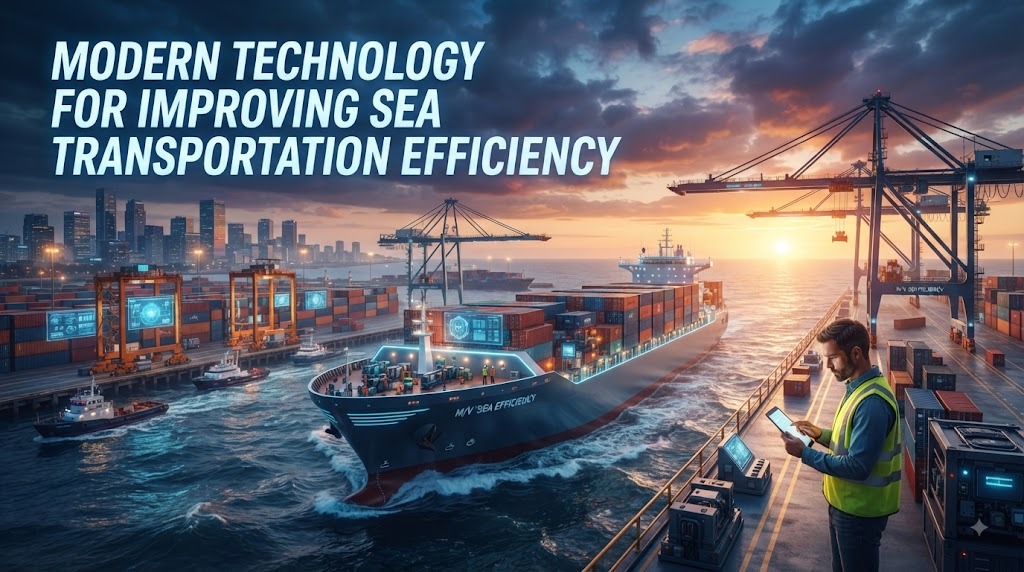
Sea transportation plays an important role in moving people and goods between countries and regions. Ships can carry large quantities of cargo over long distances, making maritime transportation an important part of global logistics. However, increasing trade demands require shipping companies to improve efficiency, safety, and reliability. Modern technology provides many solutions for improving vessel operations, port activities, navigation, and cargo management. The use of technology can help the maritime industry reduce delays, control costs, and improve overall performance.
Technology in sea transportation is developing through digital systems, automation, satellite communication, artificial intelligence, and advanced monitoring equipment. These technologies allow ships and ports to collect and process information more quickly. Real-time data can help operators make better decisions about routes, fuel consumption, maintenance, and cargo handling. At the same time, digital systems can improve communication between ships, ports, logistics companies, and customers. As a result, technology is becoming an essential part of modern maritime efficiency.
THE ROLE OF TECHNOLOGY IN SEA TRANSPORTATION
Modern technology helps shipping companies manage maritime operations more efficiently. Digital systems can monitor vessel positions, engine performance, fuel consumption, and cargo conditions. Operators can use this information to identify problems and make timely decisions. Technology can also reduce manual processes that often require more time and resources. Maritime technology therefore supports faster and more reliable transportation services.
Technology also improves communication between different parts of the maritime supply chain. Ships can exchange information with ports and control centers through digital communication systems. Companies can monitor shipments and receive updates about expected arrival times. Better information allows logistics providers to coordinate transportation more effectively. This can reduce delays and improve the overall flow of goods.
DIGITAL NAVIGATION SYSTEMS
Navigation is one of the areas that has benefited greatly from technological development. Modern ships use electronic navigation systems, satellite positioning, digital charts, and communication equipment. These systems provide crews with accurate information about vessel locations and surrounding conditions. Better navigation can help ships choose safer and more efficient routes. Digital navigation can therefore improve both safety and operational performance.
Navigation systems can also integrate weather and ocean information. Crews can use this data to adjust routes or speeds when conditions change. Reducing unnecessary distance can help lower fuel consumption and travel time. However, technology should support professional judgment rather than completely replace human decision-making. Skilled crews remain important for responding to unexpected maritime conditions.
PREDICTIVE MAINTENANCE TECHNOLOGY
Maintenance is essential for keeping vessels safe and operational. Traditional maintenance often depends on fixed schedules or inspections after problems appear. Modern technology allows companies to monitor equipment continuously using sensors. Data analysis can identify unusual patterns that may indicate a developing mechanical problem. Predictive maintenance can therefore help companies repair equipment before major failures occur.
Predictive maintenance can reduce unexpected downtime and improve vessel availability. It may also help companies manage spare parts and maintenance schedules more efficiently. Sensors can monitor temperature, vibration, pressure, and other indicators depending on the equipment. However, the system must be properly calibrated and supported by skilled technicians. Combining digital monitoring with professional inspections provides a stronger maintenance strategy.
FUEL MANAGEMENT AND ENERGY EFFICIENCY
Fuel is one of the major operating costs in maritime transportation. Modern technology can help companies monitor fuel consumption during different stages of a voyage. Data can be analyzed to identify inefficient routes, speeds, or operating conditions. Fuel efficiency can reduce costs while also lowering emissions. This makes fuel management important for both economic and environmental performance.
Advanced systems can provide recommendations for more efficient vessel operation. Companies can compare fuel use across different routes and voyages. Weather and ocean conditions can also be considered when planning journeys. Improving fuel efficiency does not always require completely new vessels because operational optimization can provide significant benefits. Technology therefore offers practical ways to improve maritime performance.
SMART PORT TECHNOLOGY
Ports are an important part of sea transportation efficiency. Modern ports can use digital systems to manage vessel arrivals, cargo handling, storage, and documentation. Automated equipment can speed up container movement and reduce manual work. Smart port technology can improve coordination between terminals, shipping companies, customs authorities, and logistics providers. Better coordination can reduce waiting times and congestion.
Digital platforms can also provide real-time information about port operations. Shipping companies can receive updates about berth availability and cargo handling schedules. Electronic documentation can reduce paperwork and administrative delays. However, smart ports require reliable digital infrastructure and strong cybersecurity. When properly implemented, digital port systems can make maritime logistics faster and more transparent.
CARGO TRACKING AND DIGITAL LOGISTICS
Cargo tracking technology provides better visibility throughout the supply chain. Digital systems can record information about cargo locations, movements, and delivery status. Companies can use this information to manage inventory and plan transportation activities. Digital logistics can reduce uncertainty and improve coordination between different service providers. This is particularly useful when cargo passes through multiple transportation modes.
Tracking systems can also improve customer service. Customers can receive updates about shipment progress without depending entirely on manual communication. Companies can identify delays and take corrective action more quickly. Data collected from shipments can also be analyzed to improve future transportation planning. As digital logistics develops, cargo movement can become more transparent and efficient.
INTERNET OF THINGS IN MARITIME TRANSPORTATION
The Internet of Things allows physical devices to communicate and exchange data through connected networks. In maritime transportation, sensors can be installed on engines, cargo equipment, fuel systems, and other components. These sensors can collect information continuously and send it to monitoring platforms. Maritime IoT can provide operators with a clearer view of vessel and equipment conditions. This can support faster decision-making and preventive maintenance.
IoT technology can also be used to monitor sensitive cargo. Temperature, humidity, and other conditions can be tracked during transportation when necessary. If conditions move outside acceptable ranges, operators can receive alerts. This can help protect goods and reduce the risk of cargo damage. However, connected devices must be properly secured to prevent unauthorized access.
IMPROVING MARITIME SAFETY
Technology can significantly support maritime safety. Modern vessels use sensors, alarms, navigation systems, weather information, and communication tools to identify potential hazards. Real-time information can help crews respond more quickly to changing conditions. Maritime safety technology can reduce risks when systems are properly maintained and used. Technology can also support emergency communication and coordination.
However, technology alone cannot guarantee safe operations. Crew members need proper training to understand digital systems and respond to equipment failures. Regular inspections and maintenance are also necessary to ensure that safety equipment remains reliable. Companies must establish clear safety procedures and emergency plans. Combining technology with skilled personnel creates a stronger maritime safety system.
CYBERSECURITY IN MODERN SHIPPING
As maritime transportation becomes more digital, cybersecurity becomes increasingly important. Ships, ports, and logistics companies rely on connected systems to manage operations and exchange information. A cyberattack could disrupt communication, navigation support, cargo management, or business operations. Maritime cybersecurity is therefore an essential part of modern transportation efficiency.
Companies need strong security policies, updated software, access controls, and employee training. Regular security testing can help identify weaknesses before they are exploited. Employees should also understand common cybersecurity risks such as phishing and unauthorized access. Protecting digital infrastructure is just as important as maintaining physical maritime equipment. A secure digital environment supports reliable and continuous maritime operations.
ENVIRONMENTAL BENEFITS OF MODERN TECHNOLOGY
Technology can help reduce the environmental impact of sea transportation. More efficient engines, optimized routes, and better fuel management can reduce fuel consumption. Alternative propulsion systems can also support the transition toward cleaner maritime transportation. Green maritime technology can help reduce emissions while maintaining operational performance. This is increasingly important as the maritime industry faces stronger environmental expectations.
Electric and hybrid systems may be suitable for certain vessels and short-distance routes. Alternative fuels are also being developed for larger ships, although their availability and infrastructure requirements vary. Ports can support cleaner transportation by developing suitable charging or alternative fuel facilities. The transition requires investment, research, and careful safety planning. Modern technology can therefore support both efficiency and environmental sustainability.
CHALLENGES OF TECHNOLOGY IMPLEMENTATION
Although technology provides many benefits, its implementation also creates challenges. Advanced equipment, software, sensors, and digital infrastructure can require significant investment. Smaller companies may have more difficulty adopting expensive technologies. Technology costs must therefore be considered when planning digital transformation. Companies also need to evaluate whether a technology provides sufficient operational benefits.
Another challenge is the availability of skilled workers. Employees need training to operate and maintain modern digital systems. Cybersecurity risks also increase as more devices become connected. Regulations need to keep pace with emerging technologies and automated maritime systems. Successful implementation requires investment, workforce development, cybersecurity, and effective regulation.
THE FUTURE OF MARITIME TECHNOLOGY
The future of sea transportation will increasingly depend on connected and intelligent systems. Artificial intelligence, automation, real-time analytics, smart sensors, and advanced communication networks are likely to become more common. These technologies can help ships and ports operate more efficiently. Future maritime technology will focus on improving safety, reducing costs, increasing reliability, and supporting sustainability.
Fully autonomous vessels may eventually become more common in certain applications, but their widespread use will require technological, regulatory, and safety developments. Digital platforms will also connect ships, ports, logistics companies, and customers more closely. Cleaner propulsion systems may become more practical as technology and infrastructure improve. The maritime industry is therefore moving toward a more connected, data-driven, and sustainable future.
CONCLUSION
Modern technology is transforming sea transportation by improving efficiency, safety, reliability, and environmental performance. Digital navigation, real-time tracking, artificial intelligence, smart ships, predictive maintenance, smart ports, and digital logistics can help reduce delays and operating costs. Connected systems also provide better information for companies, port operators, and customers. These technologies can make maritime transportation more responsive to the growing demands of global trade.
However, successful technological development requires skilled workers, strong cybersecurity, appropriate regulations, reliable infrastructure, and continuous investment. Technology should be implemented according to operational needs while maintaining human oversight and safety standards. With responsible adoption, modern technology can create a more efficient, secure, and sustainable maritime transportation system. The continued development of digital and green solutions will play an important role in shaping the future of sea transportation.
Tentang Penulis
Gusti Ayu Tita P
Penulis — Universitas STEKOM
Penulis aktif yang berfokus pada isu-isu akademik, teknologi pendidikan, dan pengembangan sumber daya manusia di lingkungan kampus.