
Rethinking the Value of a Bachelor’s Degree in a Competitive Global World
Gusti Ayu Tita P
26 Februari 2026
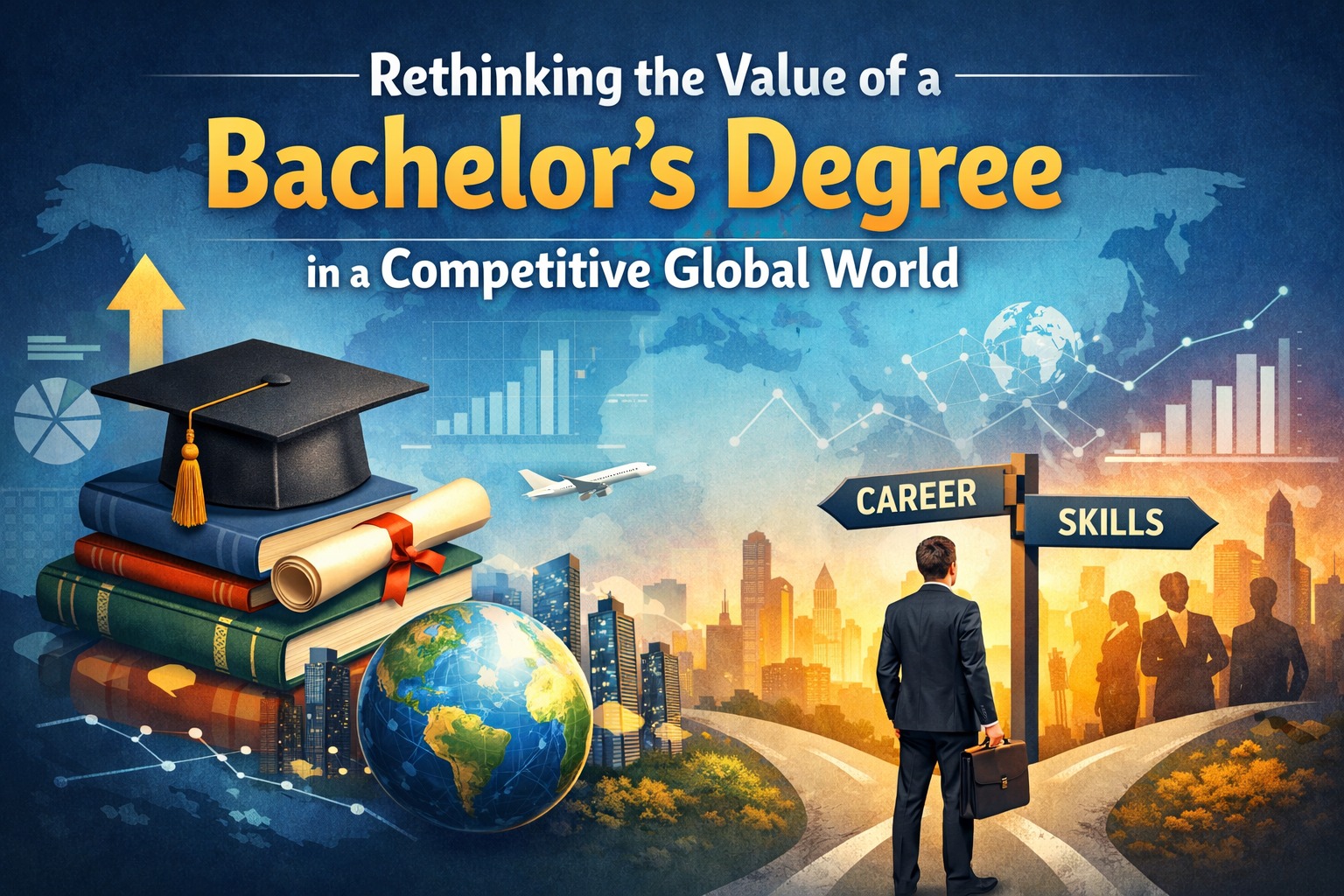
In an era defined by globalization, digital transformation, and cross-border competition, the traditional perception of higher education is evolving. For decades, earning a bachelor’s degree symbolized stability, intelligence, and access to better opportunities. Today, however, many professionals and students are rethinking the value of a bachelor’s degree in a competitive global world.
As industries become more dynamic and interconnected, success depends not only on academic credentials but also on adaptability, innovation, and measurable skills. This article explores how the relevance of a bachelor’s degree is shifting in the modern global economy.
THE IMPACT OF GLOBAL COMPETITION ON CAREERS
Globalization has expanded opportunities while intensifying competition. Professionals are no longer competing solely within local markets but against talent from around the world. Companies now recruit internationally, seeking individuals who can contribute immediately and operate across diverse environments.
In this competitive climate, employers often prioritize practical expertise, language proficiency, digital literacy, and cultural awareness. A bachelor’s degree may open initial doors, but sustained success requires continuous skill enhancement.
The global workforce demands flexibility and lifelong learning.
THE TRADITIONAL ADVANTAGES OF A BACHELOR’S DEGREE
Despite changing dynamics, a bachelor’s degree continues to offer significant benefits. University education provides structured academic training, theoretical depth, and critical thinking development. These competencies remain valuable in strategic decision-making and complex problem-solving.
Moreover, universities create opportunities for networking, mentorship, internships, and collaborative projects. Such experiences contribute to personal growth and professional confidence.
In regulated professions such as medicine, law, engineering, and education, a bachelor’s degree is still a minimum requirement. In these fields, formal education remains indispensable.
SKILLS, EXPERIENCE, AND DIGITAL COMPETENCE
In a competitive global world, employers increasingly assess candidates based on their ability to deliver results. Technical certifications, project portfolios, and practical experience often carry substantial weight during recruitment.
Digital competence has become particularly important. Knowledge of emerging technologies, data analysis, online communication tools, and remote collaboration platforms enhances employability.
Soft skills—including communication, leadership, adaptability, and teamwork—also play a crucial role. These attributes help professionals thrive in multicultural and fast-paced work environments.
INTEGRATING EDUCATION WITH CONTINUOUS DEVELOPMENT
Rather than questioning whether a bachelor’s degree is valuable, a more relevant approach is determining how to maximize its impact. Combining formal education with ongoing professional development creates a stronger competitive advantage.
Online courses, industry certifications, international exposure, and real-world projects can complement academic knowledge. Continuous learning ensures that professionals remain aligned with evolving global standards.
In today’s landscape, growth does not end at graduation—it accelerates through consistent self-improvement.
CONCLUSION
Rethinking the value of a bachelor’s degree in a competitive global world does not diminish its importance. Instead, it highlights the need to view it as a foundation rather than a final achievement.
A bachelor’s degree still provides credibility, knowledge, and access to numerous career paths. However, long-term success now depends on adaptability, practical skills, and lifelong learning. In a world where competition is global and change is constant, those who combine education with innovation will stand out and succeed.
Tentang Penulis
Gusti Ayu Tita P
Penulis — Universitas STEKOM
Penulis aktif yang berfokus pada isu-isu akademik, teknologi pendidikan, dan pengembangan sumber daya manusia di lingkungan kampus.















