Salary Tax in Indonesia A Complete Guide for Employees
Gusti Ayu Tita P
14 Agustus 2026
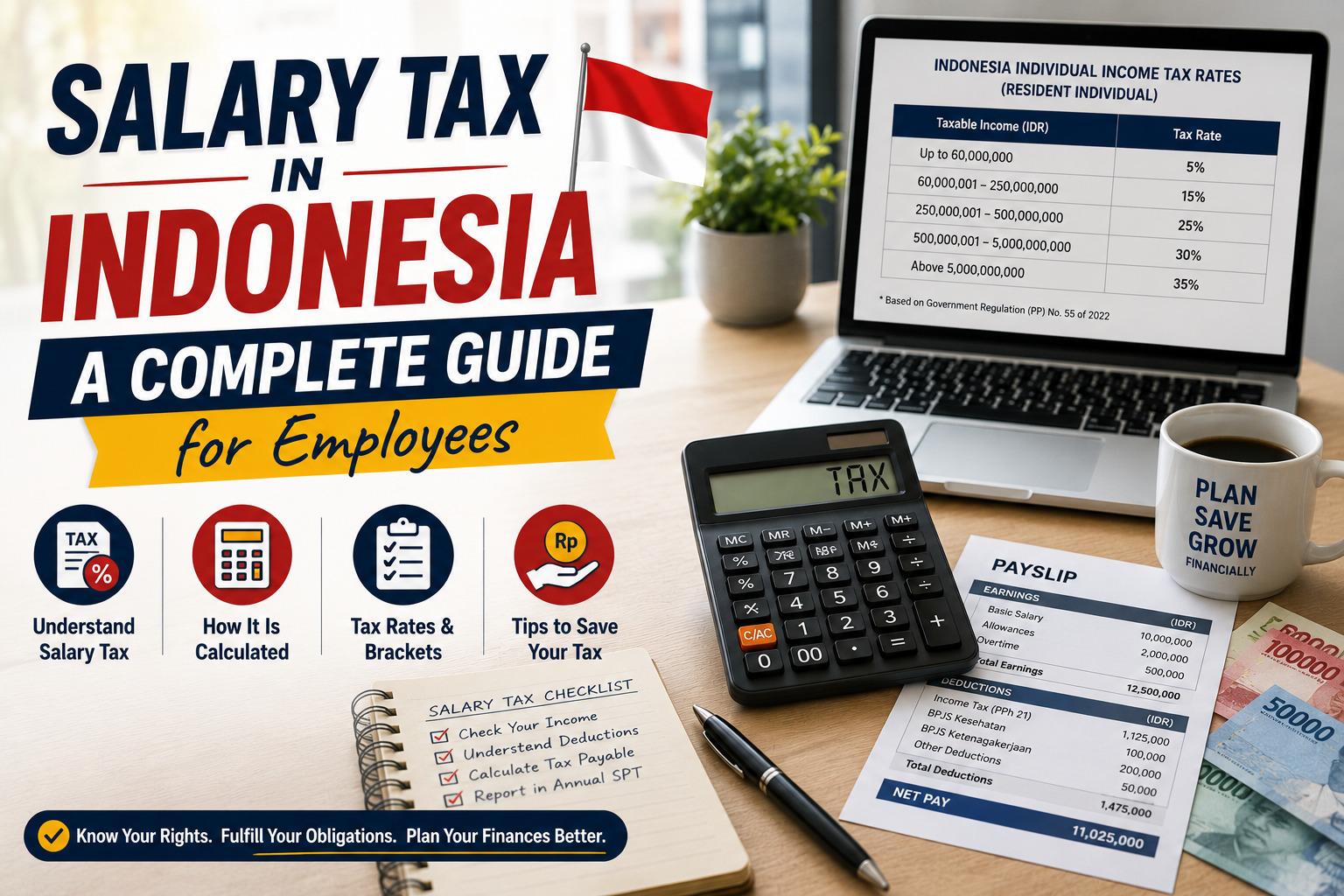
Salary tax in Indonesia is an important topic for employees because tax deductions directly affect the amount of income received each month. For employment income, the relevant mechanism generally involves Article 21 Income Tax or PPh 21, which is withheld according to applicable Indonesian tax regulations.
Understanding salary tax helps employees recognize the difference between gross salary and take-home pay. It also allows employees to check their payslips, understand tax deductions, and ensure that personal tax information used by their employer is accurate.
UNDERSTANDING SALARY TAX IN INDONESIA
Salary tax generally refers to income tax on employment-related earnings. Depending on the applicable provisions, employment income can include basic salary, allowances, bonuses, incentives, and other payments received in connection with employment.
Employers generally serve as PPh 21 withholding agents for their employees. They calculate the applicable tax, deduct it from employee income, and fulfill the required tax administration. Employees receive their salary after applicable tax and other authorized deductions have been considered.
HOW PPH 21 IS CALCULATED?
For permanent employees, Indonesia uses the Average Effective Rate or TER for PPh 21 withholding during tax periods other than the final tax period. The applicable rate depends on the employee's gross monthly income and the relevant TER category.
The TER system consists of Categories A, B, and C, which are associated with the employee's PTKP status. For example, an employee with TK/0 status and gross monthly income of IDR 8,000,000 falls within a TER Category A bracket with an effective rate of 1.50 percent. The example monthly calculation is IDR 8,000,000 × 1.50 percent = IDR 120,000.
FACTORS AFFECTING SALARY TAX
Several factors can influence the amount of PPh 21 withheld from an employee's salary. These include gross income, PTKP status, employment status, taxable income components, and the applicable tax calculation method.
Gross income may change when an employee receives a bonus, allowance, incentive, or other employment-related payment. The employee's marital status and qualifying dependents can also affect the applicable PTKP status and TER category. Therefore, employees should ensure that their personal information is correctly recorded by their employer.
WHAT EMPLOYEES SHOULD CHECK?
Employees should regularly review their payslips to understand their gross salary, PPh 21 deduction, other payroll deductions, and net salary. Checking these details can help employees understand why their take-home pay changes from one month to another.
Employees should also keep their tax information and withholding documents properly maintained. It is important to remember that monthly withholding is not necessarily the final annual tax calculation. For permanent employees, the final tax period uses an annual calculation, so the tax deduction in the final period may differ from previous months.
CONCLUSION
Salary tax in Indonesia generally involves PPh 21 on employment-related income. For permanent employees, the TER system simplifies monthly withholding during tax periods other than the final period, while the final tax period uses an annual calculation to determine the applicable tax liability.
Employees can better understand their salary tax by checking gross income, PTKP status, TER category, PPh 21 deductions, and payslips. Understanding these elements makes it easier to monitor payroll information and recognize how tax affects the income received each month.
Tentang Penulis
Gusti Ayu Tita P
Penulis — Universitas STEKOM
Penulis aktif yang berfokus pada isu-isu akademik, teknologi pendidikan, dan pengembangan sumber daya manusia di lingkungan kampus.