Scores, Expectations, and Pressure, Does SNBT Become Motivation to Rise or the Reason Students Feel Not Good Enough?
Gusti Ayu Tita P
6 Juni 2026
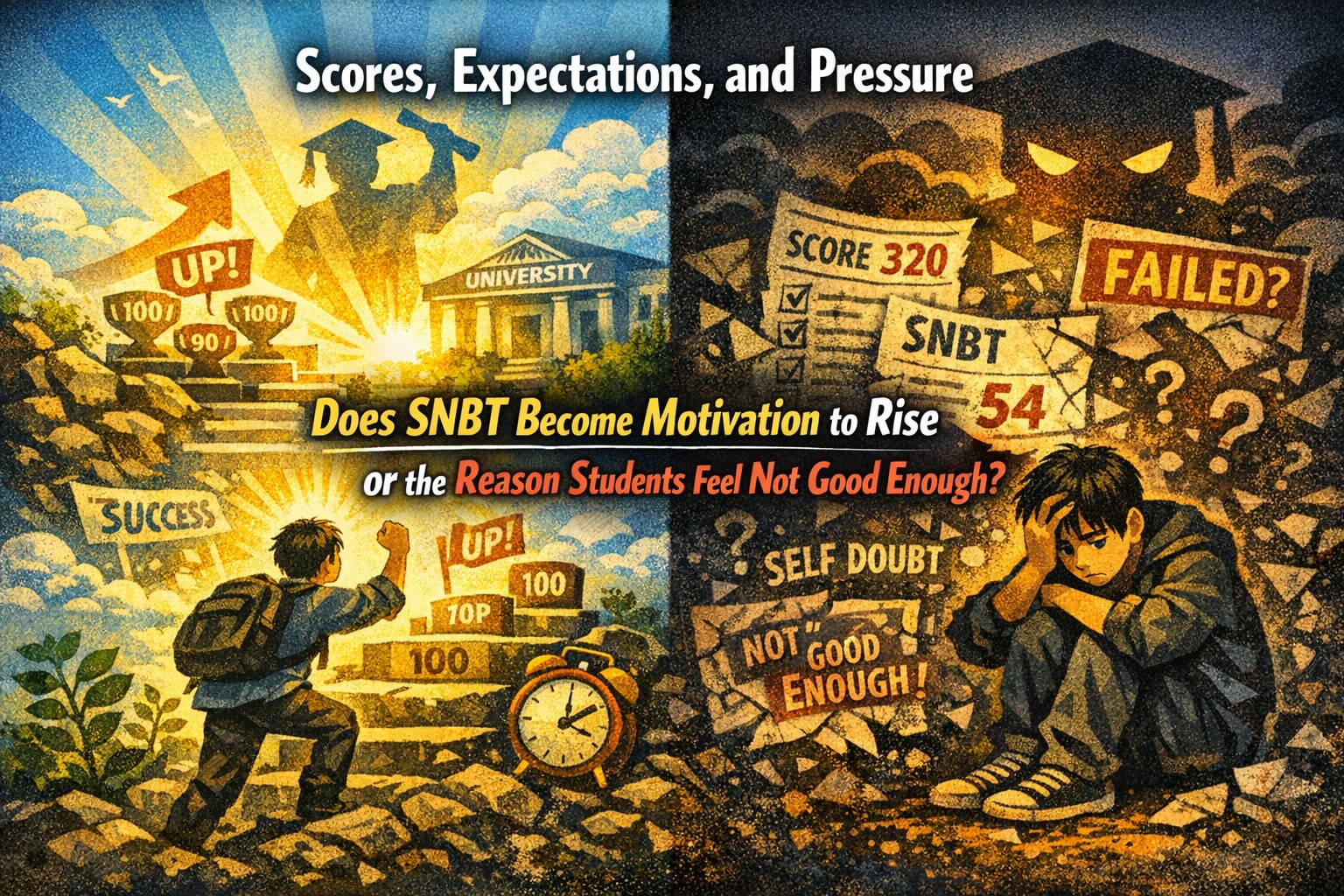
For many students in Indonesia, the journey toward university admission is one of the most emotional and challenging phases of life. It is a period filled with ambition, hope, sacrifice, and often silent fear. Among the various entrance pathways, SNBT (Seleksi Nasional Berdasarkan Tes) has become one of the most significant because it offers access to public universities through national academic competition. For students and families alike, SNBT is often seen as a major turning point that can shape the future.
Every year, thousands of students prepare intensively for this examination. They attend tutoring programs, complete endless tryout questions, and spend months trying to improve scores and rankings. Conversations at home often revolve around target campuses, passing grades, and academic strategies. In many cases, the exam becomes more than a test—it becomes a symbol of pride, family expectations, and personal worth.
This reality creates an important question. Does SNBT truly become a motivation that helps students rise and grow stronger, or does it become the reason many students feel they are never good enough? The answer lies in how students experience the process. For some, the exam inspires discipline and resilience. For others, it creates emotional pressure so strong that learning begins to feel like fear rather than opportunity.
Education should not only open doors to universities but also protect the confidence and mental health of the young people going through it. Understanding the emotional side of SNBT is essential if we want success to mean more than just numbers.
SNBT AS A SOURCE OF MOTIVATION AND AMBITION
One of the strongest positive impacts of SNBT is the way it gives students a clear academic purpose. Many students begin their final years of high school without a strong sense of direction. However, once they choose a dream major or target university, their motivation often becomes stronger and more focused.
The dream of studying medicine, engineering, psychology, education, law, or business creates a reason to work harder. Students start organizing their schedules more seriously, reducing distractions, and committing to consistent study routines. They understand that success requires preparation, not luck.
This process helps build discipline. Students learn how to manage time, set priorities, and remain consistent even when motivation decreases. Preparing for SNBT requires patience because improvement usually happens slowly through repeated practice and reflection.
SNBT also teaches resilience. Low tryout scores, difficult questions, and moments of self-doubt are common experiences. Students who continue learning despite setbacks often develop stronger emotional endurance and confidence.
Healthy competition can also be inspiring. Study groups, peer discussions, and shared goals help students grow together rather than struggle alone. In this way, SNBT can become a meaningful challenge that prepares students not only for university admission but also for future academic life.
WHEN EXPECTATIONS BECOME TOO HEAVY TO CARRY
The positive side of motivation begins to change when expectations become overwhelming. Many students are not only studying for themselves but also carrying the hopes of parents, teachers, relatives, and even their wider social environment.
Parents often want the best for their children, but repeated statements like “you must pass” or “you have to enter a top university” can turn support into pressure. Students may begin to believe that love and approval depend on academic success.
Teachers can also increase emotional weight when they focus too much on rankings and acceptance statistics. While competition is part of the process, constant emphasis on results can make students feel that failure is unacceptable.
Society often strengthens this pressure by celebrating only certain universities as symbols of intelligence and prestige. Students who choose alternative paths may feel underestimated, while those preparing for SNBT feel that they must succeed at all costs.
As expectations grow, studying becomes less about learning and more about avoiding disappointment. Students no longer ask how they can improve, but whether they are enough. This is where emotional pressure begins to quietly take control.
THE DANGEROUS HABIT OF COMPARING SCORES
Comparison is one of the most common and harmful experiences during SNBT preparation. Students constantly see scores, rankings, and academic achievements around them. Tryout results become public discussions, and social media adds even more opportunities for comparison.
A student who was once confident can quickly begin doubting themselves after seeing a friend achieve a higher score. Instead of focusing on personal progress, they start measuring value based on how they perform compared to others.
This creates unstable self-esteem. A good score brings temporary confidence, while one disappointing result can cause days of sadness and self-criticism. Students become emotionally dependent on numbers.
Rankings can be useful for evaluation, but when they become the main source of identity, they become dangerous. Students may feel invisible unless they are at the top. They forget that growth is personal and that progress does not always happen at the same speed for everyone.
Comparison also creates unnecessary panic. Students may rush to change study methods, doubt their chosen major, or lose motivation simply because they feel left behind. In reality, their own journey may still be moving in the right direction.
THE QUIET FEELING OF NOT BEING GOOD ENOUGH
One of the most painful emotional effects of SNBT pressure is the quiet feeling of never being enough. This feeling does not always appear loudly. It grows slowly through repeated disappointment, comparison, and fear of failure.
Students may begin to think that no matter how much they study, it is never sufficient. A high score feels temporary because there is always someone better. Rest feels like laziness, and mistakes feel like proof of weakness.
This mindset can damage mental health. Anxiety becomes part of daily life. Students overthink small problems, struggle to sleep, and feel guilty during moments of relaxation. Some experience burnout because they continue pushing themselves without emotional recovery.
The fear of disappointing parents adds another layer of pain. Students may hide stress because they do not want to appear weak. They smile outside while carrying emotional exhaustion inside.
When students constantly feel not good enough, learning loses its joy. Education becomes survival instead of discovery. This is a serious warning sign because academic success should never come at the cost of self-worth.
THE IMPORTANCE OF SUPPORTIVE PARENTS AND TEACHERS
Students facing SNBT need more than study materials—they need emotional safety. The role of parents and teachers is critical in determining whether the exam becomes healthy motivation or harmful pressure.
Supportive parents remind students that their value is not determined by one test result. They encourage effort, celebrate progress, and provide comfort during difficult moments. This creates confidence instead of fear.
Teachers also shape student perspectives. Educators who focus only on rankings may unintentionally increase anxiety. In contrast, teachers who recognize effort and encourage realistic improvement help students build stronger academic confidence.
Listening is often more powerful than advice. Students need spaces where they can express fear without judgment. Sometimes asking “How are you feeling?” is more meaningful than asking “What is your score?”
Schools should also provide counseling support and open conversations about stress management. Mental health should be treated as part of academic preparation, not as a separate issue.
A supportive environment helps students understand that ambition and emotional well-being can exist together.
REDEFINING SUCCESS BEYOND ONE EXAM RESULT
One of the biggest mistakes in academic culture is treating SNBT as the final measure of success. Many students believe that entering a top university is the only path to a meaningful future. This belief creates unnecessary fear and limits personal growth.
In reality, success has many forms. Public universities are valuable, but private campuses, vocational education, scholarships, entrepreneurship, and professional experience can also lead to strong and fulfilling careers.
Failure in SNBT does not mean failure in life. Sometimes rejection leads students toward paths that are more suitable for their talents and long-term goals. A different route does not mean a smaller future.
Students need to understand that they are bigger than one score. Character, discipline, creativity, resilience, and the ability to keep learning are qualities that matter far beyond university admission.
When success is defined too narrowly, pressure becomes destructive. But when success is seen as growth and contribution, students can pursue goals with healthier motivation and stronger self-respect.
Ultimately, SNBT should be a tool for opportunity, not a reason for students to doubt their worth. It should challenge them to rise, not convince them that they are never enough.
Scores, expectations, and pressure will always exist in competitive education systems. The challenge is making sure those pressures build strength instead of emotional damage. Students deserve ambition without constant fear and discipline without losing confidence.
SNBT can become motivation to rise when students are supported by balance, understanding, and realistic definitions of success. But if the system teaches them that numbers define identity, it risks becoming the reason they feel permanently inadequate.
Education should help students believe in their potential, not question their value. Because in the end, success is not only about entering university—it is about becoming someone who can keep growing with confidence and purpose.
Tentang Penulis
Gusti Ayu Tita P
Penulis — Universitas STEKOM
Penulis aktif yang berfokus pada isu-isu akademik, teknologi pendidikan, dan pengembangan sumber daya manusia di lingkungan kampus.