Social Media’s Role in Mobilizing Mass Protests
Gusti Ayu Tita P
1 September 2026
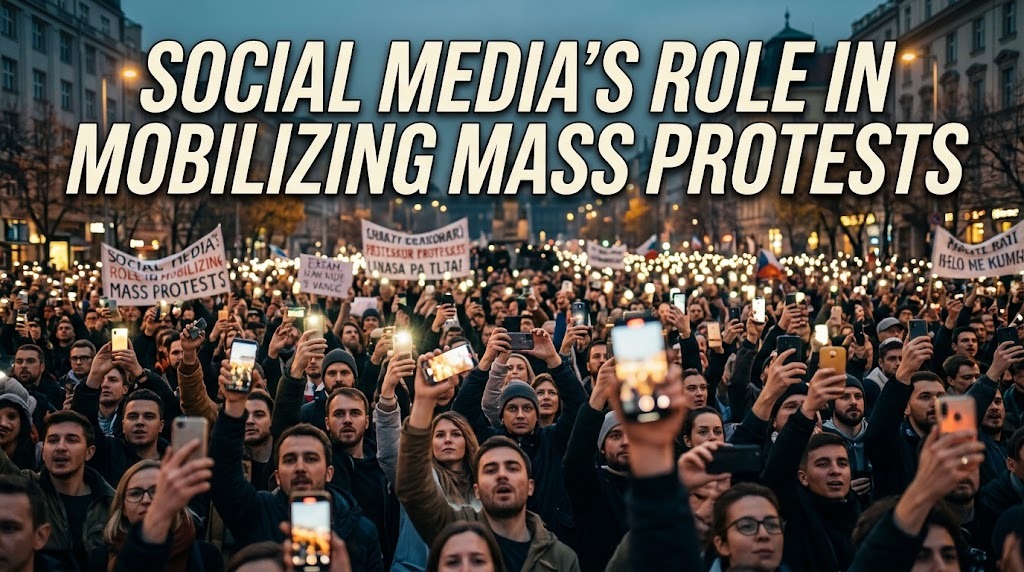
Social media has changed the way people communicate, organize, and participate in public movements. Platforms such as Facebook, Instagram, TikTok, X, and other digital networks allow information to spread quickly across large communities. In the context of mass protests, these platforms can help people discover an issue, discuss shared concerns, and coordinate participation. Research has found that social media can support protest mobilization by facilitating information exchange, emotional engagement, and social connections.
However, social media does not automatically create a successful protest movement. Online attention must often be connected with real-world participation, organization, and continued public engagement. Digital platforms can expand the reach of a movement, but they can also spread misinformation and create fragmented discussions. Understanding both the opportunities and limitations of social media is therefore important when examining modern mass protests.
SOCIAL MEDIA MAKES PROTEST INFORMATION EASIER TO ACCESS
One of the most important roles of social media is making information about public issues easier to access. People can quickly learn about a planned demonstration, its background, and the concerns being raised. Research has shown that social media can facilitate the exchange of practical information relevant to protest participation, including transportation, turnout, and other logistical matters. (DOI) This reduces some of the traditional barriers to learning about collective action.
Social media also allows information to move beyond local communities. A protest that begins in one city can attract attention from people in other regions or countries. Information sharing can therefore help transform a local concern into a wider public conversation. At the same time, users need to verify information before sharing it because speed does not guarantee accuracy.
HASHTAGS HELP CONNECT PUBLIC CONCERNS
Hashtags can provide a simple way for people to find and follow conversations about a particular issue. When many users use the same hashtag, separate posts can become part of a larger digital discussion. This can make a topic easier to discover and help participants recognize that others share similar concerns. Digital networks can therefore connect individuals who may never have interacted offline.
Research on Indonesian demonstrations has found that hashtags and social media framing can help transform fragmented grievances into more cohesive protest agendas and increase pressure on mainstream media and institutions to respond. Hashtags do not guarantee a successful movement, but they can make public conversations more visible. Their effectiveness depends on whether online attention develops into meaningful engagement and participation.
SOCIAL MEDIA SUPPORTS PROTEST COORDINATION
Organizing a large public gathering requires communication between many people. Social media can provide channels for sharing announcements, schedules, locations, updates, and other relevant information. Earlier research on political protests found that social platforms supported coordination by allowing participants to exchange practical information and communicate rapidly. This can make decentralized organization easier.
Social media can also reduce dependence on a single formal organization. Individuals and smaller groups can communicate directly with their own networks while contributing to a broader movement. Decentralized mobilization has become an important characteristic of many contemporary social movements. Research on Occupy Wall Street, for example, found that social media accounts could help protests spread to additional cities. (ScienceDirect)
EMOTIONAL MESSAGES CAN ENCOURAGE PARTICIPATION
Information alone does not always motivate people to participate in a protest. Emotional messages can also influence whether individuals feel connected to an issue. Research has identified the importance of emotions such as anger, concerns about fairness, social identification, and perceptions of group effectiveness in online protest communication. These emotions can make an issue feel personally relevant to users.
At the same time, emotional content can have negative consequences when it encourages hostility or spreads unverified claims. Highly emotional posts may receive substantial attention even when they lack reliable evidence. Responsible communication is therefore essential when using social media around sensitive public issues. Strong emotions can support civic engagement, but they should not replace facts and careful judgment.
SOCIAL NETWORKS TURN ONLINE INTEREST INTO OFFLINE ACTION
One of the most important questions is whether online activity actually leads people to participate in physical protests. Research has found connections between coordinated social media activity and subsequent offline protest events. A large-scale study of Twitter activity during the Arab Spring found that increased coordination around protest hashtags was associated with increased protests on the following day.
Social media can also influence individual decisions about whether to attend a demonstration. Research examining the Tahrir Square protests found that social media provided information that helped shape decisions about participation, protest logistics, and perceptions of whether participation could succeed. This shows how digital communication can connect online participation with offline collective action.
ONLINE SUPPORT DOES NOT ALWAYS CREATE LONG TERM MOVEMENTS
A large online following does not necessarily mean that a protest movement will remain strong. Social media can help attract thousands of people to an event while making it more difficult to maintain participation over a longer period. Research on protests in Singapore found that social media helped mobilize large crowds, but participation declined in later demonstrations and the movement did not achieve its intended policy changes. (ScienceDirect)
This distinction is important because mobilization and sustainability are different challenges. Getting people interested in an issue may be easier than maintaining organization, leadership, resources, and long-term participation. Successful social movements often need structures and relationships that extend beyond online communication. Social media can support these processes, but it cannot replace them completely.
THE ROLE OF ORDINARY USERS IS ALSO IMPORTANT
Social media movements are not driven only by activists or organizations. Ordinary users who share, comment on, or discuss protest-related content can significantly expand its reach. Research on the growth of social protests found that participants on the wider periphery of online networks can be important in spreading protest messages beyond a committed core group.
This means that even users who do not attend a physical demonstration can influence public awareness. Their online activity can introduce an issue to friends, family members, colleagues, and other communities. Digital participation can therefore take many forms, from reading and discussing information to sharing verified content. Nevertheless, online engagement should not automatically be treated as equivalent to physical participation.
MISINFORMATION CREATES NEW CHALLENGES
The speed of social media can become a problem when inaccurate information spreads alongside legitimate updates. False claims, manipulated images, old videos, and misleading captions can influence how people understand a protest. Users may react to information before checking its source or context. Misinformation can increase social tension and make constructive public discussion more difficult.
Digital literacy is therefore essential for people following protest movements online. Users should check the source, publication date, location, and supporting evidence before sharing important claims. Comparing information across reliable sources can also reduce the risk of misunderstanding. Responsible users can help create a digital environment where verified information receives greater attention than sensational claims.
SOCIAL MEDIA ALGORITHMS SHAPE WHAT PEOPLE SEE
Social media platforms do not present every piece of information equally. Algorithms influence which posts, videos, and discussions users are likely to encounter. Research on contemporary protest movements shows that activists increasingly adapt their communication to social media logic, including the timing and design of posts. This can influence which messages receive greater visibility.
Greater visibility can help a movement reach new audiences, but it can also encourage organizations to focus heavily on content that attracts engagement. Popularity does not necessarily indicate importance or accuracy. Algorithmic visibility can therefore create both opportunities and limitations for protest movements. Understanding how digital platforms work helps users interpret online protest content more critically.
SOCIAL MEDIA AND INDONESIAN PROTEST MOVEMENTS
Indonesia provides relevant examples of how social media can become part of contemporary protest communication. Research examining Indonesian demonstrations in August 2025 found that activists, labor groups, religious organizations, and citizens used social media to frame grievances and build broader reform narratives. The study concluded that social media supported decentralized mobilization and helped connect fragmented concerns into more cohesive agendas.
Earlier research on Indonesian protest movements also identified hashtags as tools for mobilizing people both online and offline. Examples discussed in academic research include movements associated with hashtags such as Gejayan Memanggil and Mosi Tidak Percaya. These examples demonstrate how digital communication can become part of public participation in Indonesia's changing media environment.
CONCLUSION
Social media plays an increasingly important role in mobilizing mass protests by making information easier to access, connecting people, spreading messages, supporting coordination, and increasing public visibility. Research indicates that digital networks can help connect online communication with offline collective action. However, social media alone does not guarantee a successful or sustainable movement.
Ultimately, the influence of social media depends on how people use it. Accurate information, responsible communication, digital literacy, meaningful participation, and effective organization can make online platforms more useful for constructive civic engagement. At the same time, misinformation, algorithmic limitations, and declining participation can reduce their effectiveness. When used responsibly, social media can serve as an important bridge between public concerns, collective action, and democratic discussion.
Tentang Penulis
Gusti Ayu Tita P
Penulis — Universitas STEKOM
Penulis aktif yang berfokus pada isu-isu akademik, teknologi pendidikan, dan pengembangan sumber daya manusia di lingkungan kampus.