The Role of Deep Learning In Developing Modern Intelligent Applications
Gusti Ayu Tita P
17 September 2026
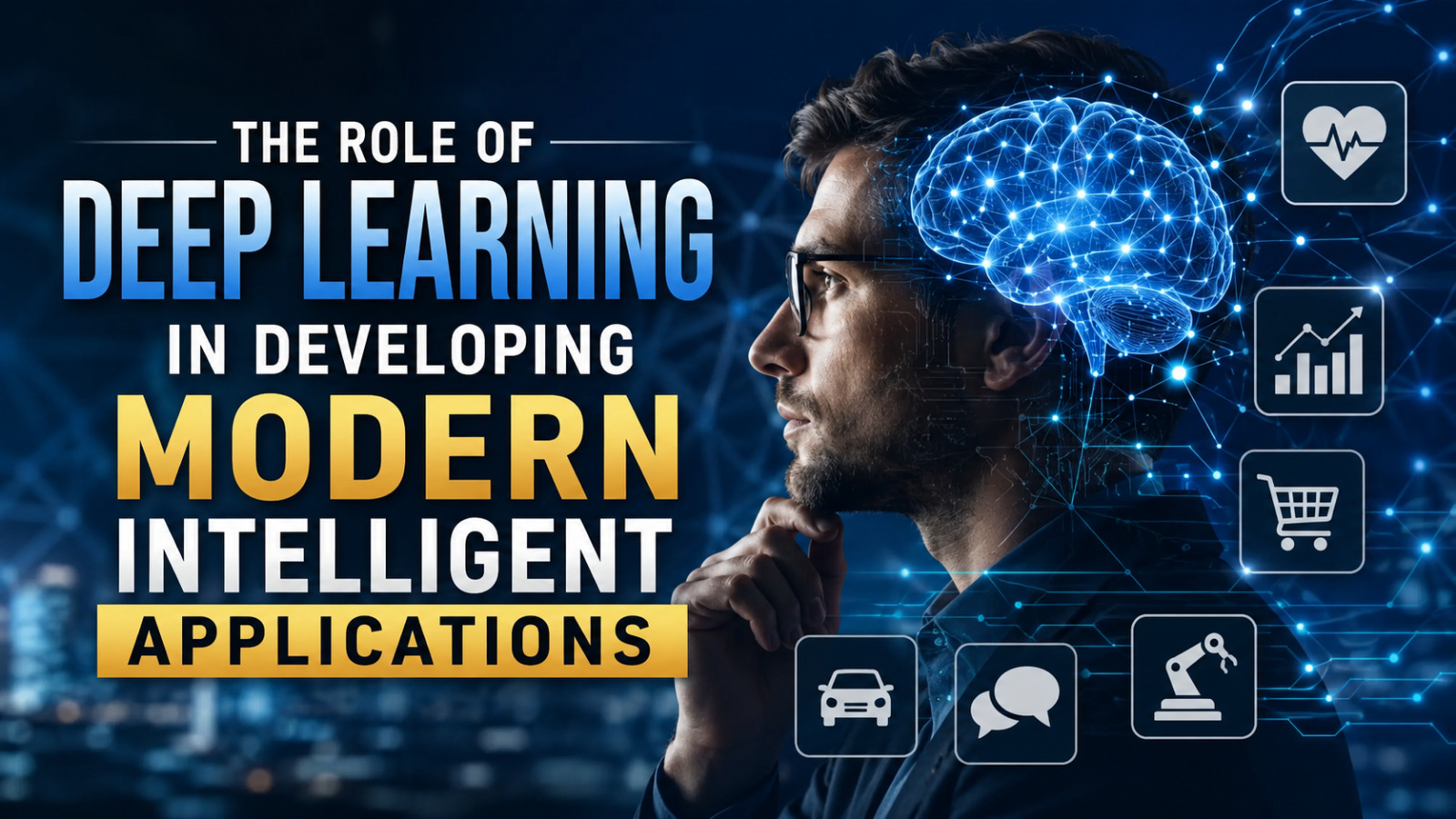
The rapid growth of Artificial Intelligence (AI) has significantly changed the way people interact with technology. One of the most influential technologies behind this transformation is Deep Learning, a branch of machine learning that enables computers to learn complex patterns from large amounts of data. Today, Deep Learning powers many intelligent applications that improve productivity, efficiency, and user experience across various industries.
From healthcare and education to finance and transportation, Deep Learning continues to drive innovation by making systems smarter and more adaptive. Modern intelligent applications can recognize images, understand speech, translate languages, and even predict future trends with impressive accuracy. As computing power and data availability continue to increase, the impact of Deep Learning will become even greater in the coming years.
UNDERSTANDING DEEP LEARNING
Deep Learning is an advanced subset of Machine Learning that uses multiple layers of Neural Networks to process information and identify patterns. Unlike traditional programming, Deep Learning models improve their performance by learning directly from large datasets rather than relying on manually created rules. This capability allows computers to solve highly complex problems with remarkable accuracy.
The strength of Deep Learning lies in its ability to automatically extract meaningful features from raw data. As more data becomes available, these models continue to improve their performance. This makes Deep Learning highly suitable for applications involving images, videos, speech, text, and other unstructured data that are difficult to process using conventional methods.
HOW DEEP LEARNING WORKS?
A Deep Learning model consists of multiple hidden layers that process data step by step. Each layer extracts increasingly sophisticated features before passing the information to the next layer. This layered approach enables the model to understand complex relationships that traditional algorithms may fail to recognize.
Training a Deep Learning model requires a large amount of data, powerful computing resources, and continuous optimization. During training, the model adjusts millions of internal parameters to minimize prediction errors. Once trained, the model can make accurate predictions, classify data, recognize objects, or generate meaningful outputs with high efficiency.
APPLICATIONS OF DEEP LEARNING IN MODERN INDUSTRIES
Deep Learning has become an essential technology in healthcare by assisting doctors in diagnosing diseases from medical images with greater precision. It also supports drug discovery, patient monitoring, and personalized treatment recommendations. These innovations contribute to faster medical decisions and improved patient outcomes.
In business and finance, Artificial Intelligence powered by Deep Learning helps detect fraud, predict market trends, automate customer service, and optimize business operations. In education, intelligent learning platforms personalize learning materials based on student performance. Meanwhile, autonomous vehicles, smart manufacturing systems, and recommendation engines continue to demonstrate the growing importance of Deep Learning across industries.
BENEFITS OF DEEP LEARNING FOR INTELLIGENT APPLICATIONS
One of the greatest advantages of Deep Learning is its ability to deliver highly accurate predictions even when processing massive datasets. Intelligent applications can continuously improve their performance through ongoing learning, resulting in better recommendations, faster decision-making, and enhanced automation.
Another important benefit is scalability. As organizations collect more data, Deep Learning models can become even more effective without requiring complete redesigns. This flexibility enables businesses to develop innovative products, improve customer experiences, reduce operational costs, and gain valuable insights from complex information.
CHALLENGES IN IMPLEMENTING DEEP LEARNING
Despite its advantages, Deep Learning also presents several challenges. Training advanced models often requires expensive hardware, large storage capacity, and significant computational power. Organizations must also invest in high-quality datasets because inaccurate or biased data can reduce model performance.
Another challenge involves model transparency. Deep Learning systems sometimes function as "black boxes," making it difficult to explain how specific decisions are made. Researchers continue developing techniques that improve model interpretability, fairness, and security while maintaining high predictive accuracy.
THE FUTURE OF DEEP LEARNING
The future of Deep Learning looks increasingly promising as computing technology continues to evolve. More efficient algorithms, specialized AI processors, and cloud computing platforms are making Deep Learning accessible to organizations of all sizes. These advancements are expected to accelerate innovation across many sectors.
Emerging technologies such as Computer Vision, Natural Language Processing, robotics, and generative AI will rely heavily on Deep Learning to deliver smarter and more human-like interactions. As ethical AI practices continue to improve, Deep Learning will play an even more important role in building reliable, secure, and intelligent digital solutions for society.
CONCLUSION
Deep Learning has become one of the most important technologies behind modern Intelligent Applications. Its ability to analyze vast amounts of data, recognize complex patterns, and continuously improve performance enables organizations to create smarter, faster, and more efficient digital solutions. Although challenges such as computational requirements and model transparency remain, ongoing research continues to address these limitations. As technology advances, Deep Learning, Artificial Intelligence, Machine Learning, Neural Networks, and Natural Language Processing will continue shaping the future of intelligent applications across nearly every industry.
Tentang Penulis
Gusti Ayu Tita P
Penulis — Universitas STEKOM
Penulis aktif yang berfokus pada isu-isu akademik, teknologi pendidikan, dan pengembangan sumber daya manusia di lingkungan kampus.