The Role of Land Certificates in Resolving Land Disputes
Gusti Ayu Tita P
2 September 2026
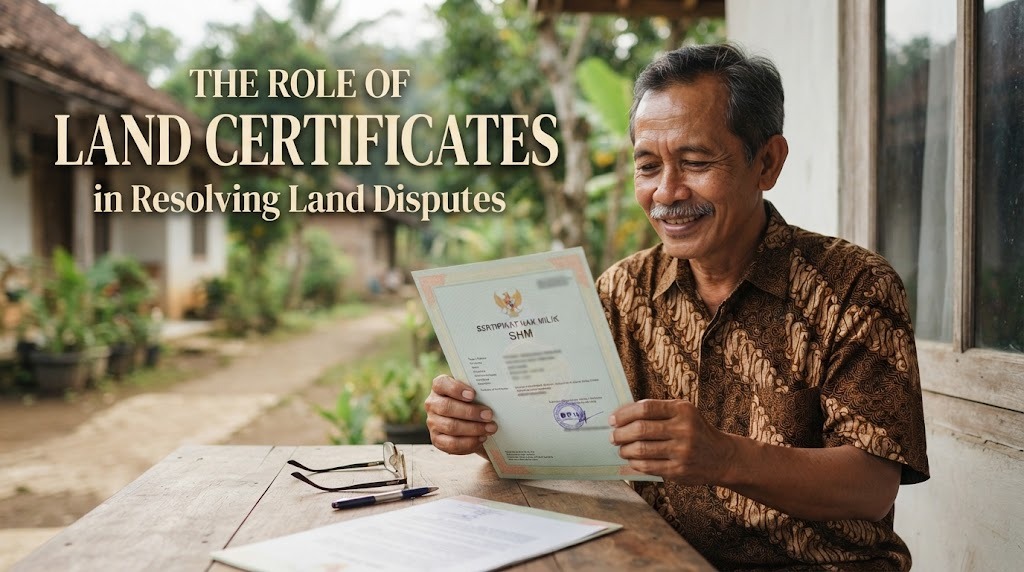
Land disputes can arise from conflicting ownership claims, unclear boundaries, inheritance issues, or differences in land records. In these situations, a land certificate can become an important document for establishing information about a property. It can help clarify who holds registered rights and provide details about the land involved in a dispute. However, a certificate should be considered together with other relevant evidence and official land records.
LAND CERTIFICATES AS PROOF OF LAND RIGHTS
A land certificate serves as official evidence of registered rights over a particular parcel of land. It generally contains important information about the right holder and the registered land. When a dispute occurs, this information can help establish the initial legal position of the person claiming rights over the property. The certificate can also be compared with other documents to understand the history and status of the land.
However, having a certificate does not necessarily mean that every dispute is automatically resolved. Some cases may involve questions about how the land was acquired, inheritance, transactions, boundaries, or administrative issues. Therefore, other supporting evidence may still be important when determining the facts. A complete review can provide a clearer picture of the dispute.
CLARIFYING LAND OWNERSHIP
One of the most important roles of a land certificate is helping identify the registered holder of land rights. When several people claim the same property, the information recorded on the certificate can provide an important reference point. Details such as the name of the right holder, land area, and property information can be checked against the claims of the parties involved. This can make discussions and dispute resolution more fact-based.
Nevertheless, ownership disputes may require a review of the property's history. Documents related to purchases, inheritance, transfers, or previous ownership may provide additional information. If there are inconsistencies, the parties should seek clarification through the relevant Land Office. This is preferable to relying solely on verbal claims.
CONFIRMING LAND BOUNDARIES
Unclear or disputed boundaries are common causes of land conflicts. Information connected to a registered land parcel can help parties understand the location, area, and boundaries of the property. When necessary, official verification or measurement can be requested through the appropriate land administration process. This can help determine whether the physical condition of the property corresponds with its registered information.
Landowners should avoid moving boundary markers, constructing fences, or occupying disputed areas unilaterally. Such actions can increase tensions and potentially create additional legal problems. A proper verification process provides a more reliable basis for resolving boundary disagreements. Cooperation between the parties can also make the process easier.
SUPPORTING MEDIATION AND NEGOTIATION
Land certificates can be useful during negotiations and mediation because they provide documented information about the property. Parties can use the certificate, together with supporting documents, to compare their respective claims. This can help discussions focus on facts rather than assumptions. A neutral mediator can then help the parties explore possible solutions.
If an agreement is reached, the settlement should be recorded in writing. Where the agreement involves a transfer or change of land rights, the parties may need to complete additional formal procedures. Professional assistance from an authorized land deed official or legal professional can help ensure that the settlement is properly documented. This reduces the risk of creating another dispute later.
A CERTIFICATE IS NOT THE ONLY PIECE OF EVIDENCE
Although a land certificate is important, it should not always be treated as the only evidence relevant to a dispute. Depending on the circumstances, other documents and facts may need to be examined. These can include transaction documents, inheritance records, survey information, previous land records, and evidence concerning possession or use. The importance of each piece of evidence depends on the specific dispute.
If someone challenges the validity or history of a registered right, the matter may require examination by the competent authority or court. Therefore, landowners should keep their original certificates and supporting documents in a secure place. They should also avoid handing original documents to unauthorized parties. Proper documentation can make it easier to protect land rights when a dispute arises.
WHAT TO DO WHEN A LAND CERTIFICATE IS DISPUTED
When the validity or information contained in a land certificate is challenged, the first step should be to understand the specific reason for the objection. The landowner can gather the certificate and supporting documents and seek clarification from the relevant Land Office. The chronology of ownership and transactions should also be documented carefully. This can help identify whether the problem relates to administration, ownership, boundaries, or another legal issue.
If the dispute cannot be resolved through administrative procedures or mediation, legal advice may be necessary. A lawyer can review the available evidence and explain the appropriate legal options. The parties should avoid making false documents or taking physical action against the disputed property. Resolving the issue through proper procedures provides greater legal certainty.
CONCLUSION
Land certificates play an important role in resolving land disputes because they provide official information about registered land rights and the property concerned. They can help clarify ownership, support boundary verification, and provide a factual basis for negotiation or mediation. However, a certificate is not necessarily the only evidence that matters in every dispute. Reviewing supporting documents, land history, official records, and relevant facts is essential for reaching a fair and legally sound resolution.
Tentang Penulis
Gusti Ayu Tita P
Penulis — Universitas STEKOM
Penulis aktif yang berfokus pada isu-isu akademik, teknologi pendidikan, dan pengembangan sumber daya manusia di lingkungan kampus.