Tips and Tricks for Conducting Historical Research through Tombs and Burial Sites
Gusti Ayu Tita P
4 September 2026
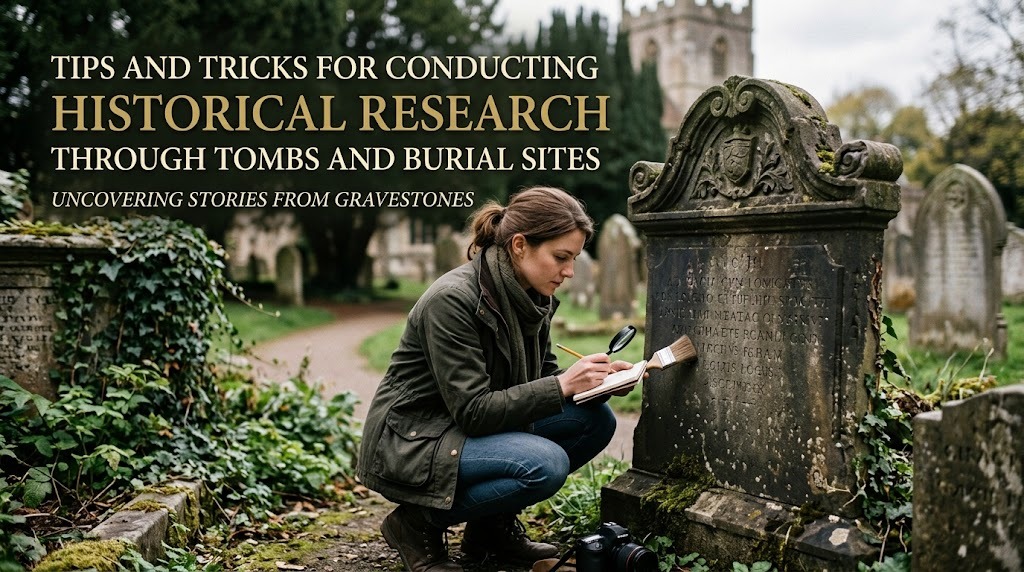
Historic tombs and burial sites can provide valuable evidence for understanding past societies, cultural traditions, and historical events. Researchers can examine architecture, inscriptions, location, materials, and other permitted evidence to develop a deeper understanding of the past. However, burial sites are often culturally or religiously sensitive, so research must be conducted carefully. A good research process combines reliable methods with respect for the site and the people connected to it.
DEFINING THE RESEARCH TOPIC
The first step in historical research is to establish a clear research question or topic. Researchers might focus on burial traditions, tomb architecture, historical figures, religious practices, or changes in local communities. A specific topic makes it easier to determine which evidence is relevant.
Researchers should also identify the historical period and geographical area being studied. Historical context helps prevent evidence from being interpreted incorrectly. Understanding the political, religious, economic, and social conditions of the period can provide important background for interpreting a burial site.
USING MULTIPLE HISTORICAL SOURCES
Tombs should not be treated as the only source of historical information. Researchers can compare evidence from inscriptions, archival documents, books, maps, oral histories, archaeological reports, and museum collections. Using multiple sources can help identify similarities, differences, and possible gaps in the historical record.
Source comparison is especially important when information about a tomb comes from local stories or popular accounts. Oral traditions can be valuable, but they should be considered alongside other evidence. A careful researcher distinguishes between documented evidence, interpretation, and tradition.
OBSERVING TOMBS AND BURIAL SITES CAREFULLY
Direct observation can provide useful information about the physical characteristics of a site. Researchers may document permitted features such as tomb dimensions, construction materials, inscriptions, decorative elements, surrounding structures, and visible signs of deterioration. Detailed notes can help preserve observations for later analysis.
Photography and mapping can support field observations when permitted. Researchers should record the date, location, and subject of each observation to maintain accurate documentation. They should never remove objects, disturb graves, or make physical changes to the site simply to obtain information.
ANALYZING INSCRIPTIONS AND SYMBOLS
Inscriptions can provide important clues about names, dates, titles, languages, beliefs, and social relationships. Researchers should document inscriptions accurately and consider their historical and linguistic context. Damaged or unclear writing should be recorded honestly rather than reconstructed without sufficient evidence.
Symbols and decorative patterns can also contribute to historical interpretation. Their meanings should be compared with reliable evidence from the same culture and period. Contextual analysis is important because the same symbol may have different meanings in different societies or historical circumstances.
USING TECHNOLOGY FOR RESEARCH
Modern technology can improve the documentation and analysis of historic burial sites. Digital photography, geographic information systems, 3D scanning, digital archives, and remote sensing can help researchers record information with greater detail. These methods can also reduce the need for unnecessary physical intervention.
Digital tools can make research materials easier to organize and compare. Researchers can create databases containing photographs, measurements, maps, inscriptions, and historical references. When properly managed, digital documentation can support future research and help preserve information about vulnerable heritage sites.
FOLLOWING ETHICAL RESEARCH PRACTICES
Ethics are especially important when researching burial sites and human remains. Researchers should follow relevant laws, obtain required permissions, and respect religious and cultural practices. Human remains should never be treated merely as research objects without considering their cultural and ethical significance.
Researchers should also communicate appropriately with local communities and heritage authorities. Local knowledge can provide useful historical context and help researchers understand traditions connected to the site. Responsible research balances the pursuit of knowledge with respect for people, communities, and cultural heritage.
CONCLUSION
Historical research through tombs and burial sites requires careful planning, reliable sources, detailed observation, appropriate technology, and strong ethical standards. Researchers can gain valuable insights by studying architecture, inscriptions, symbols, location, historical records, and cultural traditions. Comparing multiple sources helps create more accurate interpretations of the past. By protecting burial sites while conducting responsible research, researchers can expand historical knowledge without damaging valuable cultural heritage.
Tentang Penulis
Gusti Ayu Tita P
Penulis — Universitas STEKOM
Penulis aktif yang berfokus pada isu-isu akademik, teknologi pendidikan, dan pengembangan sumber daya manusia di lingkungan kampus.