Tips For Understanding Deep Learning From Beginner To Advanced Level Easily
Gusti Ayu Tita P
9 September 2026
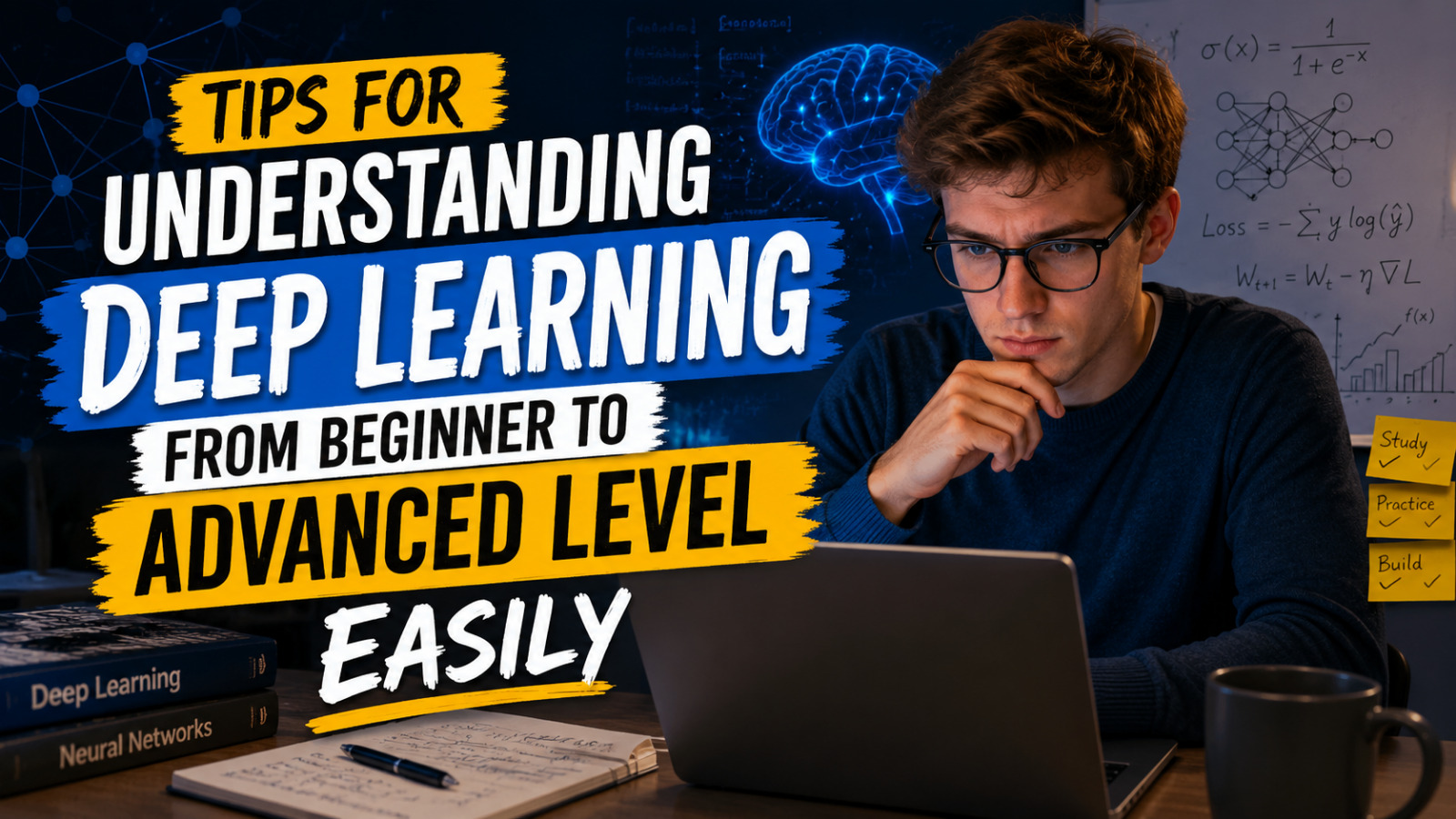
Deep Learning has become one of the most important technologies in modern Artificial Intelligence. It powers innovations such as voice assistants, recommendation systems, image recognition, autonomous vehicles, and medical diagnosis. Although many beginners think it is difficult, learning Deep Learning becomes much easier with the right strategy and consistent practice. By understanding the basic concepts first and gradually moving toward advanced topics, anyone can develop strong knowledge and practical skills in this rapidly growing field.
WHY UNDERSTANDING DEEP LEARNING IS IMPORTANT?
Deep Learning is a specialized branch of Machine Learning that enables computers to learn from massive amounts of data using artificial neural networks. It has transformed industries by improving automation, prediction accuracy, and decision-making processes. Understanding this technology opens opportunities in software development, data science, healthcare, finance, education, and many other sectors.
As businesses increasingly rely on intelligent systems, professionals with Deep Learning Skills continue to be in high demand. Even if you do not plan to become an AI researcher, learning the fundamentals helps you understand how modern technologies work. This knowledge also prepares you for future technological developments and career opportunities.
START WITH THE FUNDAMENTALS BEFORE MOVING TO ADVANCED TOPICS
Many beginners make the mistake of jumping directly into complex neural network architectures. Instead, begin by learning Basic Mathematics, including algebra, probability, calculus, and statistics. These concepts help explain how neural networks calculate predictions and improve accuracy during training.
Next, understand the fundamentals of Machine Learning, including supervised learning, unsupervised learning, datasets, features, labels, and model evaluation. Once these concepts become familiar, transitioning into Deep Learning will feel much more natural and manageable.
LEARN HOW NEURAL NETWORKS ACTUALLY WORK?
A neural network consists of multiple interconnected layers that process information step by step. The primary components include the Input Layer, Hidden Layers, and Output Layer. Each layer transforms data until the network produces a prediction.
You should also understand important concepts such as Activation Functions, Weights, Biases, Forward Propagation, Backpropagation, and Gradient Descent. Learning how these components interact provides a solid foundation before studying more advanced architectures like CNNs and Transformers.
MASTER PYTHON AND ESSENTIAL DEEP LEARNING TOOLS
The most widely used programming language for Deep Learning is Python because of its simplicity and extensive AI ecosystem. Beginners should first become comfortable with Python syntax, functions, loops, object-oriented programming, and data manipulation.
Afterward, explore popular libraries such as NumPy, Pandas, Matplotlib, TensorFlow, PyTorch, and Scikit-learn. These tools simplify model development, visualization, training, and evaluation while allowing developers to build professional AI applications efficiently.
PRACTICE WITH SMALL PROJECTS BEFORE BUILDING COMPLEX MODELS
The fastest way to improve Deep Learning Skills is through consistent hands-on practice. Start with simple projects such as handwritten digit recognition, image classification, spam email detection, or sentiment analysis. These projects reinforce theoretical knowledge through practical implementation.
As your confidence grows, gradually work on larger datasets and more sophisticated architectures. Every completed project improves your understanding of data preprocessing, model training, hyperparameter tuning, and performance evaluation.
UNDERSTAND DIFFERENT TYPES OF DEEP LEARNING MODELS
Different problems require different neural network architectures. Artificial Neural Networks (ANNs) work well for structured numerical data, while Convolutional Neural Networks (CNNs) are designed for image processing and computer vision tasks.
For sequential data such as language or time series, learn Recurrent Neural Networks (RNNs), Long Short-Term Memory (LSTM) networks, and modern Transformer Models. Understanding when to use each architecture greatly improves your ability to solve real-world AI problems.
IMPROVE YOUR KNOWLEDGE THROUGH CONSISTENT LEARNING
The field of Artificial Intelligence evolves rapidly, making continuous learning essential. Read technical blogs, research summaries, documentation, tutorials, and educational books to stay informed about new algorithms and best practices. Following structured learning paths prevents information overload.
Joining online communities and participating in AI discussions also accelerates learning. Asking questions, reviewing other developers' projects, and sharing your own experiences expose you to different perspectives and practical solutions that strengthen your expertise.
AVOID COMMON MISTAKES WHEN LEARNING DEEP LEARNING
Many beginners focus only on memorizing code without understanding the underlying concepts. This often creates confusion when models fail or datasets become more complex. Instead, prioritize learning why each algorithm works before concentrating on implementation details.
Another common mistake is expecting immediate results. Deep Learning requires patience, experimentation, and continuous improvement. Accepting mistakes as learning opportunities helps build stronger analytical and problem-solving abilities over time.
BUILD A PERSONAL LEARNING ROADMAP
Creating a structured roadmap helps you learn more efficiently. Divide your journey into manageable stages such as mathematics fundamentals, Python programming, machine learning basics, neural networks, computer vision, natural language processing, and advanced optimization techniques.
Setting realistic weekly goals keeps motivation high and makes progress easier to measure. A clear roadmap also prevents skipping essential concepts that serve as building blocks for advanced topics.
CONCLUSION
Learning Deep Learning does not have to be overwhelming when approached step by step. Begin by mastering the fundamentals of mathematics, Machine Learning, and Python before exploring neural networks and advanced AI architectures. Consistent practice through real projects, continuous learning, and understanding the theory behind every algorithm will steadily improve your expertise. By following a structured learning roadmap and maintaining persistence, anyone can develop strong Deep Learning Skills from beginner to advanced level.
Tentang Penulis
Gusti Ayu Tita P
Penulis — Universitas STEKOM
Penulis aktif yang berfokus pada isu-isu akademik, teknologi pendidikan, dan pengembangan sumber daya manusia di lingkungan kampus.