
TKA Isn't Just Memorization, But Students' Way of Thinking
Gusti Ayu Tita P
1 April 2026
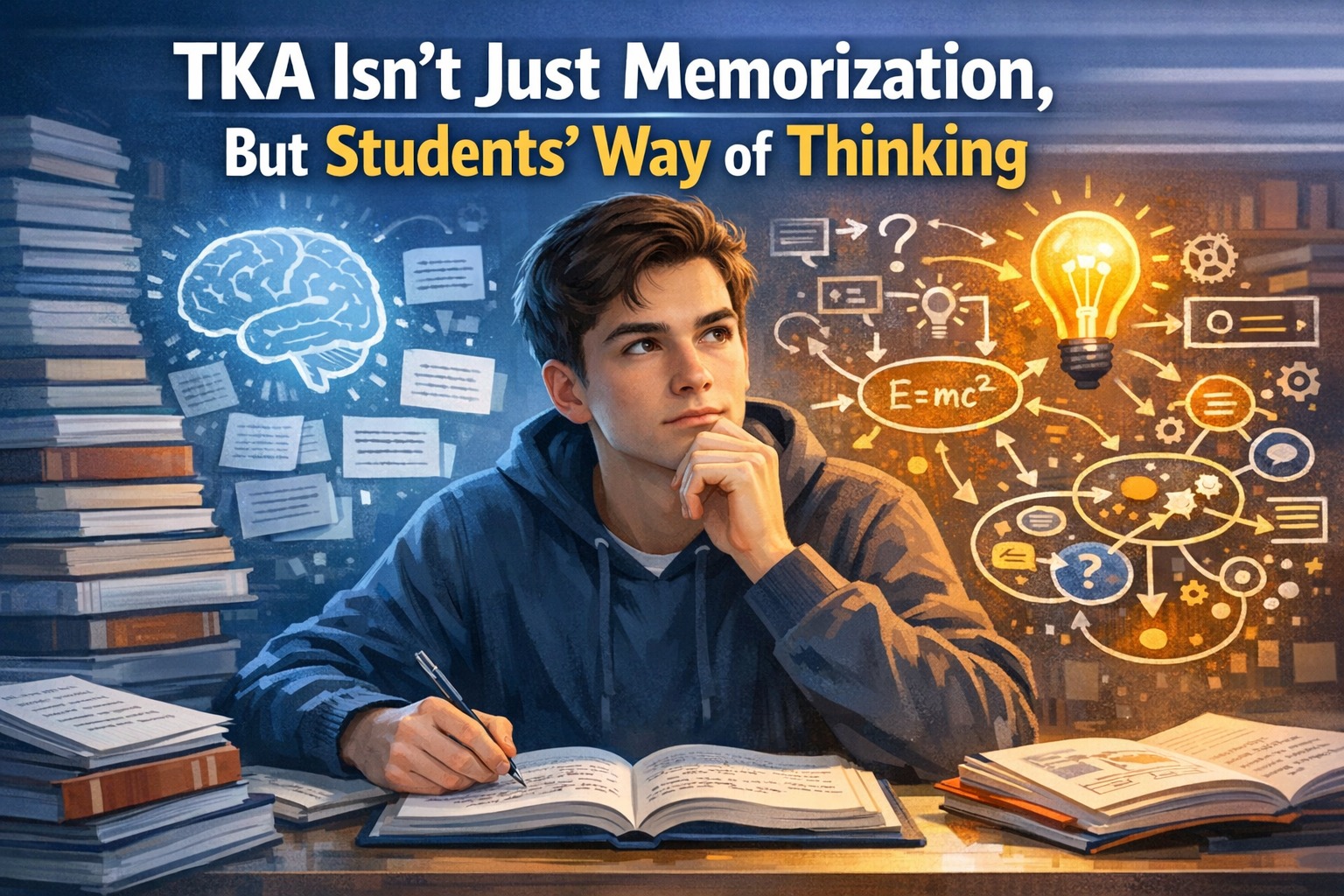
The Test of Academic Ability (TKA) is often misunderstood as a system that merely measures how well students can memorize information. In reality, TKA is designed to evaluate much more than recall. It focuses on how students process, analyze, and apply knowledge in various contexts.
Many students approach TKA with the mindset that success depends on how much material they can memorize in a short time. This perception can lead to ineffective study habits, where understanding is sacrificed for temporary retention. As a result, students may struggle when faced with questions that require deeper thinking.
TKA aims to shift this paradigm by encouraging students to move beyond memorization. Instead of asking questions that rely solely on memory, TKA presents problems that require interpretation, reasoning, and logical thinking. This approach better reflects real-world challenges.
By focusing on thinking skills, TKA prepares students for academic and professional environments where problem-solving is essential. Memorization alone is not sufficient in situations that demand creativity and adaptability.
Understanding this purpose can help students adjust their learning strategies. Rather than trying to memorize everything, they should focus on understanding concepts and practicing how to apply them in different scenarios.
Ultimately, TKA serves as a tool to measure intellectual flexibility. It is not about how much students know, but how effectively they can use what they know.
SHIFTING FROM MEMORIZATION TO CRITICAL THINKING
One of the most significant changes introduced by TKA is the emphasis on critical thinking. This shift challenges students to analyze information rather than simply recall it. Critical thinking involves questioning assumptions, evaluating evidence, and making logical conclusions.
Students who rely heavily on memorization often find this transition difficult. They may feel unprepared when questions are presented in unfamiliar formats. However, this discomfort is part of the learning process and encourages growth.
Developing critical thinking skills requires practice and patience. Students need to engage with material actively, ask questions, and explore multiple perspectives. This approach leads to a deeper understanding of the subject matter.
Teachers also play an important role in this shift. By designing learning activities that promote discussion and analysis, they can help students develop these essential skills. Classroom environments that encourage curiosity and exploration are particularly effective.
In addition, critical thinking helps students become independent learners. They are no longer dependent on memorized answers but can adapt their knowledge to new situations. This adaptability is crucial in a rapidly changing world.
Over time, students who embrace critical thinking will find that they are better equipped to handle complex problems. This skill extends beyond TKA and benefits them throughout their academic journey and future careers.
THE ROLE OF CONCEPTUAL UNDERSTANDING
Conceptual understanding is at the core of TKA. Instead of focusing on isolated facts, students are encouraged to see the bigger picture. This means understanding how different ideas are connected and how they can be applied.
When students understand concepts deeply, they can approach problems with confidence. They are able to break down complex questions into manageable parts and find logical solutions. This process is far more effective than relying on memorized answers.
A strong conceptual foundation also helps students retain information for a longer period. Unlike memorization, which is often temporary, understanding allows knowledge to be stored more meaningfully in the brain.
Furthermore, conceptual learning encourages curiosity. Students become more interested in exploring topics when they understand the underlying principles. This curiosity drives continuous learning and improvement.
Educational systems that prioritize conceptual understanding tend to produce more competent and innovative students. These students are not only able to perform well in exams but also excel in real-life situations.
In the context of TKA, conceptual understanding ensures that students are prepared for questions that require reasoning and application. It transforms learning from a passive activity into an active and engaging process.
DEVELOPING ANALYTICAL AND PROBLEM-SOLVING SKILLS
TKA places a strong emphasis on analytical and problem-solving abilities. These skills are essential for navigating complex challenges both in academics and everyday life. Analytical thinking involves examining information carefully and identifying patterns or relationships.
Problem-solving, on the other hand, requires students to use their knowledge creatively. They must evaluate different approaches and choose the most effective solution. This process often involves trial and error, which is a valuable learning experience.
Students can develop these skills by practicing a variety of questions. Exposure to different types of problems helps them become more flexible in their thinking. It also reduces anxiety when encountering unfamiliar questions.
Another important aspect is reflection. After solving a problem, students should review their approach and consider alternative methods. This reflection helps them improve and avoid repeating mistakes.
Collaboration can also enhance analytical skills. Working with peers allows students to see different perspectives and learn new strategies. This exchange of ideas fosters a deeper understanding of the material.
In the long run, strong analytical and problem-solving skills will benefit students beyond TKA. These abilities are highly valued in higher education and the workplace.
BUILDING A GROWTH MINDSET IN LEARNING
A growth mindset is essential for success in TKA. Students need to believe that their abilities can improve with effort and practice. This mindset encourages resilience and perseverance, especially when facing difficult challenges.
Students with a fixed mindset may feel discouraged when they encounter problems they cannot solve immediately. They may view failure as a sign of inadequacy rather than an opportunity to learn. This attitude can hinder their progress.
In contrast, a growth mindset helps students embrace challenges. They understand that mistakes are a natural part of the learning process. Each mistake provides valuable insights that can lead to improvement.
Teachers and parents can support this mindset by providing constructive feedback. Instead of focusing solely on results, they should emphasize effort and progress. Encouragement plays a crucial role in building confidence.
Setting realistic goals is another important strategy. By breaking down larger objectives into smaller, achievable steps, students can track their progress and stay motivated.
Ultimately, a growth mindset empowers students to take control of their learning. It aligns perfectly with the goals of TKA, which seeks to develop thoughtful and adaptable individuals.
CONCLUSION REDEFINING SUCCESS IN TKA
TKA represents a shift in how academic success is defined. It moves away from memorization and focuses on the development of thinking skills. This change reflects the demands of modern education and the evolving needs of society.
Students who understand this shift can approach TKA more effectively. By prioritizing critical thinking, conceptual understanding, and problem-solving, they can achieve better results and gain valuable skills.
The journey may not be easy, but it is worthwhile. Developing a strong way of thinking requires time, effort, and dedication. However, the benefits extend far beyond a single exam.
In the end, TKA is not just a test. It is an opportunity for students to grow intellectually and prepare for future challenges. By embracing this perspective, they can unlock their full potential.
Success in TKA is no longer about how much you memorize, but how well you think.
Tentang Penulis
Gusti Ayu Tita P
Penulis — Universitas STEKOM
Penulis aktif yang berfokus pada isu-isu akademik, teknologi pendidikan, dan pengembangan sumber daya manusia di lingkungan kampus.















