Types of Reactors Used in Nuclear Power Plants
Gusti Ayu Tita P
1 September 2026
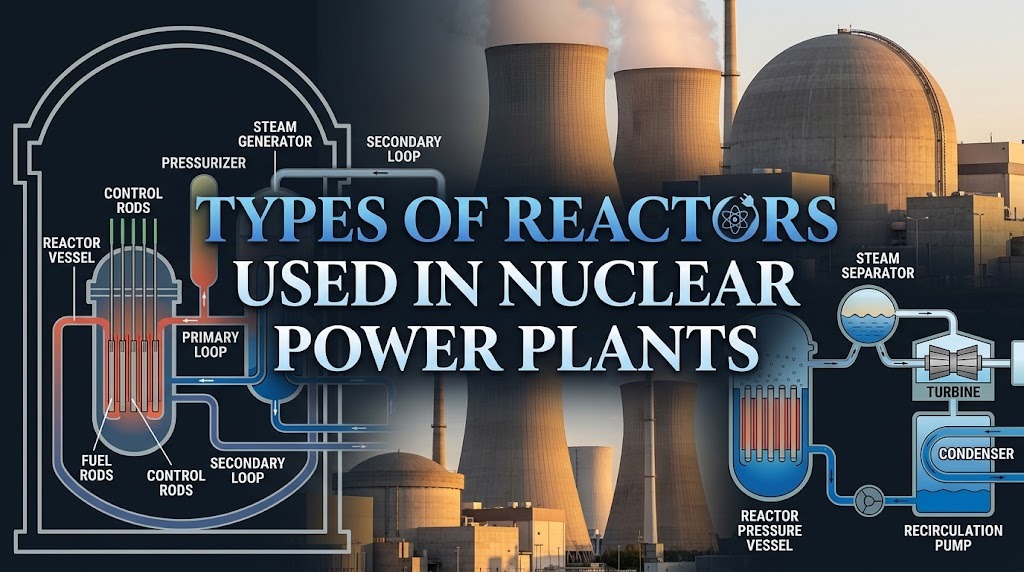
Nuclear power plants use nuclear reactors to produce the heat needed for electricity generation. Inside a reactor, nuclear fuel undergoes a controlled fission reaction that releases a large amount of heat. This heat is transferred through a cooling system and ultimately used to produce steam, drive a turbine, and generate electricity. Different reactor designs use different fuels, coolants, moderators, and operating methods.
Understanding the types of nuclear reactors is important because each design has different characteristics, advantages, technical requirements, and potential applications. Some reactor types have been used commercially for decades, while others are still being developed or introduced.
PRESSURIZED WATER REACTOR
The Pressurized Water Reactor or PWR is one of the most widely used commercial reactor designs. It uses ordinary water as both a coolant and neutron moderator. The water in the primary cooling system is maintained at high pressure so it can reach a high temperature without boiling inside the reactor core. Heat from this water is transferred to a separate secondary system through steam generators.
The secondary water turns into steam and flows toward the turbine. Because the primary and secondary systems are separated, the steam that drives the turbine does not normally come directly from the reactor core. PWR technology has been widely adopted because of its established operating experience and relatively well-understood design. Many modern reactor designs also build on the principles of the PWR.
BOILING WATER REACTOR
The Boiling Water Reactor or BWR also uses ordinary water as both coolant and moderator. However, unlike a PWR, water is allowed to boil directly inside the reactor vessel. The resulting steam is then directed toward the turbine to produce mechanical energy. The turbine is connected to a generator that converts this mechanical energy into electricity.
Because steam is produced inside the reactor vessel, the BWR does not require a separate steam generator in the same way as a PWR. This gives the system a different configuration and operating approach. BWRs have been used commercially in several countries and have undergone design improvements over time. Safety systems are incorporated to control the reactor and manage abnormal operating conditions.
PRESSURIZED HEAVY WATER REACTOR
The Pressurized Heavy Water Reactor or PHWR uses heavy water as its coolant and moderator. Heavy water contains deuterium, an isotope of hydrogen, rather than ordinary hydrogen in the same proportion as regular water. One important feature of PHWR technology is that it can operate with relatively low-enriched uranium and, in some designs, natural uranium. Canada has developed significant experience with this reactor technology.
Many PHWR designs use pressure tubes containing the nuclear fuel and pressurized coolant. Heat from the fuel is transferred to a separate water system to produce steam. The steam then drives a turbine connected to an electrical generator. This configuration gives PHWRs several technical characteristics that distinguish them from conventional light-water reactors.
GAS COOLED REACTOR
Gas Cooled Reactors use gas instead of water as the primary coolant. Helium is used in some advanced designs because it has suitable properties for high-temperature operation and does not easily react chemically with reactor materials. Graphite can serve as the neutron moderator in several gas-cooled reactor designs. The heat produced by fission can then be used to generate steam or drive a power conversion system.
High operating temperatures can provide potential efficiency advantages for certain gas-cooled reactors. However, these reactors require materials that can withstand high temperatures and specific operating conditions. Several gas-cooled concepts have been developed over the years, including advanced designs intended to improve efficiency and safety. Their commercial use remains more limited than that of conventional water-cooled reactors.
FAST REACTOR
Fast reactors operate with fast neutrons and generally do not use a moderator to slow neutrons down. This distinguishes them from thermal reactors such as PWRs and BWRs. Some fast reactor designs use liquid metals such as sodium or lead-based coolants because these materials can transfer heat effectively at high temperatures. Their operating principles allow them to be designed for different fuel-cycle strategies.
Fast reactors have attracted interest because some designs can make more efficient use of certain nuclear materials. They may also have the potential to reduce some types of long-lived radioactive waste under appropriate fuel-cycle strategies. However, fast reactor technology involves significant engineering and fuel-cycle challenges. As a result, commercial deployment is still much more limited than established light-water reactor technology.
SMALL MODULAR REACTOR
Small Modular Reactors or SMRs are smaller nuclear reactor units designed with modular construction and deployment in mind. SMR is not a single reactor type because different SMR designs can use different cooling systems and reactor technologies. Some proposed SMRs are based on light-water reactor technology, while others use alternative concepts. Their smaller size can provide potential flexibility for electricity systems with different capacity requirements.
Many SMR concepts incorporate passive or simplified safety features. Passive safety systems can use natural physical processes such as gravity and natural circulation to help maintain safe conditions without relying on continuous active intervention. However, SMRs still face challenges related to licensing, economics, manufacturing, infrastructure, and commercial deployment. Their development continues as countries and companies explore new approaches to nuclear power.
ADVANCED AND GENERATION IV REACTORS
Generation IV refers to a group of advanced reactor concepts rather than one specific reactor design. These concepts include technologies such as sodium-cooled fast reactors, lead-cooled fast reactors, molten salt reactors, and very high-temperature reactors. Researchers are developing these systems with goals that can include improved safety, better fuel utilization, reduced waste, and higher efficiency. Their technical characteristics vary considerably depending on the specific design.
Many Generation IV technologies are still under development, testing, or demonstration rather than widespread commercial operation. Some concepts use innovative coolants or fuel arrangements that require new materials and manufacturing methods. Regulatory frameworks and supply chains may also need to evolve to support wider deployment. Therefore, their potential benefits must be considered alongside their remaining technical and economic challenges.
CONCLUSION
The types of reactors used in nuclear power plants vary significantly in their fuel, coolant, moderator, configuration, and operating principles. PWRs and BWRs are among the most established commercial technologies, while PHWRs, gas-cooled reactors, and fast reactors represent other important approaches. SMRs and Generation IV reactors are being developed to provide new options with different performance and safety characteristics.
No single reactor design is ideal for every country or electricity system. The choice of technology depends on factors such as safety requirements, fuel availability, infrastructure, regulatory capacity, economics, and long-term energy goals. Understanding these differences provides a clearer picture of how nuclear reactor technology continues to develop.
Tentang Penulis
Gusti Ayu Tita P
Penulis — Universitas STEKOM
Penulis aktif yang berfokus pada isu-isu akademik, teknologi pendidikan, dan pengembangan sumber daya manusia di lingkungan kampus.