Understanding ASN Rank And Position Systems For Career Development
Gusti Ayu Tita P
10 Agustus 2026
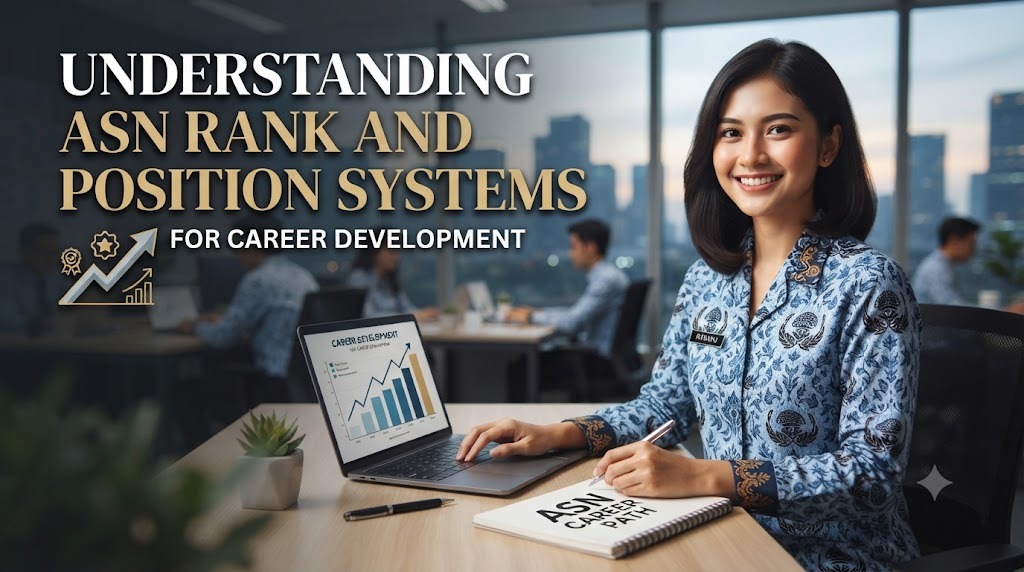
The Aparatur Sipil Negara or ASN is an important part of Indonesia's public administration system. ASN employees consist of Civil Servants or PNS and Government Employees with Work Agreements or PPPK. Understanding the rank and position system is important for employees who want to plan their careers in a clear and structured way. Career development is not only influenced by length of service but also involves qualifications, competence, performance, and organizational needs. Indonesia's current ASN framework also emphasizes the importance of a merit based system in managing public employees.
The terms rank and position should not be considered the same. A position describes an employee's role, responsibilities, and place within an organization, while rank is related to the personnel classification and career structure applicable to PNS. Therefore, understanding how these elements work can help ASN employees identify career opportunities and prepare for greater responsibilities. The current legal framework is primarily based on Law No. 20 of 2023 on ASN. (Peraturan BPK)
UNDERSTANDING THE ASN POSITION SYSTEM
Under the current ASN framework, positions are divided into managerial positions and nonmanagerial positions. Managerial positions focus on leadership, coordination, and organizational management. Nonmanagerial positions focus more on professional, technical, and operational responsibilities. This distinction helps determine the responsibilities and competencies expected from an ASN employee.
Managerial positions include high leadership positions, administrator positions, and supervisory positions. Nonmanagerial positions include functional positions and executive positions. Each position has different responsibilities and requirements, so employees should understand the career path associated with their field. This knowledge can help employees prepare for future promotions or professional development opportunities. (Peraturan BPK)
UNDERSTANDING ASN RANK AND CAREER LEVELS
Rank and position are related but different concepts within the ASN system. Rank is particularly relevant to PNS career administration, while a position refers to the role and responsibilities assigned within an organization. Career development should therefore not be understood simply as moving from one rank to another. Employees must also meet the qualifications and competencies required for the position they want to pursue.
For functional positions, career development can involve specific professional levels based on the type of functional position. The requirements can include qualifications, competence, performance, and other conditions established by the applicable regulations. For example, regulations governing certain functional positions may specifically address appointment, performance management, competency development, and rank advancement. (Peraturan BPK)
MANAGERIAL AND NONMANAGERIAL CAREER PATHS
The managerial career path is designed for employees who take responsibility for leading and managing organizational units. Leadership ability, decision making, coordination, and performance management are important competencies in this path. Employees who aim for managerial positions therefore need to develop more than technical expertise. They also need to demonstrate the ability to manage people and organizational responsibilities.
The nonmanagerial career path provides opportunities for employees to develop expertise in specific professional or operational areas. Functional positions are particularly important for employees who want to build careers based on specialized knowledge and professional competence. This path can be suitable for individuals who prefer to deepen their expertise rather than focus primarily on organizational leadership. Both career paths contribute to the achievement of government objectives.
FUNCTIONAL POSITIONS AS A CAREER OPTION
Functional positions provide an important career pathway for ASN employees with specific professional expertise. These positions are generally associated with particular fields of knowledge, skills, and professional responsibilities. Employees can develop their careers by improving competence, achieving required performance, and meeting the applicable requirements. The exact career structure depends on the specific functional position and its governing regulations.
Functional career development continues to adapt to the needs of government organizations. Regulations for individual functional positions may establish provisions concerning duties, appointment, performance management, competency development, and rank advancement. For this reason, employees should regularly check the latest regulations related to their functional position. Understanding current requirements can prevent employees from relying on outdated information when planning their careers. (Peraturan BPK)
THE ROLE OF COMPETENCE IN CAREER DEVELOPMENT
Competence is one of the most important elements of ASN career development. Employees need knowledge and skills that match the responsibilities of their current or targeted positions. Competence can include technical expertise as well as managerial and social skills, depending on the position. Strong competence helps employees perform their duties effectively and prepare for more challenging responsibilities.
Competence can be developed through training, education, workplace experience, self learning, and professional development programs. Employees should identify the skills required for their desired career path and compare them with their current abilities. This process helps reveal competency gaps that need to be addressed. Continuous learning is especially important because government work and technology continue to change.
THE IMPORTANCE OF PERFORMANCE FOR ASN CAREERS
Performance plays a major role in professional development because ASN employees are expected to deliver measurable and responsible results. Employees need to understand their duties, targets, and expected outcomes. Good performance demonstrates the ability to carry out responsibilities professionally. Performance evaluation can also help employees identify areas that require improvement.
Career development should be supported by integrity, accountability, discipline, professionalism, and quality public service. The merit system is intended to strengthen objective ASN management based on relevant qualifications, competence, and performance rather than personal considerations. This approach supports fairer opportunities for employees who demonstrate the required abilities and results. (Peraturan BPK)
HOW TO PLAN AN ASN CAREER
The first step in career planning is to determine a clear professional direction. Employees can identify whether they are more interested in managerial leadership or specialized expertise through a functional position. After choosing a direction, they should study the qualifications, competencies, experience, and other requirements associated with their target position. This makes career planning more realistic and measurable.
Employees should also create a personal development plan based on their current strengths and weaknesses. Relevant training, education, work assignments, and professional experiences can be selected to close competency gaps. Regular evaluation is important because career goals and organizational needs can change. A structured approach allows employees to prepare gradually rather than waiting for a promotion opportunity to appear.
DIGITALIZATION AND THE FUTURE OF ASN CAREERS
Digital transformation is becoming an important part of ASN management. Law No. 20 of 2023 specifically includes digitalization of ASN management as part of the transformation of the public employee management system. This means digital capabilities are increasingly relevant to how government organizations operate and manage their workforce. (Peraturan BPK)
ASN employees therefore need to develop digital literacy, data awareness, information security skills, and the ability to use workplace technology. Technology can improve efficiency, but employees still need professional judgment and responsibility when using digital systems. Adaptability is particularly important because government services and administrative processes continue to evolve. Employees who combine professional expertise with digital skills can be better prepared for future changes.
TIPS FOR BUILDING A STRONG ASN CAREER
Building a strong ASN career requires more than waiting for formal promotion opportunities. Employees should actively develop professional competence, work performance, communication skills, and leadership abilities. They should also understand the regulations that govern their position and keep track of changes that may affect their career pathway. A proactive approach allows employees to make better career decisions.
It is also useful to document achievements, training, projects, and relevant work experiences. These records can help employees evaluate their professional growth and identify areas that still need improvement. Continuous learning and adaptability should become long term habits rather than activities performed only when promotion is approaching. With consistent preparation, ASN employees can build careers that support both personal development and organizational goals.
CONCLUSION
Understanding the ASN rank and position system is essential for effective career development in Indonesia's public sector. ASN employees consist of PNS and PPPK, while positions are broadly organized into managerial and nonmanagerial categories. Rank should not be confused with position because they represent different aspects of the personnel and organizational structure. Career development is influenced by qualifications, competence, performance, experience, and organizational requirements. By understanding the applicable regulations, developing relevant skills, maintaining strong performance, and adapting to digital transformation, ASN employees can build a more structured and sustainable career.
Tentang Penulis
Gusti Ayu Tita P
Penulis — Universitas STEKOM
Penulis aktif yang berfokus pada isu-isu akademik, teknologi pendidikan, dan pengembangan sumber daya manusia di lingkungan kampus.