
Understanding Mass Protests in Modern Democratic Life
Gusti Ayu Tita P
1 September 2026
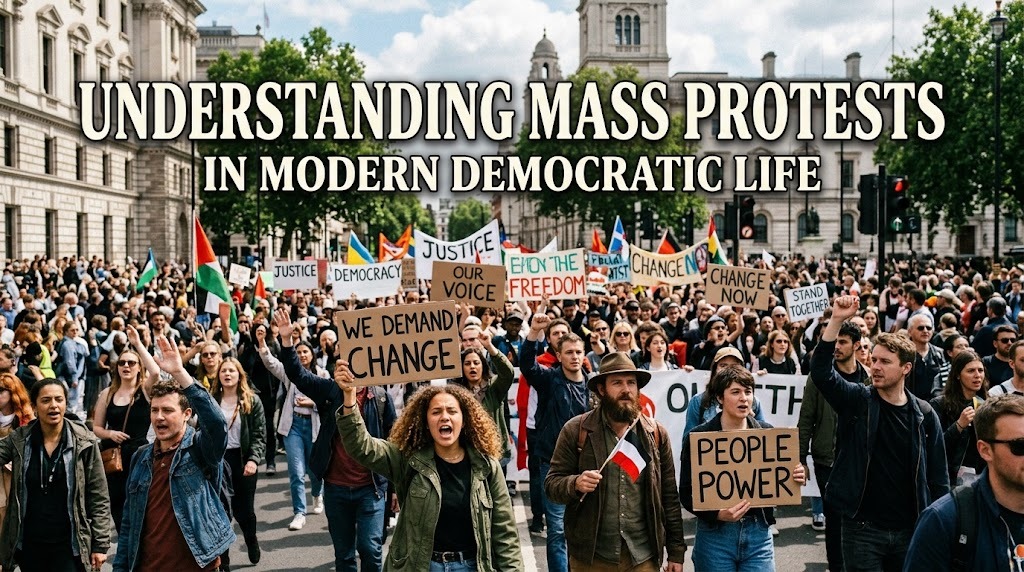
Mass protests are a visible part of modern democratic life. They provide a way for people to express concerns, criticism, demands, and hopes about issues that affect society. When many individuals gather around a shared concern, their voices can attract public attention and encourage wider discussion. Protests can also reveal social tensions that may not be obvious through formal political institutions alone. Understanding mass protests therefore requires looking at their causes, social impact, and role in democratic participation.
MASS PROTESTS AS DEMOCRATIC PARTICIPATION
Democracy allows citizens to participate in public affairs through elections, public discussions, community activities, and other forms of civic engagement. Mass protests represent another form of participation when people want to communicate their opinions collectively. Protesters may raise concerns about government policies, economic conditions, social inequality, environmental issues, or public services. Their collective presence can make an issue more visible to decision makers and the wider public. Peaceful demonstrations can therefore become part of the broader democratic conversation.
However, protests do not automatically represent the views of an entire population. Different groups can have different interests and interpretations of the same issue. Some citizens may support a protest, while others may disagree with its demands or methods. Respect for different opinions is essential when discussing controversial public issues. Democracy becomes stronger when disagreement can be expressed without turning into hostility.
WHY MASS PROTESTS HAPPEN
Mass protests can develop when people experience concerns that they believe require greater public attention. A controversial policy, economic pressure, social inequality, or dissatisfaction with public services can become a reason for collective action. In some situations, people may feel that existing channels have not adequately addressed their concerns. Public dissatisfaction can then encourage groups to organize and communicate their demands more visibly. The scale of a protest may reflect how strongly an issue resonates with different communities.
Protests can also be influenced by events that increase public awareness. A particular decision or incident may bring an existing concern to the surface and encourage people to respond. Social networks can connect individuals who previously experienced similar problems separately. Shared experiences can strengthen solidarity and create a sense of collective purpose. As more people become involved, a local concern can develop into a wider public issue.
THE ROLE OF COLLECTIVE VOICES
A major characteristic of mass protests is the transformation of individual concerns into a collective voice. A person may have limited influence when expressing a concern alone, but a large group can attract greater public attention. Participants can use speeches, signs, statements, and other peaceful forms of communication to explain their demands. The collective nature of a protest can demonstrate that an issue matters to more than one individual. This can encourage institutions and communities to examine the issue more closely.
Collective action does not eliminate differences among participants. People can join the same protest for different personal or social reasons while supporting a common demand. Solidarity provides a connection between these different motivations. Understanding this diversity helps explain why mass movements can include many perspectives. It also reminds the public that the meaning of a protest should be examined through its demands and context rather than its size alone.
MEDIA AND PUBLIC PERCEPTION
Media coverage can significantly influence how people understand mass protests. News reports can provide information about the reasons for a demonstration, the demands of participants, and responses from authorities. When an issue receives extensive coverage, people who are not present at the protest can become aware of it. Public attention may then expand beyond the original group involved. This can turn a specific protest into a broader social discussion.
The way an event is presented can also affect public perception. Images, headlines, short videos, and commentary may highlight different aspects of the same event. For this reason, people should compare information from reliable sources before forming strong conclusions. Critical media consumption helps audiences distinguish factual reporting from opinion or incomplete information. A better-informed public can discuss protests more objectively.
SOCIAL MEDIA AND DIGITAL PARTICIPATION
Social media has changed how people communicate during mass protests. Information can be shared quickly through videos, photographs, live broadcasts, and personal accounts. People who are far from the protest location can follow developments and participate in online discussions. Digital participation allows public voices to reach larger audiences than was possible through physical gatherings alone. It can also help communities organize conversations around issues that matter to them.
The speed of digital communication also creates challenges. Unverified claims can spread rapidly, while old images or videos may be presented as if they were recent. Emotional content can attract attention even when it provides little reliable information. Digital literacy is therefore important when following protests online. Checking sources, dates, locations, and context can reduce the risk of spreading misleading information.
PROTESTS AND PUBLIC ORDER
Mass gatherings can affect people who are not directly involved in the demonstration. Large crowds may influence traffic, access to public facilities, business activity, and everyday movement. These effects become more significant when protests take place in busy public areas. Public order is therefore an important consideration when organizing and managing demonstrations. The interests of protesters and the wider community should both be taken into account.
Organizers, participants, authorities, and surrounding communities can contribute to safer conditions. Organizers can communicate clear information and encourage peaceful behavior, while participants can respect public facilities and the rights of others. Authorities can focus on maintaining safety while respecting lawful public expression. Communication and cooperation can help prevent unnecessary tension. A balanced approach makes it possible to protect both civic participation and community safety.
PEACEFUL PROTEST AND SOCIAL RESPONSIBILITY
The manner in which people demonstrate can influence how their message is received. Peaceful action allows attention to remain focused on the issue rather than on unnecessary conflict. Participants can express strong criticism while avoiding actions that threaten the safety of others. Peaceful protest can create more opportunities for dialogue between citizens and institutions. It also demonstrates that disagreement can be expressed without abandoning social responsibility.
Social responsibility also means considering people who are not part of the demonstration. Public spaces are shared by workers, residents, students, businesses, and other groups. Respecting their needs can reduce unnecessary disruption and tension. Responsible civic action strengthens the credibility of public participation. It allows people to defend their views while recognizing that other citizens also have rights and interests.
MASS PROTESTS AND SOCIAL CHANGE
Mass protests can contribute to social change by bringing neglected or controversial issues into public discussion. A demonstration may encourage policymakers, institutions, journalists, academics, and communities to examine a particular problem. However, social change rarely results from one protest alone. Long-term change often requires continued dialogue, policy evaluation, public pressure, and institutional action. Protests can therefore represent one stage in a broader process.
The impact of a protest can continue after people leave the streets. Citizens may monitor government responses, participate in discussions, submit feedback, or support community initiatives. These activities help maintain attention on important concerns. Sustained civic engagement can make public participation more meaningful over time. It can also help transform public demands into practical discussions about solutions.
THE IMPORTANCE OF INFORMED CITIZENS
Modern democracy depends not only on people having the opportunity to express opinions but also on their ability to understand public issues. Citizens who examine evidence and consider different perspectives are better prepared to evaluate protests and their demands. Informed citizens can distinguish legitimate criticism from misleading claims. They are also more capable of participating in constructive public discussions. Education and media literacy therefore play important roles in democratic life.
Being informed does not require everyone to reach the same conclusion. People can study the same issue and still hold different opinions. What matters is the ability to explain those opinions responsibly and remain open to relevant evidence. Healthy disagreement is a normal part of democracy. It becomes productive when people focus on ideas and facts rather than personal attacks.
CONCLUSION
Understanding mass protests means recognizing their role as part of modern democratic life. Protests can provide citizens with a collective platform to express concerns, raise public awareness, and encourage discussion about important social issues. Their development may be influenced by public dissatisfaction, shared experiences, social solidarity, media coverage, and digital communication. At the same time, demonstrations must consider public safety, social responsibility, and the rights of people who are not involved.
Ultimately, the value of a mass protest depends on more than the number of participants. Clear demands, peaceful participation, reliable information, open dialogue, and continued civic engagement can make collective action more constructive. When citizens are willing to listen as well as speak, disagreements can become part of a healthy democratic process. In this way, mass protests can contribute to greater public awareness and meaningful social change.
Tentang Penulis
Gusti Ayu Tita P
Penulis — Universitas STEKOM
Penulis aktif yang berfokus pada isu-isu akademik, teknologi pendidikan, dan pengembangan sumber daya manusia di lingkungan kampus.