Understanding The ASN Career Path From Entry Level To Strategic Positions
Gusti Ayu Tita P
10 Agustus 2026
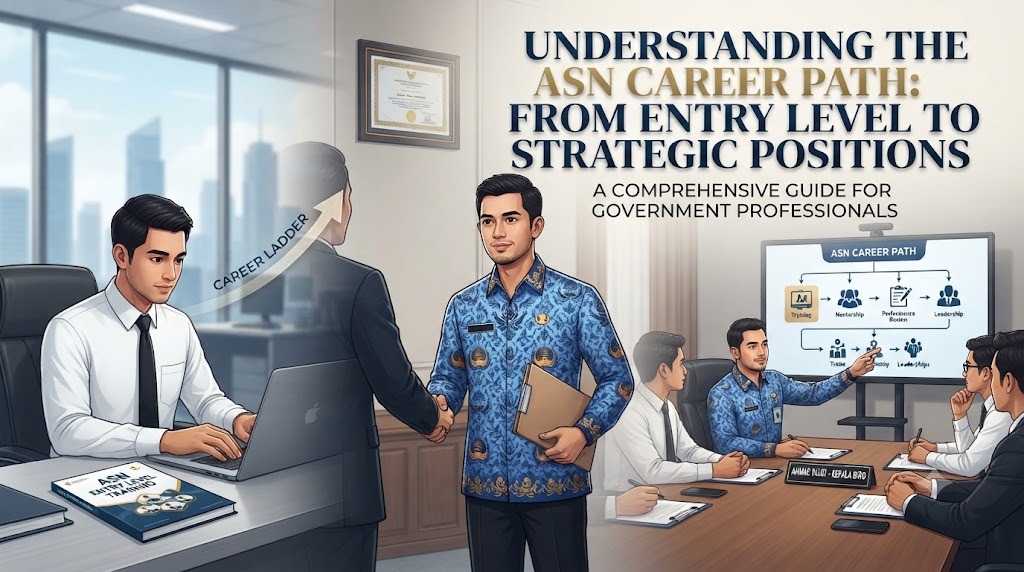
ASN career development is a continuous process that allows government employees to improve their competence, experience, and responsibilities over time. In Indonesia, ASN consists of Civil Servants or PNS and Government Employees with Work Agreements or PPPK. A career path can begin with an entry level role and gradually develop toward professional, managerial, or strategic responsibilities. However, career advancement is not automatic because it depends on qualifications, competence, performance, organizational needs, and applicable regulations.
Understanding the career path can help ASN employees prepare for future responsibilities. Career development is not only about moving to a higher position but also about building expertise, gaining experience, improving performance, and demonstrating leadership. Employees who understand their possible career directions can make better decisions about education, training, assignments, and professional development.
UNDERSTANDING THE ASN CAREER STRUCTURE
The ASN position structure broadly includes managerial and nonmanagerial positions. Managerial positions are associated with leadership and organizational management, while nonmanagerial positions include functional and executive roles. Each category has different responsibilities and competency requirements. Understanding these categories is important before planning a long term ASN career.
An employee does not necessarily need to follow one identical career route throughout their working life. Career development can involve professional specialization, leadership responsibilities, broader assignments, or movement between appropriate career roles. The available pathway depends on the employee's position, qualifications, competence, performance, and institutional needs. Therefore, employees should understand both their current role and the opportunities available within their career system.
STARTING THE ASN CAREER JOURNEY
For the PNS pathway, an individual's career generally begins with the CPNS stage after successfully completing the required recruitment and selection process. CPNS employees enter a probationary period and are expected to complete the applicable professional development requirements. This period provides an opportunity to understand government work, organizational procedures, and public service responsibilities. It also allows employees to develop the competence required for their positions.
The entry level stage should be viewed as a foundation for long term professional growth. New employees need to understand their duties, workplace rules, performance expectations, and professional values. They should also develop good working habits from the beginning. Strong foundations can make it easier to handle more complex responsibilities later in the career journey.
DEVELOPING COMPETENCE AT THE EARLY CAREER STAGE
Competence is one of the most important elements of career development. New ASN employees should develop technical, communication, digital, problem solving, and teamwork skills according to their positions. They should understand which competencies are required for their current role and which skills may be needed for future opportunities. This helps employees make their learning activities more focused.
Competence development should continue throughout the career. Employees can learn through training, education, mentoring, workplace assignments, professional communities, and self learning. Practical experience is particularly valuable because it allows employees to apply knowledge to real problems. Consistent learning can help employees remain capable as government work and public expectations evolve.
BUILDING EXPERIENCE THROUGH PROFESSIONAL ASSIGNMENTS
Work experience is an important part of moving from entry level responsibilities toward more advanced roles. Employees can gain experience by participating in projects, handling different tasks, coordinating with other units, and solving workplace problems. Each assignment can provide opportunities to develop professional judgment. Meaningful experience can also help employees understand how their work contributes to broader organizational objectives.
Employees should not focus only on routine tasks. They can seek opportunities to participate in activities that develop communication, collaboration, decision making, and problem solving abilities. Challenging assignments can provide valuable lessons when handled responsibly. Over time, accumulated experience can prepare employees for positions with greater responsibilities.
DEVELOPING A FUNCTIONAL CAREER PATH
The functional career path is an important option for ASN employees who want to develop specialized professional expertise. Functional positions are associated with specific areas of knowledge and professional responsibilities. Employees in these positions can deepen their expertise while developing their careers according to applicable requirements. The exact career structure depends on the relevant functional position and regulations.
A functional career does not mean limited professional growth. Employees can continue developing their competence and taking on more complex professional responsibilities. They should understand the requirements for their specific functional position and maintain strong performance. Specialized expertise combined with continuous development can create a sustainable professional career.
MOVING TOWARD MANAGERIAL RESPONSIBILITIES
Employees who are interested in leadership can gradually develop toward managerial positions. Managerial responsibilities require more than technical expertise because employees must coordinate people, resources, priorities, and organizational objectives. Leadership, decision making, communication, and problem solving become increasingly important. Employees should therefore develop these abilities before taking on formal management responsibilities.
Leadership development can begin through everyday work. Employees can practice leadership by coordinating projects, supporting colleagues, managing activities, and taking responsibility for results. Good leadership requires integrity, accountability, communication, and the ability to make responsible decisions. Building these qualities early can help employees prepare for future managerial opportunities.
UNDERSTANDING STRATEGIC POSITIONS
Strategic positions involve responsibilities that can influence important organizational programs, policies, services, or decisions. Within the ASN structure, senior leadership roles carry broader responsibilities and require strong leadership capabilities. Strategic responsibilities require employees to understand not only their own tasks but also organizational goals and wider public interests.
Employees who aim for strategic roles need to develop broader competencies. These can include strategic thinking, policy understanding, stakeholder management, risk assessment, decision making, and organizational leadership. They also need a strong record of professional performance and integrity. Strategic career development is built gradually through competence, experience, leadership, and trust.
THE ROLE OF PERFORMANCE IN CAREER ADVANCEMENT
Performance is a major factor in professional career development. Employees should consistently demonstrate that they can complete responsibilities effectively and contribute to organizational goals. Good performance includes work quality, accountability, discipline, professionalism, and public service orientation. Performance should therefore be viewed as an ongoing responsibility rather than something that matters only during promotion periods.
Employees can strengthen their professional records by documenting meaningful achievements and contributions. They should also use performance feedback to identify areas for improvement. A strong performance record combined with relevant competence can support future career opportunities within the applicable system. Consistent results are more valuable than short term achievements that cannot be sustained.
BUILDING DIGITAL AND ADAPTABILITY SKILLS
Government administration continues to experience digital transformation. ASN employees increasingly work with digital platforms, electronic documents, data systems, and technology based public services. Digital competence can improve efficiency and help employees adapt to changing work processes. It is therefore useful at both entry level and advanced career stages.
Employees should develop skills in digital communication, data management, workplace applications, information security, and responsible technology use. They should also remain open to learning new systems as technology changes. Adaptability and learning agility can become important advantages for employees preparing for future roles. Employees who combine professional expertise with digital capability can be better prepared for modern government work.
DEVELOPING INTEGRITY AND PROFESSIONAL VALUES
Career advancement should always be accompanied by integrity and professional responsibility. Government employees have a duty to maintain public trust and perform their work according to applicable rules. Technical competence without ethical behavior can create serious professional risks. Integrity therefore needs to be developed at every stage of the career journey.
Employees should demonstrate honesty, accountability, discipline, fairness, and commitment to public service. These values become even more important when employees receive greater authority and responsibility. The higher the responsibility, the greater the need for ethical judgment and accountability. A strong professional reputation can support long term career development.
UNDERSTANDING THE MERIT SYSTEM
The merit system is an important principle in ASN personnel management. Career management should consider objective factors such as qualifications, competence, performance, potential, and organizational needs. This approach encourages employees to focus on genuine professional development. It also supports a more professional and accountable government workforce.
Understanding merit based career management can help employees set realistic expectations. Career advancement should not be viewed simply as a result of seniority or personal relationships. Employees should focus on developing relevant competencies and demonstrating meaningful performance. This creates a stronger foundation for professional opportunities and organizational trust.
PREPARING FOR STRATEGIC CAREER OPPORTUNITIES
Employees who want to reach strategic positions should begin preparing well before such opportunities become available. They can strengthen their qualifications, develop leadership abilities, gain diverse experience, and improve their understanding of organizational challenges. Strategic thinking should be developed gradually through exposure to complex problems and decision making.
Professional networking can also support knowledge sharing and collaboration, provided that it remains professional and ethical. Employees should seek feedback from supervisors, colleagues, and experienced professionals. They should regularly evaluate whether their current competencies match their future career goals. Early preparation allows employees to respond more confidently when appropriate opportunities arise.
CREATING A LONG TERM CAREER PLAN
A long term career plan helps employees connect their current responsibilities with future goals. Employees can begin by identifying their desired professional direction and understanding its requirements. They can then create development targets related to education, competence, experience, performance, and leadership. Progress should be reviewed regularly because career goals and organizational needs can change.
A career plan should remain flexible rather than being treated as a fixed path. New assignments, organizational reforms, technology, or changes in professional interests may create different opportunities. Employees should be willing to adjust their plans while maintaining their broader professional objectives. Continuous evaluation and adaptation can make career planning more realistic and sustainable.
CONCLUSION
The ASN career path from entry level to strategic positions is a gradual process built through competence, experience, performance, integrity, and continuous development. The journey can begin with the CPNS stage and develop through functional expertise, managerial responsibilities, or other appropriate career pathways. Employees who want to advance should understand their position requirements and actively develop the skills needed for future responsibilities.
Reaching a strategic position should not be viewed as the only measure of career success. A strong ASN career also means becoming a competent, ethical, adaptable, and reliable public servant. By combining continuous learning, meaningful experience, strong performance, digital capability, and professional integrity, ASN employees can prepare themselves for greater responsibilities while contributing to effective public services.
Tentang Penulis
Gusti Ayu Tita P
Penulis — Universitas STEKOM
Penulis aktif yang berfokus pada isu-isu akademik, teknologi pendidikan, dan pengembangan sumber daya manusia di lingkungan kampus.