What Happens When Report Card Grades Are Unstable Before SNBP Selection?
Gusti Ayu Tita P
14 Agustus 2026
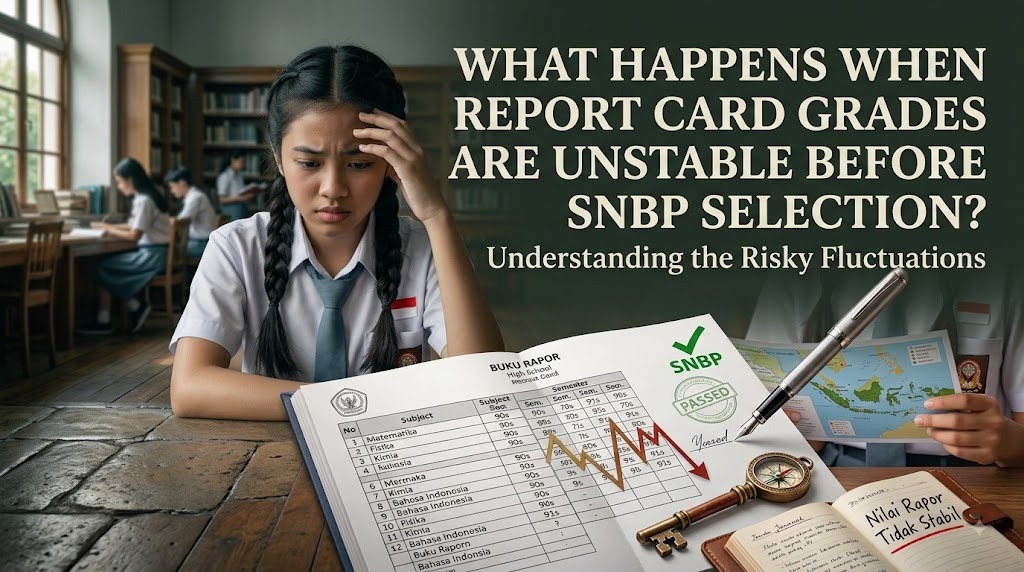
For Indonesian high school students, report card grades can be an important part of preparing for the Seleksi Nasional Berdasarkan Prestasi or SNBP. Students may become worried when their grades rise and fall significantly between semesters. Unstable grades do not automatically mean that a student will fail SNBP, but they can become a concern when building a strong academic record. Students should understand how academic consistency fits into the selection process instead of assuming that one low grade determines their future. With early evaluation and better study habits, students can still work toward improving their academic performance.
UNDERSTANDING REPORT CARD GRADES IN SNBP
SNBP is a national university admission pathway based on student achievement. The selection uses the requirements and assessment mechanisms established for the relevant admission year, so students should not rely entirely on information from previous years. Report card grades are among the academic information considered in the SNBP process. However, the selection outcome is not determined simply by looking at one individual score. Students should understand the complete selection rules and their school's role in the process.
Because SNBP regulations can change, students should always verify current information through official SNPMB sources and their school. Eligibility and selection procedures may involve several requirements beyond simply having a high average. The competitiveness of the chosen university and study program can also affect the level of challenge faced by applicants. Therefore, students should avoid assuming that a particular grade guarantees acceptance. Accurate information is essential when preparing for a competitive admission pathway.
WHAT UNSTABLE GRADES CAN INDICATE
Unstable grades may indicate that a student has experienced changes in learning performance over time. A sudden decline can happen for many reasons, including difficulty understanding certain subjects, poor time management, changes in study habits, or other personal circumstances. A temporary decrease does not necessarily describe a student's overall ability. What matters is whether the student recognizes the problem and takes steps to improve. Early action can prevent a temporary academic difficulty from becoming a long-term pattern.
Grade fluctuations can also help students identify areas that need more attention. For example, a student may perform well in most subjects but repeatedly struggle with mathematics or science. Instead of becoming discouraged, the student can use the results as a guide for improving their learning strategy. Academic self-evaluation can reveal which subjects require additional practice or support. This makes report card results more useful as a tool for improvement rather than simply a number to worry about.
MANAGING DIFFICULT SUBJECTS
Difficult subjects can contribute significantly to unstable report card grades. Students should not ignore subjects they find challenging because weak performance can continue if the underlying problems are not addressed. They can begin by identifying specific topics they do not understand rather than treating the entire subject as impossible. Breaking complex material into smaller sections can make learning more manageable. Practice and repetition can gradually strengthen understanding.
Students should also seek help when independent study is not enough. Teachers, classmates, tutors, and trusted educational resources can provide different explanations that may make difficult concepts easier to understand. Asking for assistance is not a sign of weakness. It shows that the student is willing to take responsibility for their learning. Active problem-solving can help turn academic difficulties into opportunities for improvement.
CHOOSING SNBP STUDY PROGRAMS REALISTICALLY
Students with unstable grades should pay close attention when selecting their target study programs. They should consider their academic strengths, interests, and the competitiveness of the programs they want to enter. Researching official information about universities and study programs can help students understand their options. Students should not choose a program solely because it is popular. A realistic and well-researched choice can help them develop a more thoughtful admission strategy.
This does not mean students should immediately abandon ambitious goals. Instead, they should understand the level of competition and assess whether their academic profile aligns with their intended choices. Self-awareness and research can help students make better decisions. Students should also discuss their plans with their school when appropriate. Ultimately, no strategy can guarantee acceptance because SNBP remains a competitive selection process.
DEVELOPING A RECOVERY PLAN
When grades become unstable, students can create an academic recovery plan for the next semester. The plan can include specific targets, such as improving performance in two difficult subjects or completing assignments more consistently. Students should avoid setting unrealistic goals that create additional pressure. Instead, they can focus on small improvements that can be measured over time. Regularly reviewing the plan can show whether the strategy is working.
A recovery plan should also address the reasons behind previous academic problems. If distractions are affecting study time, students can reduce unnecessary screen time during learning sessions. If they struggle with organization, they can use a calendar or weekly task list. Small consistent changes can gradually create better academic habits. The objective is not simply to increase grades temporarily but to build a sustainable learning routine.
MAINTAINING CONFIDENCE BEFORE SNBP
Unstable grades can make students feel worried about their chances of entering university. However, excessive anxiety can make it harder to concentrate and maintain effective study habits. Students should recognize that an academic setback is not a complete definition of their ability. They can focus on the actions they can control, such as studying consistently and seeking support. Confidence should come from preparation, not from assuming that success is guaranteed.
Students should also avoid constantly comparing their grades with their classmates. Competition can become unhealthy when it causes unnecessary stress or discouragement. Every student has different strengths and learning conditions. Focusing on personal progress can make academic preparation more productive. Resilience and realistic expectations can help students continue working toward their goals even when their grades are not perfect.
CONCLUSION
Unstable report card grades before SNBP selection can create challenges, but they do not automatically determine a student's outcome. Students should understand that SNBP selection follows official rules that can change each year, so current information should always be verified through official sources. Instead of focusing only on past fluctuations, students should identify the reasons behind their performance and create a practical improvement plan. Regular study habits, targeted learning, and appropriate support can help strengthen academic performance.
The most important lesson is that students should not give up because of one weak semester or a temporary decline. Consistent effort and early improvement can help students build a stronger academic foundation. At the same time, they should make realistic study program choices and understand that SNBP acceptance cannot be guaranteed by grades alone. By staying disciplined, informed, and focused on improvement, students can approach the selection process with greater confidence and better preparation.
Tentang Penulis
Gusti Ayu Tita P
Penulis — Universitas STEKOM
Penulis aktif yang berfokus pada isu-isu akademik, teknologi pendidikan, dan pengembangan sumber daya manusia di lingkungan kampus.