What Is a Fingerprint and Why Does Everyone Have One?
Gusti Ayu Tita P
14 September 2026
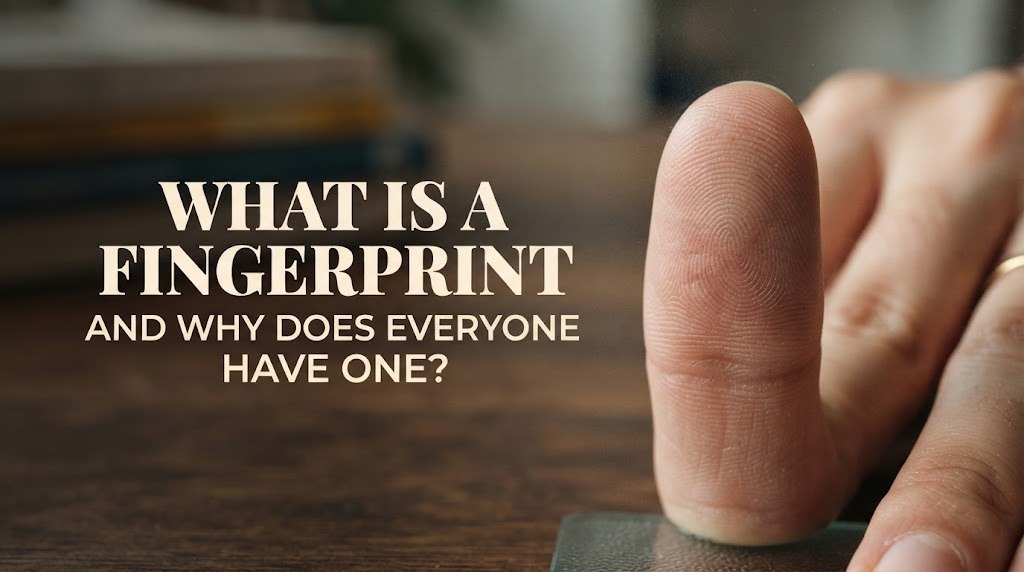
A fingerprint is a unique pattern of lines and ridges found on the surface of a person's fingers. These patterns develop before birth and generally remain stable throughout a person's life. Fingerprints are commonly used to recognize people because each individual has a different ridge arrangement. Even identical twins do not have exactly the same fingerprints. Because of this uniqueness, fingerprints have become an important part of identification and security technology.
WHAT IS A FINGERPRINT?
A fingerprint is the pattern created by raised ridges and small spaces on the skin of a finger. These ridges form different shapes, curves, and points that create an individual pattern. When a finger touches a surface, the natural moisture and oils on the skin can leave an impression of this pattern. A fingerprint can therefore be collected using traditional ink methods or modern digital scanners. Today, fingerprint technology is widely used in offices, smartphones, security systems, and identification processes.
Fingerprints are not simply marks on the skin because they contain many details that can help distinguish one person from another. Small characteristics such as ridge endings, branches, and curves contribute to the uniqueness of the pattern. The overall arrangement can be analyzed by specialized systems to compare one fingerprint with another. This makes fingerprints useful when a reliable form of personal identification is required.
HOW DO FINGERPRINTS DEVELOP?
Fingerprints begin to develop while a baby is still inside the womb. Their formation is influenced by genetic factors as well as conditions around the developing fingers. The growth of the skin layers and the position of the fingers can affect the final ridge pattern. Small differences during development help create a pattern that is specific to each person. By the time a baby is born, the basic fingerprint pattern has already been formed.
Although the size of a person's fingers changes as they grow, the basic ridge arrangement usually remains the same. This stability allows fingerprints to be used for identification over a long period. Minor injuries may temporarily affect the surface of the skin, but the deeper ridge structure can remain unchanged unless the injury causes significant damage. This is one reason fingerprints are considered a stable biometric characteristic.
WHY DOES EVERYONE HAVE A DIFFERENT FINGERPRINT?
Every person has a different fingerprint because fingerprint formation involves a combination of genetic instructions and environmental conditions before birth. Even people who share very similar genes, such as identical twins, develop different ridge details. The exact pressure, movement, growth, and position of the developing fingers can contribute to these differences. As a result, no two people normally have completely identical fingerprints. This natural variation makes fingerprints highly useful for personal identification.
The uniqueness of fingerprints comes from many small details rather than only their general shape. Two people may both have an arch or loop pattern, but their individual ridge features will still differ. Modern fingerprint scanners can examine these details and create a digital representation for comparison. Therefore, fingerprint identification does not depend only on whether two patterns look similar at first glance.
WHAT ARE THE MAIN FINGERPRINT PATTERNS?
Fingerprints are commonly grouped into three basic patterns: loops, whorls, and arches. A loop pattern has ridges that enter from one side, curve around, and generally return toward the same side. A whorl pattern contains circular or spiral-like ridge formations. An arch pattern has ridges that generally rise in the middle before moving toward the opposite side.
These three categories provide a basic way to describe fingerprints, but individual fingerprints contain much more detailed information. Each person's ridge endings, intersections, and other characteristics create a distinctive combination. Fingerprint recognition systems use these detailed features to compare a captured fingerprint with stored information. This combination of broad patterns and small details makes fingerprints difficult to match accidentally.
WHY ARE FINGERPRINTS USEFUL FOR IDENTIFICATION?
Fingerprints are useful for identification because they provide a unique and relatively permanent biometric feature. Unlike passwords, fingerprints do not need to be memorized, and they cannot normally be changed easily. This makes them convenient for systems that need to verify whether a person is authorized to access something. Fingerprint recognition is now commonly found in mobile devices, workplace attendance machines, and access control systems.
However, fingerprint systems still need to be designed and managed carefully. A fingerprint scanner may have difficulty reading a finger that is wet, dirty, injured, or positioned incorrectly. Organizations also need to protect stored biometric information because fingerprints are sensitive personal data. Proper security practices are therefore important when fingerprint technology is used for identification.
CONCLUSION
Fingerprints are unique patterns formed by ridges on the fingers before birth. Their combination of stable structure and individual differences makes them valuable for identification and biometric security. Although people may share similar general patterns, the detailed features of their fingerprints are different. This is why fingerprint technology has become useful in everyday devices, workplaces, and security systems. Understanding how fingerprints work can help people use biometric technology more safely and effectively.
Tentang Penulis
Gusti Ayu Tita P
Penulis — Universitas STEKOM
Penulis aktif yang berfokus pada isu-isu akademik, teknologi pendidikan, dan pengembangan sumber daya manusia di lingkungan kampus.