What Makes a New SAR Team Effective in Handling Emergency Situations?
Gusti Ayu Tita P
29 September 2026
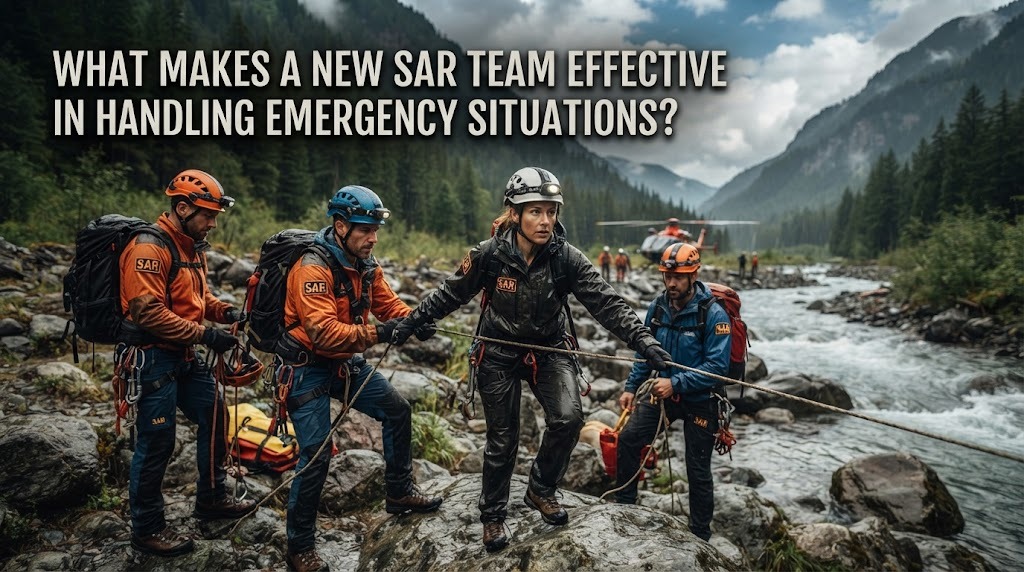
A new SAR team becomes effective in emergency situations when its members can combine technical skills, teamwork, communication, safety procedures, and proper resource management. Emergency missions can change quickly and may involve difficult terrain, damaged infrastructure, severe weather, or limited information. Recent BASARNAS training in September 2026 emphasized the importance of practicing every stage of a SAR operation, from receiving information and planning to field search, rescue, and evaluation.
Effectiveness is therefore not measured only by how quickly a team reaches an incident. A capable search and rescue team must make decisions based on available information, understand its operational limits, and coordinate with other responders. BASARNAS training in Bali in June 2026 also focused on command systems, inter-agency coordination, communication, and integrated reporting through realistic emergency simulations.
STRONG TRAINING AND PRACTICAL SKILLS
A new SAR team needs structured training before handling demanding emergency missions. Members should learn important abilities such as searching, navigation, first aid, victim handling, communication, and appropriate technical rescue methods. Practical exercises are especially important because rescuers must be able to apply procedures under pressure rather than only understand them in theory. Regular SAR training can also help members become familiar with their individual roles.
Training should reflect the types of emergencies that the team may actually face. Exercises can use scenarios involving missing persons, floods, landslides, accidents, or other local risks. BASARNAS describes continuous training and assessment as part of efforts to maintain personnel readiness for different emergency conditions. A new team can use these activities to identify skill gaps before they become operational problems.
CLEAR COMMUNICATION AND TEAMWORK
Communication and teamwork are essential when several rescuers work on different tasks at the same time. Members need to report locations, hazards, victim information, and changes in conditions clearly and through established communication channels. BASARNAS's June 2026 SAR preparedness exercise specifically trained participants in communication mechanisms, command systems, coordination, and integrated reporting. These skills help create a common understanding during an emergency.
Teamwork also requires clear responsibilities. One member may focus on searching, another on navigation, while others handle medical support, communications, logistics, or other assigned duties. Role clarity can reduce confusion and prevent important tasks from being overlooked. When members understand how their responsibilities connect, the team can work in a more organized way.
ACCURATE SITUATION ASSESSMENT
A new SAR team must be able to understand the emergency before deciding how to respond. Important information may include the location, number of possible victims, terrain, weather, accessibility, and known hazards. BASARNAS emergency exercises begin with receiving and analyzing information before the operational plan is implemented. This makes situation assessment an important part of effective rescue work.
Conditions may also change after the team reaches the incident area. In a January 2026 evaluation of disaster operations in Aceh and Sumatra, BASARNAS reported challenges including disrupted access, extreme terrain, prolonged bad weather, limited air assets, and communication blind spots. A new team should therefore keep monitoring conditions and update its plans when new information appears.
PROPER EQUIPMENT AND RESOURCE MANAGEMENT
A capable SAR team needs equipment that matches its operational responsibilities. Depending on the situation, this can include protective equipment, communication devices, navigation tools, medical supplies, lighting systems, ropes, stretchers, or specialized rescue tools. BASARNAS's National Accreditation Process activities in 2026 included preparedness, equipment management, logistics, and cross-sector interoperability as important areas for USAR capability.
Equipment must also be maintained and understood by the people using it. A team should inspect important equipment before deployment and ensure that members have appropriate training for specialized tools. Resource management also means knowing when additional support is required instead of attempting tasks beyond the team's capabilities. Good planning can help prevent equipment shortages and unnecessary delays.
SAFETY AND RISK MANAGEMENT
Emergency environments can contain hazards that are difficult to recognize immediately. Rescuers may encounter unstable structures, floodwater, debris, difficult terrain, fire, severe weather, or other threats depending on the incident. FEMA's US&R framework gives task force leadership responsibility for safety, wellness, supervision, and operational oversight during rescue missions.
A new team should make risk assessment part of every operation. Members need to use appropriate protective equipment, report hazards, follow safety procedures, and understand when an activity should be modified or stopped. BASARNAS has also highlighted the importance of minimizing risks and strengthening integrated command during emergency operations. Rescuer safety and victim safety should remain connected throughout the mission.
EFFECTIVE COORDINATION WITH OTHER RESPONDERS
Large emergencies often require more than one organization. A new SAR team may need to work with other SAR units, medical personnel, police, firefighters, local authorities, disaster management agencies, or community responders. BASARNAS's 2026 preparedness exercise in Bali involved six SAR potential elements and focused on inter-agency coordination and communication.
Coordination is most effective when each organization understands its responsibilities and uses compatible communication and command procedures. The new team should report its findings, resource needs, and operational progress through the established structure. Inter-agency cooperation can help prevent duplicated work and make it easier to request specialized assistance. This becomes increasingly important as the size and complexity of an emergency increase.
REALISTIC EXERCISES AND CONTINUOUS EVALUATION
A new SAR team needs regular simulations to test whether its procedures work under realistic conditions. BASARNAS's September 2026 exercise required participants to move through the full operational sequence, including information reception, planning, search and rescue, and final evaluation. Such exercises can reveal weaknesses in communication, decision-making, equipment use, teamwork, and coordination.
Evaluation should lead to practical improvements. Teams can review what happened, identify operational gaps, and update training or procedures based on the findings. BASARNAS also continues to evaluate SAR training quality and personnel readiness as part of its program development. Continuous improvement allows a new team to build stronger capabilities as it gains experience.
CONCLUSION
A new SAR team becomes effective in emergency situations through a combination of strong training, clear communication, teamwork, accurate assessment, reliable equipment, safety awareness, coordination, and continuous evaluation. Recent BASARNAS activities show that practical simulations and cross-agency exercises are used to strengthen these capabilities before and during emergency operations.
Effectiveness also depends on the team's ability to recognize its limitations and adapt to changing conditions. Preparedness is an ongoing process, supported by training, equipment checks, communication practice, realistic exercises, and lessons learned. By developing these elements consistently, a new search and rescue team can contribute to emergency response in a more organized, coordinated, and safety-focused way.
Tentang Penulis
Gusti Ayu Tita P
Penulis — Universitas STEKOM
Penulis aktif yang berfokus pada isu-isu akademik, teknologi pendidikan, dan pengembangan sumber daya manusia di lingkungan kampus.