
When the Village Becomes a Mirror Do Students Truly Learn?
Gusti Ayu Tita P
27 Februari 2026
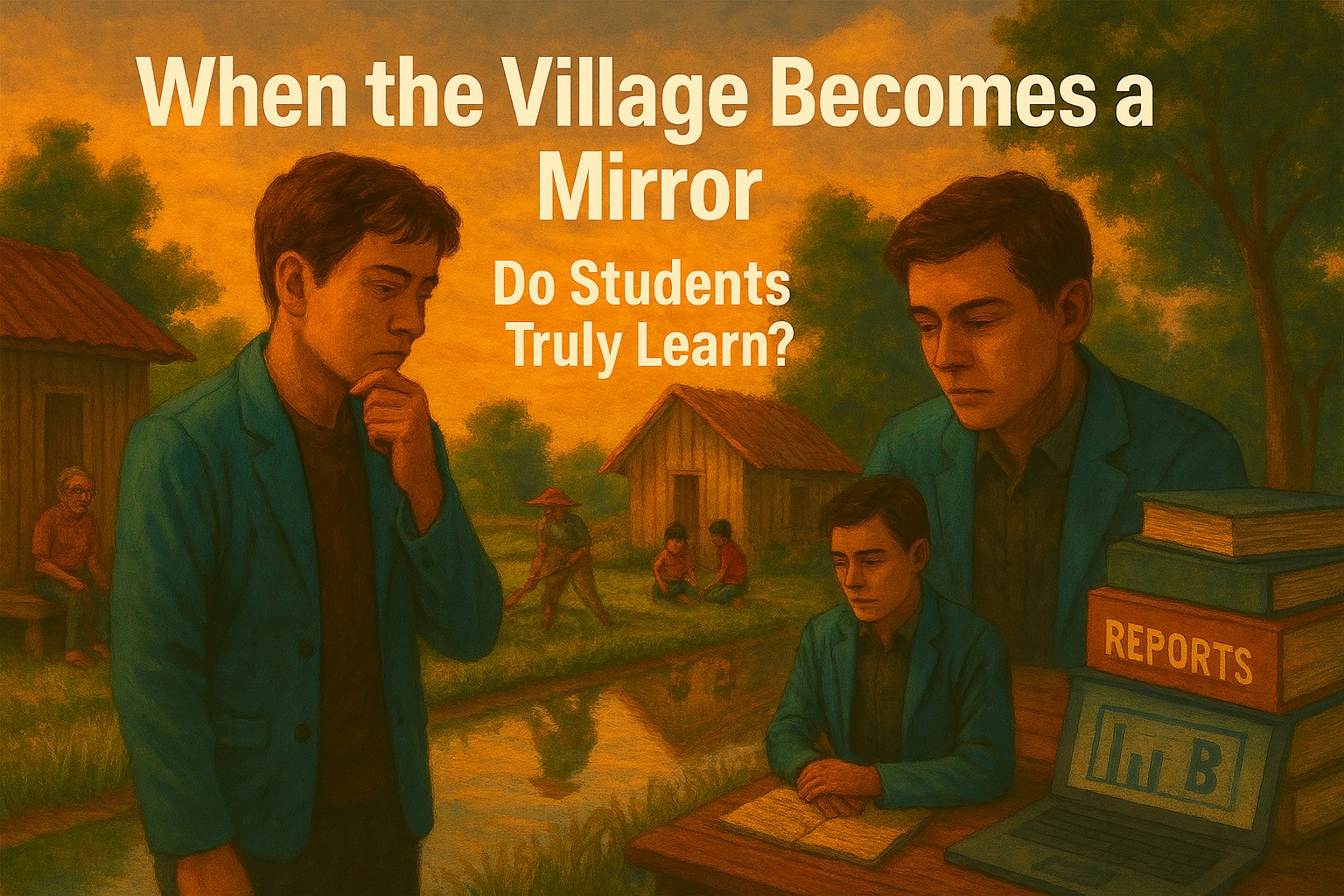
Experiential learning has become an essential part of modern higher education. Programs that send students into rural communities, small towns, or underserved areas are designed to bridge theory and practice. But when the village becomes a mirror, reflecting social realities back at students, a deeper question emerges: do students truly learn, or do they simply complete an academic requirement? This article explores how community immersion programs challenge students intellectually, socially, and emotionally and whether those experiences translate into meaningful growth.
THE VILLAGE AS A LIVING CLASSROOM
Unlike lecture halls and digital classrooms, villages offer dynamic, unpredictable learning environments. Social structures, cultural traditions, economic struggles, and local wisdom coexist in ways that textbooks rarely capture.
In this setting, students encounter real issues such as limited educational access, public health concerns, environmental challenges, and small scale economic struggles. These experiences transform abstract concepts into tangible realities.
The village becomes more than a location it becomes a living classroom where observation, dialogue, and participation replace passive listening.
CONFRONTING REALITIES BEYOND THEORY
Academic theories often present structured models and ideal solutions. However, real communities operate within complex social and cultural frameworks. A development strategy that works in one area may fail in another due to differences in leadership, trust, or local priorities.
When students engage directly with residents, they begin to understand that problem solving requires empathy and adaptability. They learn to ask questions before offering solutions. They realize that listening is often more impactful than speaking.
This confrontation between theory and reality forces students to rethink their assumptions and refine their critical thinking skills.
SELF REFLECTION: THE TRUE MEASURE OF LEARNING
When the village becomes a mirror, it does not only reflect social issues it reflects the students themselves. Their attitudes, biases, communication styles, and leadership abilities are tested daily.
Do they approach communities with humility?
Are they willing to adapt when plans change?
Can they accept constructive criticism from local residents?
True learning occurs when students reflect on these questions. Without reflection, community programs risk becoming superficial activities focused on documentation rather than transformation.
Self awareness and personal growth often become the most valuable outcomes of village immersion programs.
CHALLENGES THAT SHAPE CHARACTER
Living and working in rural areas can be physically and emotionally demanding. Limited infrastructure, cultural differences, and time constraints challenge students’ patience and resilience.
However, these challenges are precisely what foster maturity. Students learn teamwork, conflict resolution, and responsible decision making. They gain a clearer understanding of social inequality and community strength.
Character development often overlooked in formal assessments becomes one of the strongest indicators of meaningful learning.
FROM TEMPORARY PRESENCE TO LASTING IMPACT
A critical concern in community based education is sustainability. Students may stay for only a few weeks, but communities live with long term consequences.
Meaningful learning happens when students focus on collaboration rather than intervention. Instead of imposing ideas, they work alongside residents to support ongoing initiatives. They document experiences not just for grades, but for accountability and shared knowledge.
When approached with sincerity and respect, the village experience leaves a lasting impact not only on the community, but also on the students’ future perspectives and professional values.
DO STUDENTS TRULY LEARN?
The answer depends largely on intention and reflection. If students treat the village as merely a project site, learning remains surface level. But if they view it as a mirror—revealing both societal realities and personal strengths and weaknesses then transformation becomes possible.
Education is not only about acquiring information. It is about developing empathy, responsibility, and critical awareness. When students embrace these dimensions, village immersion becomes one of the most powerful educational experiences in higher education.
Tentang Penulis
Gusti Ayu Tita P
Penulis — Universitas STEKOM
Penulis aktif yang berfokus pada isu-isu akademik, teknologi pendidikan, dan pengembangan sumber daya manusia di lingkungan kampus.















