
Why Are Digital Skills Important for Education Office Employees?
Gusti Ayu Tita P
15 September 2026
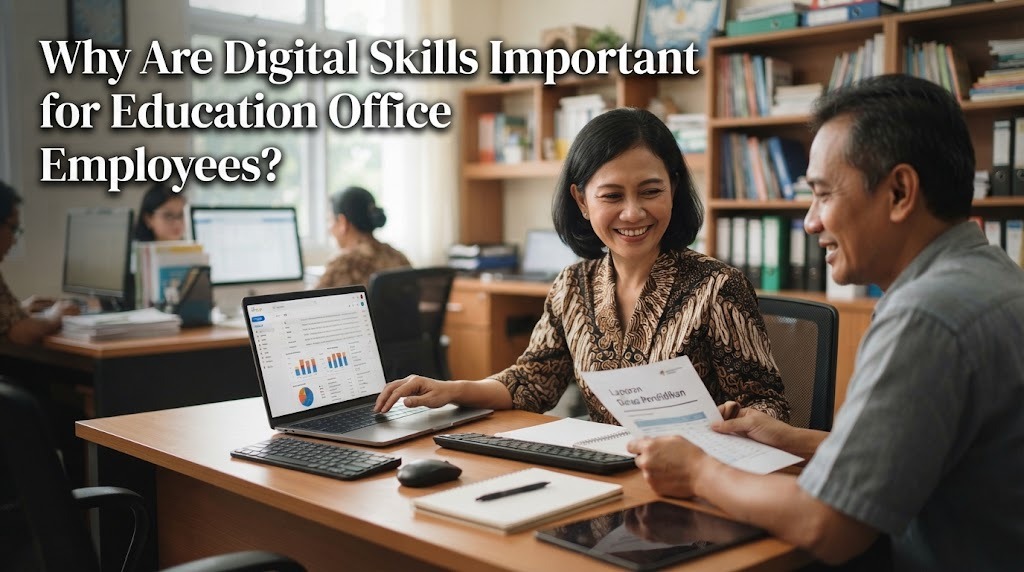
The development of technology has changed the way education offices manage information and provide public services. Education Office employees now use computers, digital applications, online platforms, and information systems in their daily work. Digital Skills help employees complete tasks more efficiently and manage information accurately. These skills are also important for adapting to changes in modern education administration. Therefore, improving digital abilities can support better performance and education services.
SUPPORTING EFFICIENT ADMINISTRATIVE WORK
Digital skills help employees complete administrative tasks more quickly and efficiently. Many activities, such as creating documents, processing data, sending information, and managing files, can be performed using digital tools. Employees who understand these tools can reduce unnecessary manual work. Digital systems also make it easier to organize and retrieve important documents. Efficient Administration allows employees to focus more on their main responsibilities.
Digital skills can also reduce errors during administrative processes. Employees can use spreadsheets, databases, and other applications to manage information systematically. Proper use of technology makes repetitive tasks easier to handle. It can also improve coordination between departments and education institutions. Good digital abilities contribute to faster and more organized administrative services.
IMPROVING DATA MANAGEMENT
Education Office employees handle various types of data related to schools, teachers, students, and education programs. Digital skills help employees collect, organize, process, and store this information properly. Accurate data management is important because education policies and programs may depend on reliable information. Employees need to understand how to use databases, spreadsheets, and digital reporting systems. Effective Data Management supports accurate education planning and decision making.
Employees must also understand how to protect information when using digital systems. They should know how to manage passwords, control access, and handle files responsibly. Careful data management can reduce the possibility of errors and information leaks. Regular checking is also useful for maintaining data accuracy. Strong digital skills help employees manage education data safely and systematically.
ENHANCING DIGITAL COMMUNICATION
Digital communication has become an important part of education administration. Employees may communicate with schools, teachers, government institutions, and communities through email, messaging platforms, video meetings, and other online channels. Digital skills help employees choose and use the right communication tools. Clear digital communication can reduce misunderstandings and improve coordination. Effective Communication supports smoother cooperation between education stakeholders.
Employees also need to understand professional communication practices when using digital platforms. Messages should be clear, polite, accurate, and appropriate for the intended audience. Important documents should be shared through secure and suitable channels. Employees should also respond to digital communication in a timely manner. Professional digital communication can improve the quality of public and institutional services.
ADAPTING TO NEW TECHNOLOGY
Technology continues to develop, so Education Office employees need to be willing to learn new systems. New applications and platforms may be introduced to improve education administration and public services. Employees with strong digital skills can adapt more easily to these changes. Continuous learning also helps employees remain productive when work procedures change. Technology Adaptation is important for maintaining effective performance in a changing work environment.
Training and practical experience can help employees become more confident when using new technology. Employees can learn through workshops, online courses, demonstrations, and teamwork. They can also share knowledge with colleagues who have experience with specific digital tools. A positive attitude toward learning makes technological changes easier to manage. Continuous digital learning supports long-term professional development.
IMPROVING PUBLIC SERVICES
Digital skills can help Education Office employees provide faster and more accessible public services. Many education services can now be supported by online forms, digital information platforms, and electronic document systems. Employees need to understand these systems so they can assist users effectively. They should also be able to explain digital procedures clearly to people who need assistance. Better Digital Services can improve efficiency and user experience.
Employees with good digital skills can respond more effectively to technical and administrative problems. They can identify basic issues and provide appropriate guidance when users experience difficulties. Digital technology can also make information easier to distribute to schools and communities. However, digital services should remain accessible to users with different levels of technological ability. Skilled employees play an important role in creating reliable, efficient, and user-friendly education services.
CONCLUSION
Digital skills are important for Education Office employees because technology has become part of modern education administration. These skills support administrative efficiency, data management, digital communication, technology adaptation, and public services. Employees who continuously improve their digital abilities can perform their responsibilities more effectively. Training and continuous learning are necessary to keep up with technological developments. By strengthening digital skills, the Education Office can provide more professional and efficient education services.
Tentang Penulis
Gusti Ayu Tita P
Penulis — Universitas STEKOM
Penulis aktif yang berfokus pada isu-isu akademik, teknologi pendidikan, dan pengembangan sumber daya manusia di lingkungan kampus.



