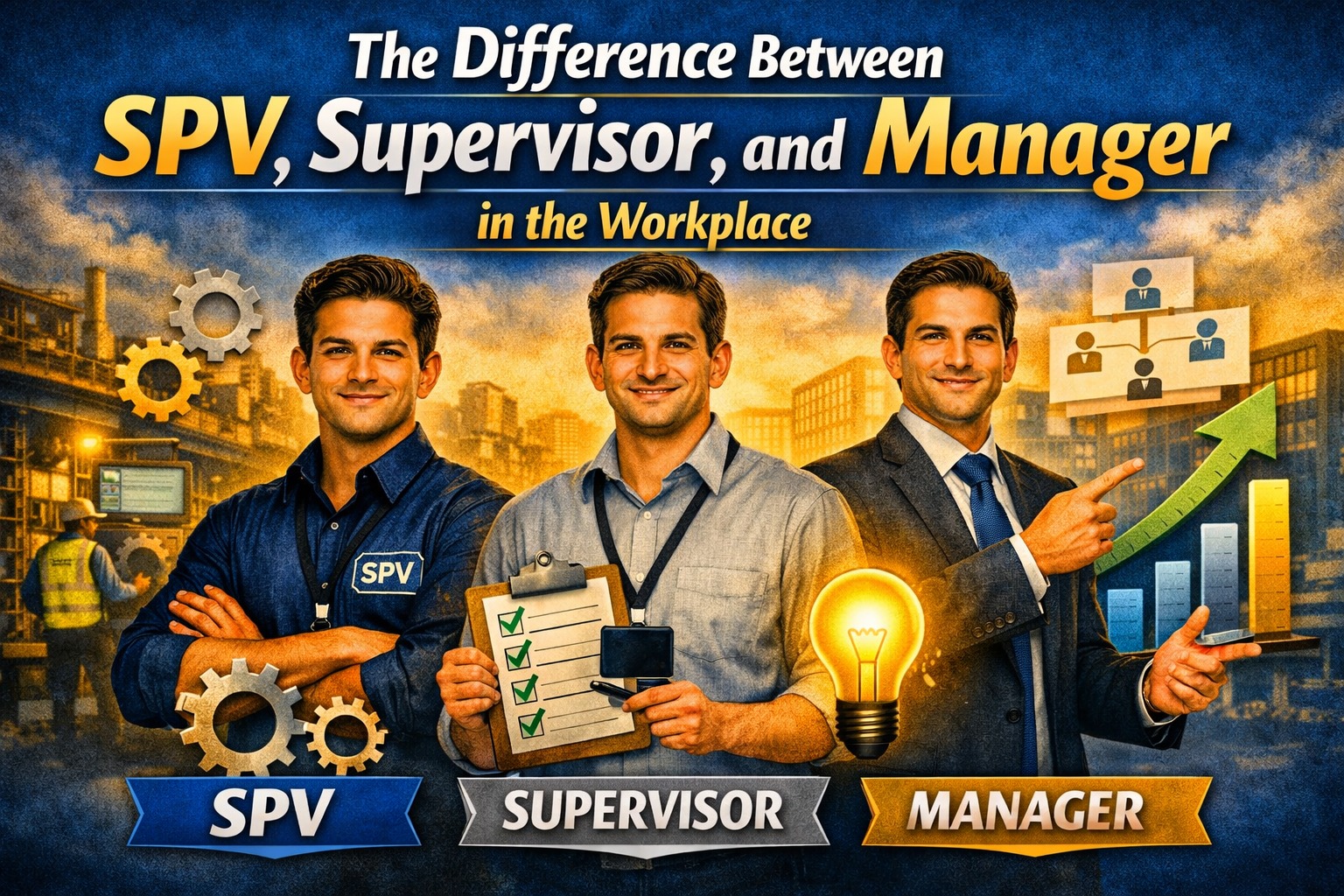
In the professional world, terms such as SPV, Supervisor, and Manager are commonly used in organizational structures. Many people assume these positions are the same because they all involve leadership and team management. However, each role has different responsibilities, authority levels, and functions within a company.
Understanding the difference between SPV, Supervisor, and Manager is important for employees who want to build a career path and for companies that want to maintain effective organizational structures. Knowing these distinctions can also help improve communication and workplace efficiency.
UNDERSTANDING THE TERM SPV
SPV is the abbreviation for Supervisor. In many companies, the terms SPV and Supervisor are used interchangeably because they refer to the same position. An SPV is generally responsible for overseeing employees and ensuring daily operations run smoothly.
Supervisors usually work directly with operational staff and focus on implementing company policies and achieving productivity targets.
WHAT IS A SUPERVISOR?
A Supervisor is a professional who monitors employee activities and coordinates operational tasks within a department or team. Supervisors act as the bridge between employees and higher management.
Their responsibilities include:
- Monitoring employee performance
- Ensuring tasks are completed properly
- Maintaining workplace discipline
- Providing guidance to staff
- Reporting operational progress to management
Supervisors are highly involved in daily operations and employee coordination.
WHAT IS A MANAGER?
A Manager holds a higher position within the organizational structure compared to a Supervisor. Managers are responsible for planning, organizing, controlling, and evaluating broader business operations.
Unlike supervisors who focus mainly on daily activities, managers are more involved in strategic decision-making and long-term business planning.
Manager responsibilities often include:
- Setting department goals
- Creating operational strategies
- Managing budgets
- Evaluating overall team performance
- Making important business decisions
- Coordinating multiple supervisors or departments
Managers typically have greater authority and responsibility within the company.
DIFFERENCE IN POSITION LEVEL
One of the main differences between an SPV or Supervisor and a Manager is the level of position in the company hierarchy.
Generally:
- Staff work under Supervisors
- Supervisors report to Managers
- Managers report to higher executives or directors
This structure shows that managers usually have broader authority than supervisors.
DIFFERENCE IN RESPONSIBILITIES
Supervisors focus more on operational and technical activities. They ensure employees complete tasks correctly and maintain workplace productivity.
Managers, on the other hand, focus on strategic planning, business development, and overall department performance. They are responsible for making decisions that affect larger organizational goals.
DIFFERENCE IN DECISION-MAKING AUTHORITY
Supervisors usually make decisions related to daily operations, employee schedules, or minor workplace issues. Their authority is generally limited to operational matters.
Managers have broader decision-making power, including budgeting, policy implementation, staffing strategies, and long-term operational planning.
DIFFERENCE IN WORK FOCUS
The work focus of a Supervisor is generally more operational and employee-oriented. Supervisors spend much of their time directly interacting with staff and monitoring workplace activities.
Managers focus more on business performance, strategy, and coordination between departments to achieve company objectives.
DIFFERENCE IN LEADERSHIP SCOPE
A Supervisor usually manages a smaller team or operational unit. Their role involves direct supervision and employee support.
Managers often oversee multiple teams, supervisors, or departments. Their leadership scope is wider and involves broader organizational responsibilities.
DIFFERENCE IN SKILL REQUIREMENTS
Although both positions require leadership skills, the required competencies may differ.
SKILLS NEEDED BY SUPERVISORS
- Communication skills
- Team coordination
- Problem-solving ability
- Time management
- Employee supervision
SKILLS NEEDED BY MANAGERS
- Strategic thinking
- Decision-making ability
- Business planning
- Financial management
- Leadership development
Managers generally require stronger strategic and analytical skills.
DIFFERENCE IN CAREER PATH
Many professionals begin their careers as staff members before being promoted to Supervisor positions. After gaining leadership experience, they may advance to Manager roles.
The common career progression is:
- Staff
- SPV or Supervisor
- Manager
- Senior Manager or Director
This career path allows employees to gradually develop leadership and management skills.
DIFFERENCE IN SALARY AND BENEFITS
Managers usually receive higher salaries and benefits than Supervisors because they carry greater responsibilities and authority within the company.
However, salary levels can vary depending on industry, company size, and professional experience.
THE IMPORTANCE OF BOTH POSITIONS
Both Supervisors and Managers are essential for company success. Supervisors help maintain operational efficiency and employee productivity, while Managers ensure business strategies and long-term goals are achieved.
Without effective supervisors and managers, organizational performance may decline.
CHALLENGES FACED BY SUPERVISORS AND MANAGERS
Both positions come with challenges. Supervisors often deal directly with employee conflicts, operational pressure, and daily productivity targets.
Managers face challenges related to strategic planning, company performance, financial management, and organizational growth.
HOW TO BECOME A SUCCESSFUL SUPERVISOR OR MANAGER
To succeed in either position, professionals should continuously improve leadership, communication, and problem-solving skills. Gaining experience, attending management training, and learning workplace strategies can support career development.
Strong professionalism and adaptability are also important for long-term success.
CONCLUSION
SPV and Supervisor generally refer to the same role, which focuses on supervising employees and maintaining daily operations. Managers, however, hold a higher position with broader responsibilities related to strategy, planning, and organizational management.
Understanding the differences between SPV, Supervisor, and Manager can help employees plan their career growth and understand workplace structures more clearly. Both roles are equally important in creating productive, organized, and successful business operations.
Tentang Penulis
Gusti Ayu Tita P
Penulis — Universitas STEKOM
Penulis aktif yang berfokus pada isu-isu akademik, teknologi pendidikan, dan pengembangan sumber daya manusia di lingkungan kampus.