What Is the Difference Between a Kaprogdi and a Head of Department?
Gusti Ayu Tita P
19 September 2026
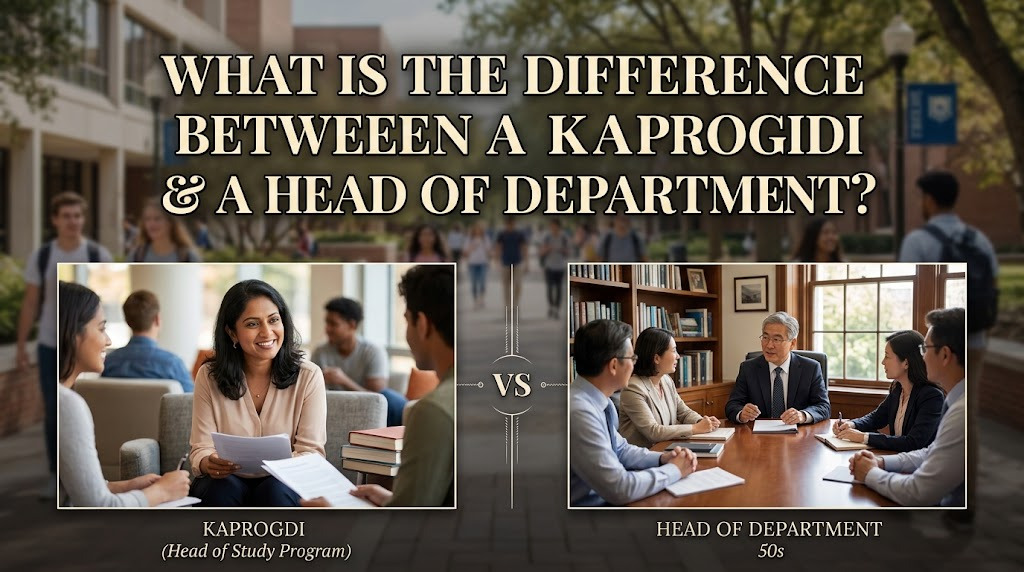
A Kaprogdi and a Head of Department are academic leadership positions that may exist within a higher education institution. Although both can be involved in managing academic activities, they may have different scopes of responsibility depending on the university's organizational structure. A Kaprogdi generally focuses on a specific study program, while a Head of Department may coordinate a broader academic unit or group of related programs.
The difference between a Kaprogdi and a Head of Department cannot always be described in exactly the same way at every university. Some institutions may have both positions, while others may use different organizational terms or structures. Therefore, understanding their roles requires looking at the organizational system and regulations of the particular higher education institution.
A KAPROGDI FOCUSES ON A STUDY PROGRAM
A Kaprogdi or Head of a Study Program generally manages and coordinates activities within a specific study program. The responsibilities can include coordinating lecturers, monitoring learning activities, evaluating academic programs, communicating with students, and supporting the development of the program.
Because the focus is on one study program, a Kaprogdi may work closely with lecturers and students in that program. The position can also communicate the program's academic needs to the faculty or other university units. The exact authority depends on the institution's organizational structure and internal policies.
A HEAD OF DEPARTMENT MAY HAVE A BROADER ACADEMIC SCOPE
A Head of Department generally leads or coordinates a department that may contain several academic areas, study programs, or related units. However, the meaning and scope of a department can differ between universities. In some institutions, a department may serve as an organizational level above one or more study programs.
Because of this structure, the Head of Department may coordinate matters that involve multiple programs or academic areas. Responsibilities can include academic coordination, faculty or department planning, resource management, and communication with study program leaders. The exact duties depend on the university's organizational model.
DIFFERENCES IN SCOPE AND RESPONSIBILITIES
The main difference between a Kaprogdi and a Head of Department is generally their organizational scope. A Kaprogdi focuses on managing a specific study program, while a Head of Department may have responsibility for a broader academic unit that can include several related programs or areas.
For example, an issue involving the implementation of a particular course may be handled at the study program level by the Kaprogdi. Meanwhile, matters involving several study programs within a department may require coordination at the department level. This division can help distribute academic management responsibilities within the institution.
HOW KAPROGDI AND HEAD OF DEPARTMENT CAN WORK TOGETHER?
A Kaprogdi and Head of Department may need to communicate when an institution has both positions. The Kaprogdi can provide information about the needs, activities, and evaluation results of the study program. The Head of Department can use this information when coordinating matters that have a broader academic scope.
Their cooperation can support academic management and program development. However, the relationship between these positions depends on the university's organizational structure. In institutions without a separate department structure, the responsibilities may instead be handled through other academic leadership positions.
CONCLUSION
The difference between a Kaprogdi and a Head of Department generally lies in their organizational scope. A Kaprogdi usually focuses on managing and coordinating a specific study program, while a Head of Department may oversee a broader academic unit that can include several related programs or areas.
However, the structure and terminology can vary between higher education institutions. Therefore, students and lecturers should refer to the official organizational structure of their university to understand the exact responsibilities and authority of a Kaprogdi and Head of Department.
Tentang Penulis
Gusti Ayu Tita P
Penulis — Universitas STEKOM
Penulis aktif yang berfokus pada isu-isu akademik, teknologi pendidikan, dan pengembangan sumber daya manusia di lingkungan kampus.