Why Should a New SAR Team Understand Disaster Response Procedures?
Gusti Ayu Tita P
29 September 2026
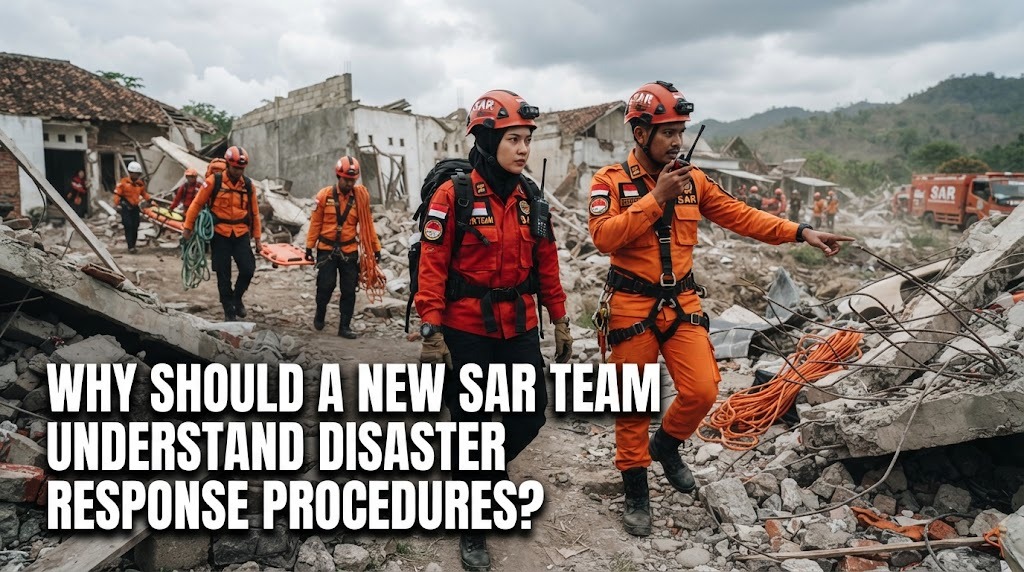
A new SAR team should understand disaster response procedures because emergency operations require organized actions, clear responsibilities, and careful coordination. Disasters can create dangerous conditions such as damaged buildings, blocked roads, floods, landslides, or communication disruptions. Indonesia's current SAR guidance describes the SAR system as a framework for providing fast and coordinated emergency response, supported by trained personnel, technology, standardized procedures, and cooperation among different agencies.
Understanding procedures also helps new rescuers know what should happen before, during, and after an operation. BASARNAS procedures include receiving and verifying reports before personnel move to the incident location, while the wider SAR process involves planning, coordination, search, rescue, and evacuation. For a new search and rescue team, following established procedures creates a common working system and helps members perform their duties more consistently.
CREATING AN ORGANIZED RESPONSE
A new SAR team needs disaster response procedures to understand how an emergency operation should be organized. A clear procedure can define how information is received, how personnel are assigned, and how resources are prepared for deployment. BASARNAS describes a SAR system involving coordination between command centers, operational units, and frontline search and rescue units. This structure helps ensure that different parts of the response work toward the same operational objectives.
Without a common procedure, new members may interpret the same situation differently. Clear operational procedures give rescuers a reference for what actions should be taken and who should make specific decisions. They can also make communication between team members more predictable. For a new team, learning this structure early can support more organized emergency operations.
REDUCING CONFUSION DURING EMERGENCIES
Disaster situations can change quickly, so a new team must know how to respond without creating additional confusion. Procedures provide guidance for activities such as reporting information, preparing resources, entering search areas, and coordinating rescue work. BASARNAS's operational information system includes sections for situation assessment, initial action, planning, implementation, logistics, coordination, control, and communication. These elements show how different parts of an operation need to be connected.
Following procedures can also help members understand their individual roles and responsibilities. A rescuer who knows whom to report to is less likely to send important information through the wrong channel. This becomes especially useful when several teams are working at the same incident. Clear procedures can therefore support faster and more consistent coordination.
SUPPORTING SAFER RESCUE OPERATIONS
Safety is another major reason a new SAR team needs to understand disaster response procedures. Rescue areas may contain hazards that are not immediately visible, and conditions can become more dangerous during an operation. Proper procedures help members assess situations, use suitable equipment, communicate hazards, and follow established safety measures. Indonesia's current SAR guidance emphasizes trained personnel, standardized procedures, operational support, and coordination as important parts of the SAR system.
New rescuers should understand that helping victims does not mean ignoring risks to themselves or other responders. Rescuer safety and victim safety need to be considered together during emergency operations. Procedures can help teams determine when additional resources or specialized support are required. This approach can reduce unnecessary risks while allowing rescuers to continue working within their capabilities.
IMPROVING SEARCH AND RESCUE COORDINATION
Large disasters often require more than one rescue team or organization. A new SAR team therefore needs to understand how coordination works with other SAR units, medical personnel, authorities, and supporting agencies. BASARNAS states that operational coordination uses procedures developed jointly with relevant agencies and SAR potential elements. INSARAG similarly organizes international USAR response around preparedness, mobilization, operations, demobilization, and post-mission phases, with coordination throughout the cycle.
Coordination becomes more effective when every team uses compatible procedures and communication methods. New members should know how to share information, receive assignments, and report operational progress. Team coordination can help prevent duplicated searches or conflicting actions in the same area. It also makes it easier to request additional support when the situation becomes more complex.
HELPING TEAMS USE RESOURCES CORRECTLY
Disaster response procedures can also help a new team manage limited personnel, equipment, transportation, and logistics. BASARNAS's operational planning system includes specific sections for tasks, logistics, administration, coordination, control, and communication. This structured approach helps teams identify what resources are available and what additional support may be needed.
Resource management is important because not every SAR team has the same capabilities. Equipment and personnel should match the mission, and specialized tasks should be handled by members with appropriate training. A new team that understands its limitations can communicate its needs instead of taking unnecessary operational risks. Good procedures therefore help ensure that resources are used in a practical and controlled way.
PREPARING FOR DIFFERENT DISASTER CONDITIONS
Not every emergency has the same characteristics, so disaster response procedures help a new team adapt its actions to different situations. A flood may require different equipment and methods from an earthquake, landslide, maritime incident, or missing-person search. Indonesia's SAR guidance covers response across land, sea, and air and identifies technology, trained human resources, and standardized procedures as parts of the national SAR system.
Training should therefore include scenario-based exercises that reflect the team's expected operational environment. INSARAG recommends that USAR teams use the preparedness period for training, exercises, reviewing lessons learned, and updating SOPs when needed. Practicing different scenarios can help new rescuers understand how procedures are applied when conditions change.
SUPPORTING CONTINUOUS IMPROVEMENT
Understanding procedures is not a one-time activity because rescue operations can provide new lessons for future missions. A new SAR team should review its performance after exercises and operations to identify problems in communication, planning, equipment, coordination, or safety. INSARAG's preparedness framework specifically encourages teams to review lessons learned and update Standard Operating Procedures as needed. This creates a cycle in which training and operational experience improve future readiness.
BASARNAS also maintains operational and preparedness functions that include training, exercises, equipment management, communication, and coordination. By regularly evaluating its procedures, a new team can make them clearer and more practical. Continuous improvement helps the team develop stronger capabilities instead of repeating the same operational problems.
CONCLUSION
A new SAR team should understand disaster response procedures because procedures provide a clear framework for planning, communication, coordination, resource management, safety, searching, rescue, and evacuation. Current BASARNAS guidance emphasizes a fast, coordinated, standardized, and technology-supported SAR system, while INSARAG uses a structured response cycle supported by preparedness and continuous improvement.
For new rescuers, knowing these procedures can make emergency work more organized and predictable. Regular training, realistic exercises, clear roles, effective communication, and continuous evaluation can strengthen the team's readiness for different disaster situations. By understanding and consistently applying disaster response procedures, a new search and rescue team can contribute to emergency operations in a safer and more coordinated manner.
Tentang Penulis
Gusti Ayu Tita P
Penulis — Universitas STEKOM
Penulis aktif yang berfokus pada isu-isu akademik, teknologi pendidikan, dan pengembangan sumber daya manusia di lingkungan kampus.