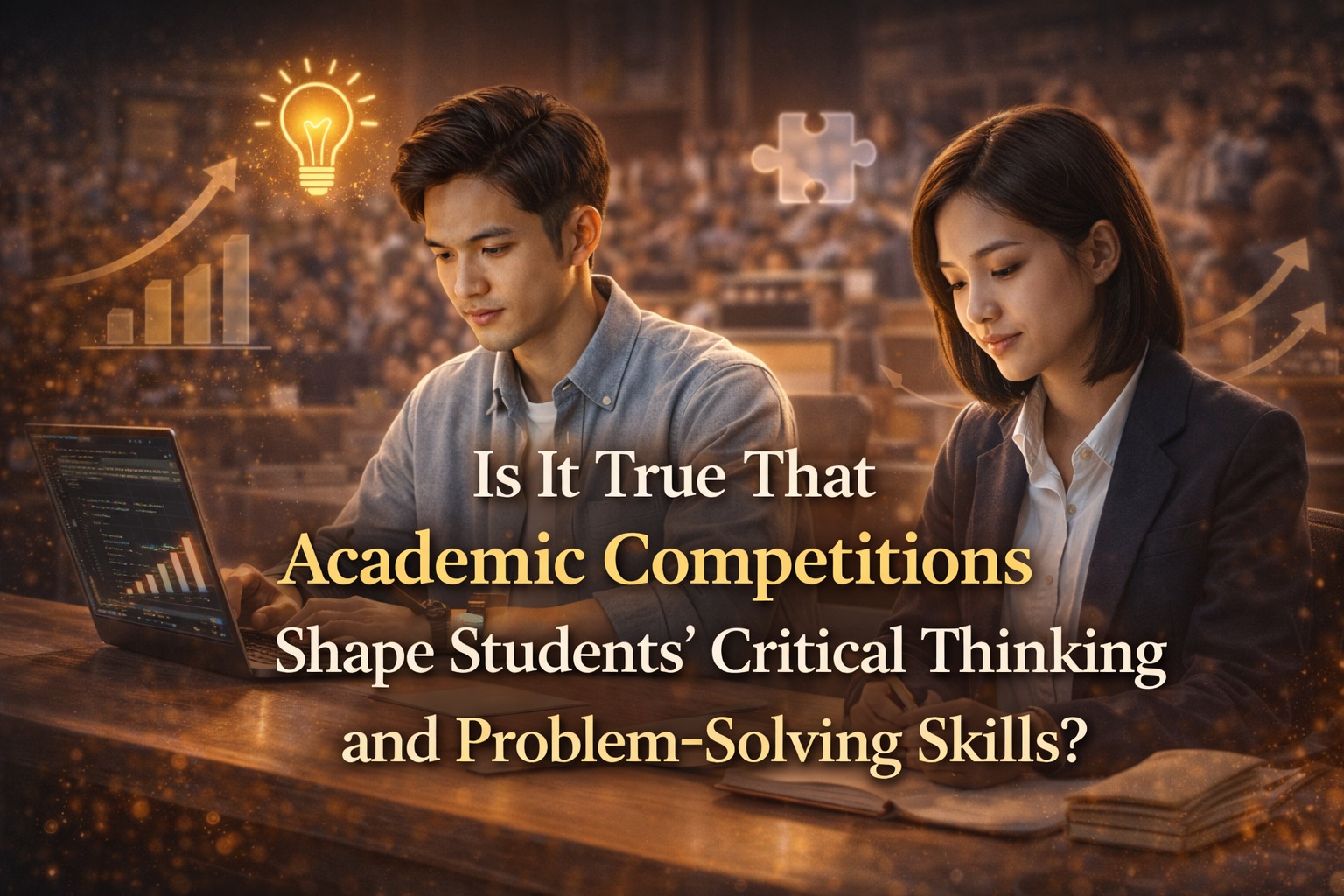
Academic competitions are often promoted as effective platforms for enhancing students’ intellectual quality. From scientific writing contests and debates to technology innovation competitions, all are claimed to train critical thinking and problem-solving abilities. But do academic competitions truly develop these competencies in a significant way?
This article explores in depth how academic competitions contribute to shaping students’ critical thinking patterns and problem-solving skills.
WHAT ARE CRITICAL THINKING AND PROBLEM SOLVING?
Critical thinking is the ability to analyze information objectively, evaluate arguments, and draw conclusions based on logic and evidence. Meanwhile, problem solving refers to the capacity to identify problems, formulate alternative solutions, and select the most effective strategy to resolve them.
Both competencies are key indicators in higher education and in today’s modern job market, which demands analytical and evidence-based decision-making.
HOW ACADEMIC COMPETITIONS TRAIN CRITICAL THINKING
Academic competitions are designed with assessment standards that prioritize argumentation, analytical sharpness, and data validity. For example, in programs facilitated by Indonesia’s Ministry of Education, Culture, Research, and Technology, such as the Student Creativity Program (PKM), participants are required to develop systematic, research-based proposals.
In debate competitions like the National University Debating Championship, students must analyze issues from multiple perspectives, construct logical arguments, and refute opposing viewpoints rationally. This process directly strengthens evaluative and reflective thinking skills.
STRUCTURAL PROBLEM ANALYSIS
Students are not merely asked to give opinions; they must build structured frameworks of thought. They learn to identify root causes, map causal variables, and consider both short-term and long-term impacts.
DATA VALIDATION AND ARGUMENTATION
Academic competitions encourage the use of credible data. Participants are required to conduct literature reviews, cite reliable sources, and develop fact-based justifications. This habit reinforces an objective and evidence-based academic culture.
THE ROLE OF COMPETITIONS IN ENHANCING PROBLEM-SOLVING SKILLS
Problem-solving skills are not developed through theory alone but through direct practice. Competitions simulate real-world challenges that demand innovative solutions.
DEVELOPING APPLICABLE SOLUTIONS
In innovation or business plan competitions, students must design realistic, measurable, and implementable solutions. They learn to consider technical, financial, and social impact aspects.
DECISION-MAKING UNDER PRESSURE
Tight deadlines and multi-layered selection processes train students to think quickly without compromising analytical quality. This skill is highly relevant to dynamic professional environments.
FACTORS DETERMINING THE EFFECTIVENESS OF COMPETITIONS
Although competitions have great potential to develop critical thinking and problem-solving skills, their effectiveness depends on several factors:
- Participants’ orientation toward learning rather than merely winning
- The quality of mentorship and guidance
- The frequency of reflection and post-competition evaluation
- Support from the academic environment
Without a reflective approach, competitions may become mere formal activities with limited cognitive impact.
CONCLUSION
Academic competitions fundamentally contribute to shaping students’ critical thinking and problem-solving abilities. Through in-depth analysis, data validation, and innovative solution development, students become accustomed to systematic and logical thinking.
However, these benefits do not occur automatically. Competitions are most effective when positioned as strategic learning platforms that encourage reflection and continuous self-development. With the right approach, academic competitions can serve as powerful catalysts in forming critical, solution-oriented students ready to face complex future challenges.
About the Author
Gusti Ayu Tita P
Author — STEKOM University
An active author focused on academic issues, educational technology, and human resource development in the campus environment.