
More Than Memorizing TKA Tests Students' Reasoning Skills
Gusti Ayu Tita P
1 April 2026
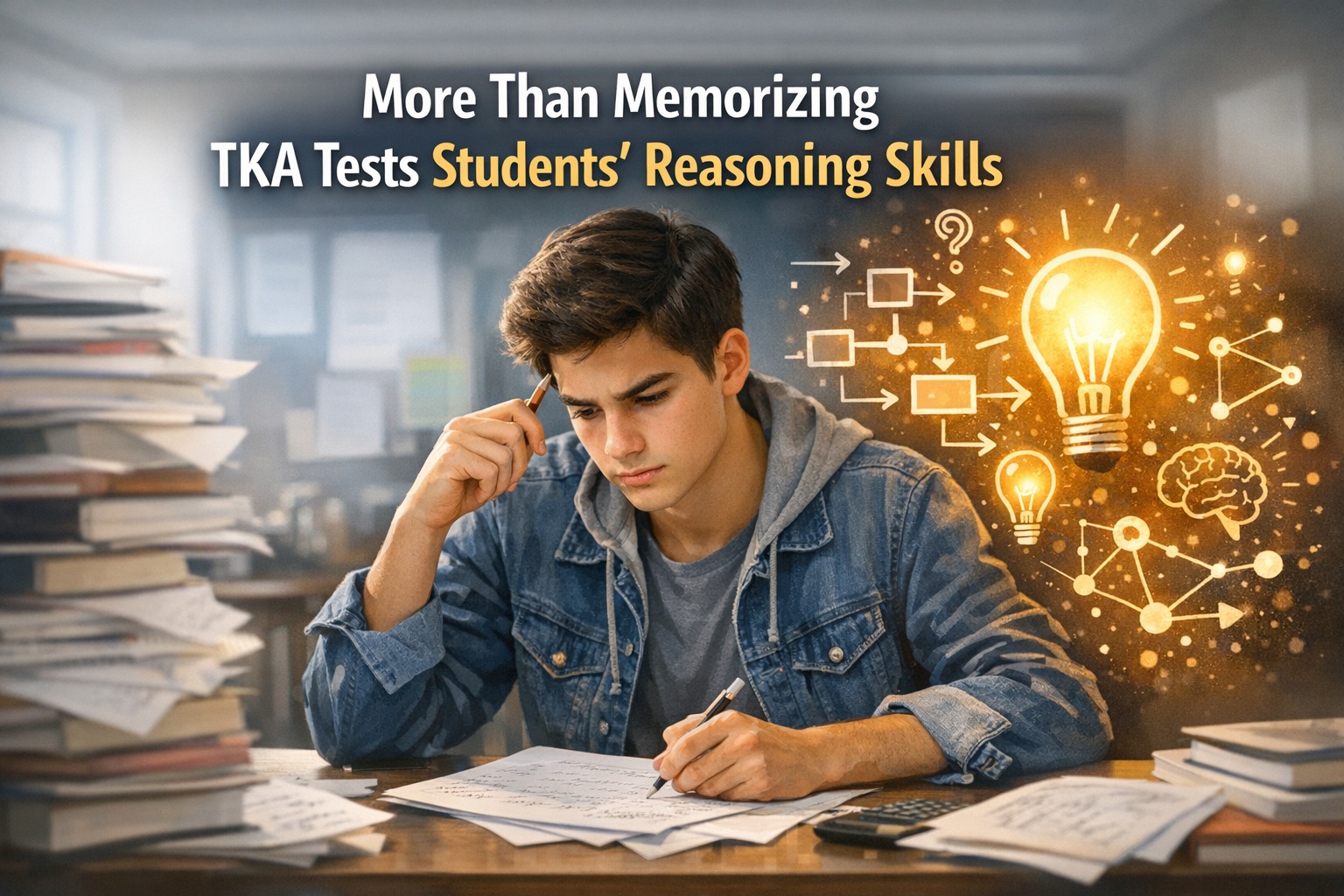
The Test Kompetensi Akademik (TKA) has often been misunderstood as a system that prioritizes memorization above all else. In reality, modern education frameworks are increasingly shifting toward assessing deeper cognitive abilities. TKA is part of this transformation, aiming to evaluate how students think rather than how much they can recall.
In today’s rapidly changing world, information is easily accessible. Students no longer need to rely solely on memorization because knowledge can be found within seconds. What matters more is how they process that information and apply it effectively. This is where reasoning skills become essential.
TKA reflects this shift by focusing on problem-solving, logical thinking, and comprehension. Students are expected to analyze questions, identify patterns, and draw conclusions based on evidence. These abilities go beyond memorizing formulas or definitions.
The perception that exams like TKA are purely about remembering facts can create unnecessary anxiety among students. Many feel pressured to memorize large amounts of material, even though the test itself often rewards understanding over repetition.
By redefining its approach, TKA aligns with global educational trends that emphasize critical thinking. This prepares students not only for academic success but also for real-world challenges where reasoning is key.
Understanding the true purpose of TKA helps students adopt better learning strategies. Instead of focusing solely on memorization, they can develop skills that will benefit them in the long term.
WHY REASONING SKILLS MATTER MORE THAN MEMORY
Reasoning skills enable students to make sense of complex information. Rather than recalling isolated facts, students learn to connect ideas and build a deeper understanding of subjects. This approach leads to more meaningful learning experiences.
Memory-based learning often has limitations. Students may forget information quickly after exams if they do not truly understand it. Reasoning, on the other hand, helps retain knowledge because it involves active engagement with the material.
In TKA, many questions are designed to test how students think through problems. This includes interpreting data, evaluating arguments, and identifying logical relationships. These tasks require more than just memorization.
Students with strong reasoning skills are better equipped to handle unfamiliar questions. Even if they encounter new topics, they can use logic and analysis to arrive at correct answers. This flexibility is crucial in academic assessments.
Developing reasoning skills also boosts confidence. Students feel more prepared when they understand concepts deeply rather than relying on rote memorization. This reduces stress and improves overall performance.
Ultimately, reasoning is a lifelong skill. It extends beyond exams and plays a significant role in decision-making, problem-solving, and critical thinking in everyday life.
HOW TKA QUESTIONS ENCOURAGE ANALYTICAL THINKING
TKA questions are often structured to challenge students’ analytical abilities. Instead of asking for direct answers, they present scenarios that require interpretation and evaluation. This encourages students to think more deeply.
Many questions involve real-life contexts. Students may be asked to analyze graphs, read passages, or solve problems based on practical situations. This approach makes learning more relevant and engaging.
Analytical thinking involves breaking down information into smaller parts. TKA questions guide students to identify key elements, compare options, and determine the best solution based on evidence.
The format of TKA also discourages guesswork. Students cannot rely on memorized answers alone because questions are often designed to test understanding in new ways. This ensures a fair assessment of their abilities.
By practicing analytical thinking, students improve their ability to process information quickly and accurately. This is especially useful in time-limited exams where efficiency matters.
Over time, students who adapt to this style of questioning become more independent learners. They rely less on memorization and more on reasoning, which enhances their academic growth.
THE ROLE OF CONCEPTUAL UNDERSTANDING IN TKA SUCCESS
Conceptual understanding is at the heart of success in TKA. Students who grasp underlying principles can apply them in various contexts, making it easier to answer complex questions.
Rather than memorizing formulas, students are encouraged to understand how and why those formulas work. This deeper knowledge allows them to adapt when faced with unfamiliar problems.
Conceptual learning also improves retention. When students understand a concept, they are more likely to remember it because it makes sense to them. This reduces the need for repetitive memorization.
In TKA, questions often test the application of concepts rather than their definition. This means students must be able to use their knowledge in practical situations, not just recall it.
Teachers and educators play an important role in fostering conceptual understanding. By encouraging discussion and exploration, they help students develop stronger reasoning skills.
Students who focus on understanding concepts tend to perform better in TKA. They are able to think critically, solve problems efficiently, and approach questions with confidence.
SHIFTING STUDENT MINDSET FROM MEMORIZING TO THINKING
One of the biggest challenges students face is changing their mindset. Many are used to traditional learning methods that emphasize memorization. Transitioning to reasoning-based learning requires effort and adaptation.
Students need to realize that understanding is more valuable than memorizing. This shift can improve not only their performance in TKA but also their overall learning experience.
Practice plays a crucial role in developing reasoning skills. By working through different types of questions, students can train their minds to think analytically and logically.
It is also important for students to reflect on their learning process. Instead of asking “What should I memorize?” they should ask “Do I understand this concept?” This simple change can make a big difference.
Support from teachers and parents can help reinforce this mindset. Encouragement and guidance can motivate students to focus on understanding rather than memorization.
As students adopt this new approach, they become more confident learners. They are better prepared to face challenges and adapt to different types of questions.
CONCLUSION BUILDING SKILLS FOR THE FUTURE
TKA is more than just an academic test. It is a tool designed to measure how students think, analyze, and solve problems. This makes it an important part of modern education.
By focusing on reasoning skills, TKA prepares students for future challenges. These skills are essential in higher education, careers, and everyday life.
Students who understand the purpose of TKA can approach it with a more effective strategy. Instead of memorizing, they can focus on developing critical thinking and problem-solving abilities.
Education systems worldwide are moving toward this approach. TKA reflects this shift by emphasizing understanding over memorization.
In the long run, reasoning skills provide greater value than memorized knowledge. They help students adapt, innovate, and succeed in a constantly changing world.
Embracing this perspective allows students to unlock their full potential and achieve meaningful success beyond exams.
About the Author
Gusti Ayu Tita P
Author — STEKOM University
An active author focused on academic issues, educational technology, and human resource development in the campus environment.















