
Shifting the TKA System from Memorization to Thinking
Gusti Ayu Tita P
1 April 2026
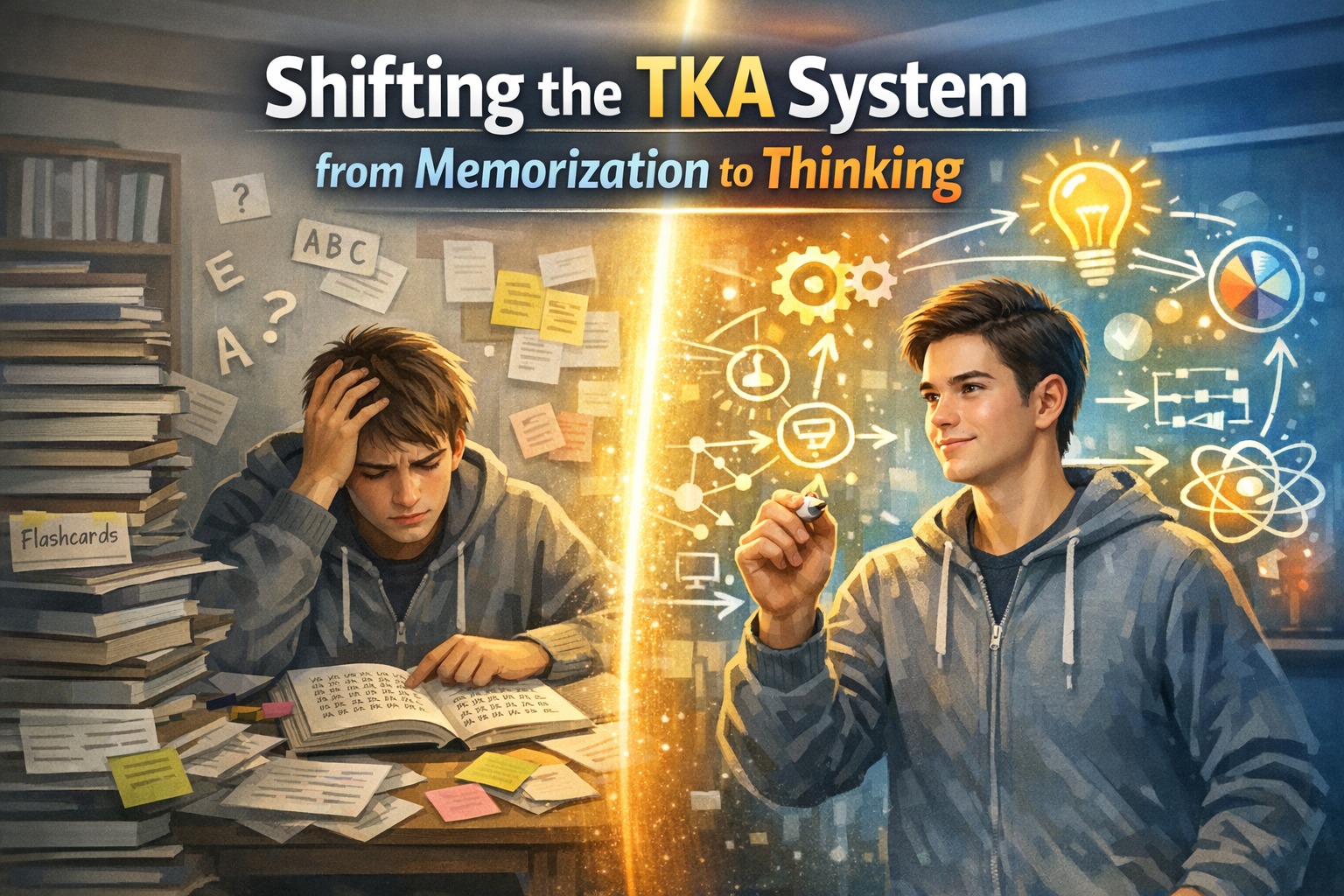
The Test Kompetensi Akademik (TKA) has long been associated with memorization, where students are expected to recall facts, formulas, and definitions within limited time frames. This traditional approach has shaped how many students prepare for exams, often focusing on repetition rather than understanding.
However, as the world evolves, so do the demands placed on students. The modern era requires individuals who can think critically, solve problems creatively, and adapt to new challenges. Memorization alone is no longer sufficient to prepare students for real-world situations.
This shift in global educational trends has sparked discussions about transforming TKA into a more thinking-oriented assessment. Educators and policymakers are beginning to question whether the current system truly reflects a student’s intellectual ability.
Students themselves are also starting to feel the limitations of rote learning. Many find that while they can remember information for exams, they struggle to apply it in practical contexts. This gap highlights the need for a more meaningful evaluation system.
By shifting from memorization to thinking, TKA can become a tool that measures deeper understanding rather than surface-level knowledge. This transformation is not just necessary but inevitable.
Ultimately, rethinking TKA is about aligning education with the skills needed for the future. It is about preparing students not just to pass exams, but to succeed in life.
THE LIMITATIONS OF MEMORIZATION-BASED LEARNING
Memorization has its place in education, especially when it comes to foundational knowledge. However, relying too heavily on it can limit a student’s intellectual growth and curiosity.
When students focus solely on memorizing, they often miss the opportunity to truly understand the material. They may remember information temporarily, but this knowledge is quickly forgotten after the exam.
This approach can also reduce learning to a mechanical process. Students become passive recipients of information rather than active participants in their education.
Moreover, memorization does not encourage problem-solving skills. In real-life situations, answers are not always straightforward, and individuals must analyze, evaluate, and create solutions.
Another drawback is the pressure it creates. Students often feel overwhelmed trying to remember large amounts of information, which can lead to stress and burnout.
By recognizing these limitations, educators can begin to shift towards a more balanced approach that values understanding as much as retention.
THE IMPORTANCE OF CRITICAL THINKING IN MODERN EDUCATION
Critical thinking is one of the most essential skills in today’s world. It enables students to analyze information, question assumptions, and make informed decisions.
In a rapidly changing environment, the ability to think critically allows individuals to adapt and innovate. This skill is particularly important in the digital age, where information is abundant but not always reliable.
Integrating critical thinking into TKA means designing questions that require reasoning rather than recall. Students should be encouraged to explain their answers and justify their thought processes.
This approach not only improves academic performance but also prepares students for future challenges. Employers today value individuals who can think independently and solve complex problems.
Furthermore, critical thinking fosters a deeper engagement with learning. Students become more curious and motivated when they are challenged to think beyond the surface.
By prioritizing critical thinking, TKA can become a more effective tool for measuring true academic competence.
STRATEGIES TO SHIFT TKA TOWARD THINKING-BASED ASSESSMENT
Transforming TKA requires changes in both teaching methods and assessment design. One of the first steps is to move away from questions that simply test memory.
Instead, exams should include scenarios, case studies, and problem-solving tasks. These types of questions encourage students to apply their knowledge in meaningful ways.
Teachers also play a crucial role in this transition. They need to create learning environments that promote discussion, exploration, and critical analysis.
Another strategy is to incorporate open-ended questions. These allow students to express their ideas and demonstrate their understanding more fully.
Technology can also support this shift. Digital tools can provide interactive learning experiences that go beyond traditional textbooks.
Finally, continuous evaluation is important. The system should be regularly reviewed to ensure it meets the evolving needs of students and society.
THE IMPACT OF A THINKING-ORIENTED TKA SYSTEM
A thinking-based TKA system can have a significant impact on students’ overall development. It encourages them to become active learners who seek to understand rather than memorize.
This shift can also improve long-term knowledge retention. When students understand concepts deeply, they are more likely to remember and apply them in the future.
In addition, it helps build confidence. Students who develop strong thinking skills are better equipped to مواجهة challenges and make decisions independently.
The impact extends beyond academics. Critical thinking skills are valuable in everyday life, from solving problems to making informed choices.
Parents and educators may also notice a change in students’ attitudes. Learning becomes more meaningful and less stressful when it focuses on understanding.
Ultimately, a thinking-oriented TKA system prepares students not just for exams, but for life in a complex and dynamic world.
CONCLUSION BUILDING A FUTURE-READY EDUCATION SYSTEM
Shifting the TKA system from memorization to thinking is not a simple task, but it is a necessary one. It requires collaboration between educators, institutions, and policymakers.
This transformation is about more than changing exam formats. It is about redefining what it means to be a successful student.
By focusing on thinking skills, TKA can become a more accurate reflection of a student’s abilities. It can help identify those who are truly prepared for future challenges.
Students, in turn, will benefit from a more engaging and meaningful learning experience. They will be equipped with the skills needed to navigate an increasingly complex world.
The future of education lies in its ability to adapt and evolve. By embracing this shift, TKA can play a vital role in shaping the next generation.
In the end, education should not just fill minds with information, but empower individuals to think, question, and create.
About the Author
Gusti Ayu Tita P
Author — STEKOM University
An active author focused on academic issues, educational technology, and human resource development in the campus environment.















