
Basic Neural Network Techniques Every Deep Learning Learner Must Know
Gusti Ayu Tita P
23 September 2026
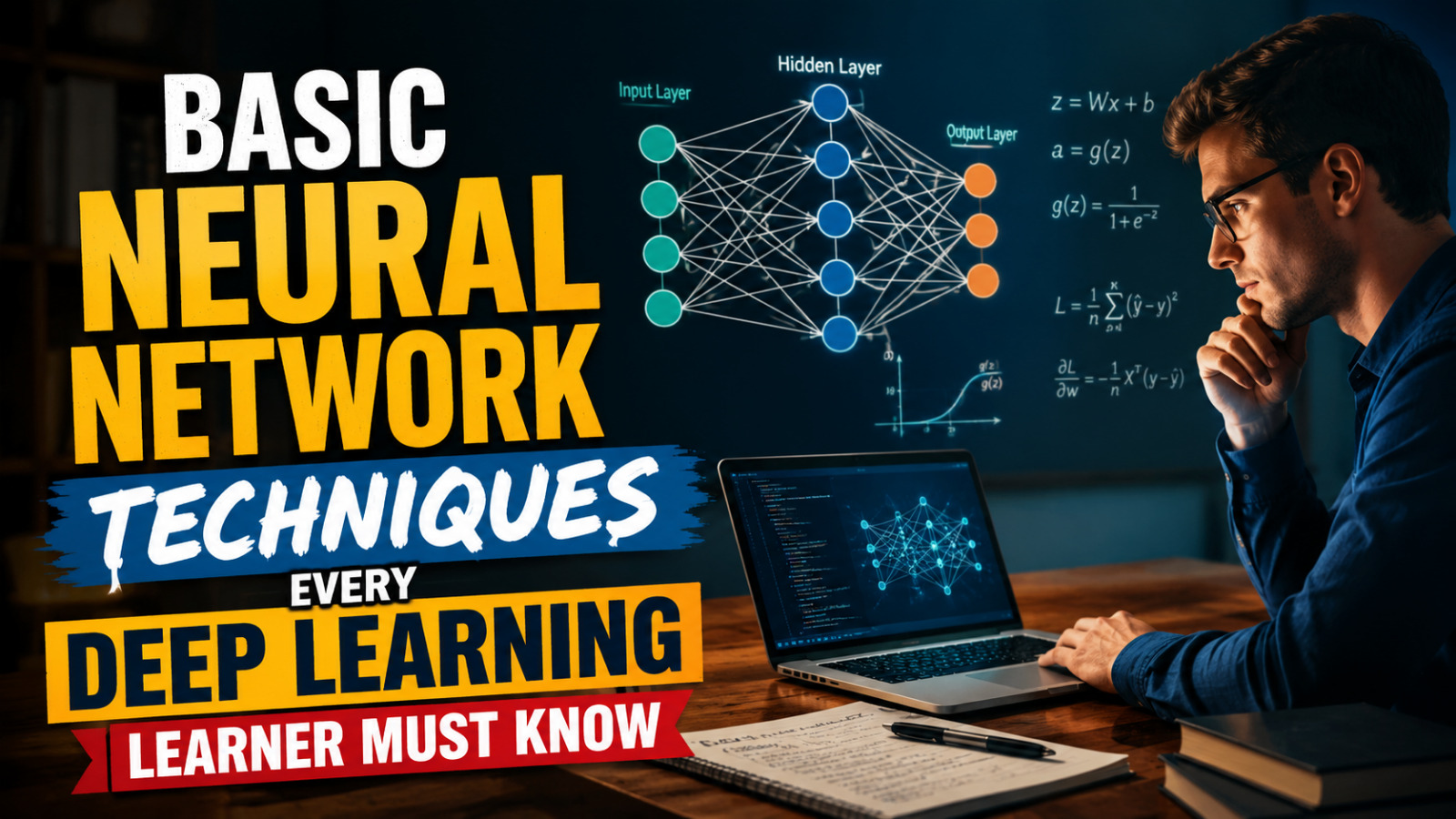
Artificial Intelligence continues to transform industries, and Deep Learning has become one of its most influential technologies. At the core of Deep Learning is the Neural Network, a computational model inspired by the human brain that can recognize patterns, classify data, and make predictions. Understanding the basic techniques behind Neural Networks is essential for anyone who wants to build intelligent applications or pursue a career in AI.
Mastering the fundamentals before moving to advanced architectures allows learners to understand how Deep Learning models work internally. It also helps improve model performance, troubleshoot training issues, and select appropriate techniques for different machine learning tasks. This article explains the most important Neural Network techniques that every beginner should understand in a simple and practical way.
UNDERSTANDING THE STRUCTURE OF A NEURAL NETWORK
A Neural Network consists of three primary components: the Input Layer, Hidden Layers, and the Output Layer. The Input Layer receives data, the Hidden Layers process information through mathematical operations, and the Output Layer produces the final prediction or classification. Each layer contains multiple neurons, which are connected by weighted links that determine how information flows through the network.
Every neuron performs calculations by multiplying input values with weights, adding a bias, and applying an Activation Function. During training, these weights and biases are continuously adjusted to improve prediction accuracy. Understanding this structure is the first step toward mastering Deep Learning because every advanced architecture builds upon these basic concepts.
LEARNING HOW ACTIVATION FUNCTIONS WORK
An Activation Function determines whether a neuron should pass information to the next layer. Without activation functions, Neural Networks would behave like simple linear models and fail to solve complex problems. Popular activation functions include ReLU, Sigmoid, and Tanh, each serving different purposes depending on the model design.
The ReLU function is widely used because it speeds up training and reduces computational complexity. Sigmoid is commonly applied in binary classification problems, while Tanh often performs better when data contains both positive and negative values. Selecting the appropriate activation function can significantly improve model performance and training efficiency.
UNDERSTANDING FORWARD PROPAGATION AND BACK PROPAGATION
Forward Propagation is the process of passing input data through every layer until the network produces an output. During this stage, each neuron calculates its value based on incoming data, weights, biases, and activation functions. The predicted result is then compared with the actual target to measure the model's error.
The learning process occurs during Back Propagation, where the model calculates how much each weight contributed to the error. Using mathematical derivatives, the algorithm updates these weights to reduce future mistakes. This continuous adjustment allows the Neural Network to gradually become more accurate after multiple training iterations.
MASTERING GRADIENT DESCENT OPTIMIZATION
Gradient Descent is one of the most important optimization techniques in Machine Learning and Deep Learning. Its objective is to minimize prediction errors by updating model parameters in the direction that reduces the loss function. Every training iteration moves the model closer to the optimal solution.
Several variations of Gradient Descent are commonly used, including Batch Gradient Descent, Stochastic Gradient Descent, and Mini Batch Gradient Descent. Mini Batch Gradient Descent is particularly popular because it balances computational speed and training stability. Choosing the appropriate optimizer can greatly influence both learning speed and final accuracy.
PREVENTING OVERFITTING IN NEURAL NETWORKS
One common challenge in Deep Learning is Overfitting, where the model memorizes training data instead of learning general patterns. An overfitted model performs very well on training data but poorly on unseen data. Preventing overfitting is essential for building reliable AI systems.
Several techniques help reduce overfitting, including Dropout, Early Stopping, Regularization, and expanding the training dataset through Data Augmentation. These methods encourage the model to learn meaningful features rather than memorizing examples. Proper validation during training also helps detect overfitting before it becomes a serious problem.
IMPORTANCE OF DATA PREPROCESSING
High-quality data is just as important as a well-designed Neural Network. Before training begins, datasets should be cleaned by removing duplicates, handling missing values, and correcting inconsistencies. Proper preprocessing improves model accuracy and reduces unnecessary computational costs.
Another essential technique is Feature Scaling, which standardizes numerical values into similar ranges. This prevents features with larger values from dominating the learning process. Combined with proper data splitting into training, validation, and testing sets, preprocessing creates a strong foundation for successful Deep Learning models.
CHOOSING THE RIGHT LOSS FUNCTION
A Loss Function measures the difference between predicted outputs and actual values. It serves as the objective that the Neural Network tries to minimize throughout training. Different machine learning tasks require different types of loss functions.
For classification tasks, Cross Entropy Loss is commonly used because it effectively measures prediction confidence. For regression problems, Mean Squared Error is often the preferred choice. Selecting the correct loss function ensures that the optimization process aligns with the intended learning objective.
BUILDING STRONG FOUNDATIONS BEFORE ADVANCED MODELS
Many beginners are eager to study advanced architectures such as Convolutional Neural Networks and Recurrent Neural Networks. However, these sophisticated models rely on the same basic Neural Network principles discussed earlier. A strong understanding of these fundamentals makes advanced concepts much easier to learn.
Developing projects with simple Neural Networks first allows learners to understand training behavior, parameter tuning, and performance evaluation. This practical experience creates confidence and prepares learners for more complex AI applications. Consistent practice remains one of the most effective ways to master Deep Learning.
CONCLUSION
Understanding Basic Neural Network Techniques is essential for every Deep Learning learner. Concepts such as Neural Network Structure, Activation Functions, Forward Propagation, Back Propagation, Gradient Descent, Loss Functions, Data Preprocessing, and Overfitting Prevention provide the foundation for building intelligent machine learning models. By mastering these techniques, learners can create more accurate, efficient, and reliable AI systems while preparing themselves for advanced topics in Artificial Intelligence.
Tentang Penulis
Gusti Ayu Tita P
Penulis — Universitas STEKOM
Penulis aktif yang berfokus pada isu-isu akademik, teknologi pendidikan, dan pengembangan sumber daya manusia di lingkungan kampus.















